
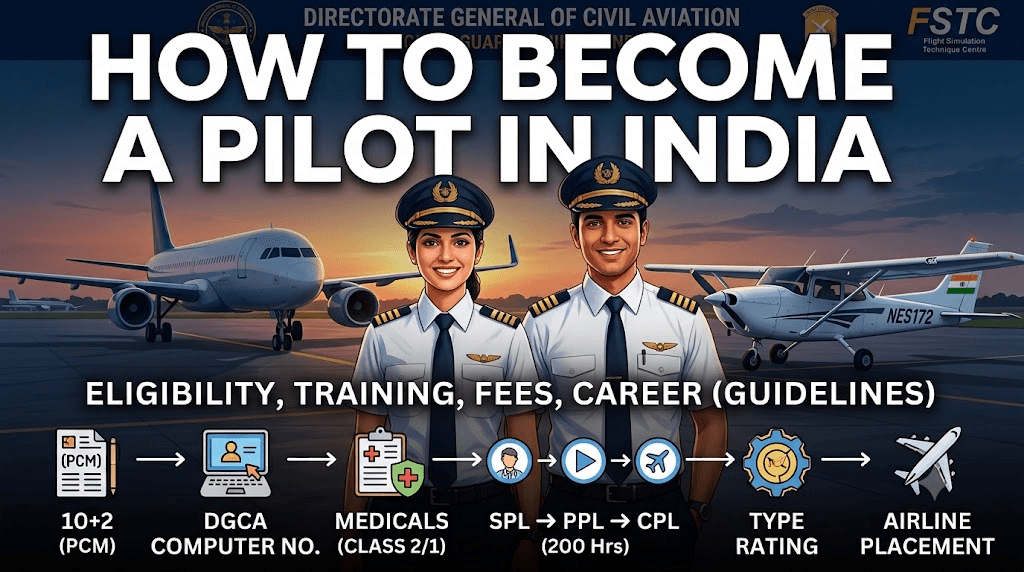
How to Become a Pilot in India 2026: Eligibility, Fees & Career
For anyone curious about how to become a pilot in India, there is a clear path managed by the Directorate General of Civil Aviation (DGCA). Becoming a pilot in India requires meeting requirements, passing medical tests, getting flight training and getting the right licence.
What differs from one person to another is how well they prepare. Understanding the rules for eligibility, how much it costs to become a pilot in India, how long the process takes and what happens after the licence is given can make all the difference.
This guide explains how to become a pilot in India including a new rule in 2026 that is about to let students who are not in the science stream to enter pilot training for the first time in almost 30 years.
How to Become a Pilot in India (2026).
To become a pilot in India you need to have completed Class 12 with Physics and Maths (or an approved bridge course) a DGCA medical certificate, 200 hours of flight training at a DGCA-approved flying school and a Commercial Pilot Licence (CPL). The process usually takes 12 to 24 months. Costs between ₹35 to 60 lakh, before type rating.
Who Can Become a Pilot in India? (Eligibility)
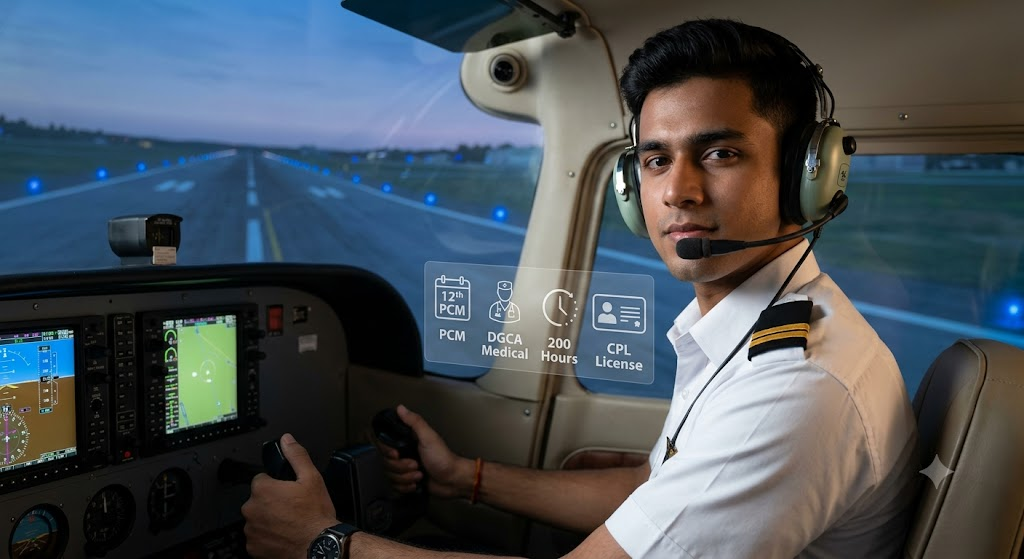
Before any flying school or any fee discussion, the DGCA sets a baseline. Every aspiring pilot in India needs the following:
- Class 12 with Physics and Mathematics as subjects.
- A minimum age of 17 to begin flying training and 18 to hold a Commercial Pilot Licence.
- A Class 2 Medical Certificate to start training upgraded to a Class 1 Medical Certificate before the CPL is issued.
- Working proficiency in English since radio communication and technical training are conducted in it. Aspiring pilots may also need DGCA AELP training and testing.
- A DGCA Computer Number (CN).
- The registration ID needed before appearing for any ground exam.
These are not suggestions. They are the entry gate. Meeting them early before committing to a flying school is the single most useful thing an aspiring pilot can do.
2026 Update: The PCM Rule Is Changing
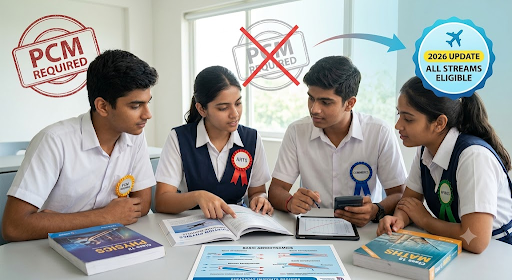
For 30 years Physics and Maths in Class 12 have been non-negotiable for CPL eligibility. That's changing. But not yet official and most guides online are getting the status wrong. Here's where things stand:
- The DGCA has approved and recommended dropping the Physics/Maths requirement opening CPL training to Arts and Commerce students.
- The recommendation is now sitting with the Ministry of Civil Aviation and the Ministry of Law for notification. Until it clears both it is not yet in effect.
- If you're an Arts or Commerce student today the current rule still applies to you. The accepted route is clearing Physics and Maths at the Class 12 level through NIOS (National Institute of Open Schooling). A 3–6 month process most students complete alongside a college degree with no need to repeat an academic year.
- Once notified, expect flying schools to introduce short bridging modules in aviation-relevant physics and maths, for non-science entrants since these subjects underpin aerodynamics, performance and flight-systems training.
The Military Route: Pilot Training Without the Fee
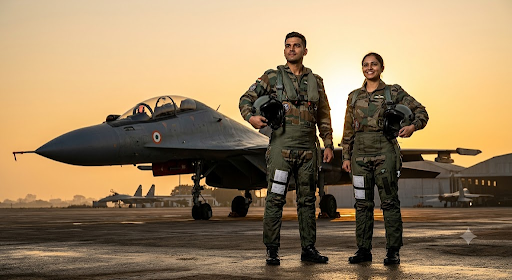
Not every path to the cockpit goes through a flying school.
The National Defence Academy or NDA is an option. After finishing Class 12 you can. If you pass the Air Force Common Admission Test or AFCAT you can join. Most people who finish college under the age of twenty‑four can enter.
Both of these routes lead to pilot jobs. You could fly fighters, transport planes or helicopters. The best part is that the training is paid for by the government and you earn a salary during the training period.
A military pilot's life is not the same as aviation. The demands are different and the daily routine changes.. If you have ever wondered how to become a pilot without spending between thirty‑five to sixty lakh rupees, on a Commercial Pilot Licence this is the straightforward answer.
Stages of Becoming a Pilot in India
A pilot can proceed through a number of stages, depending on the career they choose. Below are the general stages, from starting training in India to working as a professional flying and command capacity in a commercial airline environment.
Stage 1: Student Pilot Licence (SPL)
This is a basic certification an aspiring pilot will obtain in India once they have meet the relevant eligibility criteria and pass the required oral examination through their own flying school. This licence permits someone to fly an aircraft under the tutelage of a qualified instructor.
Stage 2: Private Pilot Licence (PPL)
Once a pilot has accumulated the necessary flight training, completed and passes various flight theory exams, and met the skill requirements they are eligible for the PPL. This licence allows pilots to fly for personal reasons and leisure, but not for hire or reward.
Stage 3: Commercial Pilot Licence (CPL)
To be eligible for a commercial role in aviation a CPL in India is a mandatory licence to have. This licence involves gaining a substantial amount of flying hours, passing a set of specific DGCA theory exams, passing applicable medical tests, and finally successfully passing a skill test. A CPL qualifies you for employment as airline pilot, charter pilot, flight instructor, and many other commercial aviation jobs.
Stage 4: Type Rating and Airline Preparation
For those seeking employment with airlines, once you get a CPL, you may need to choose the right type rating after CPL. This can be done with an aviation training organisation, and it is the certification required to act as commander or co-pilot on a particular type of aircraft. Pilots often do this in preparation for recruitment to a specific airline as it prepares you for simulator assessments and any initial operating training required for a particular aircraft.
Stage 5: First Officer & Hour Building
Once licensed and, where applicable, type-rated, most new airline pilots begin their careers as First Officers (FO). This entails flying as co-pilot to a Captain. While this is an opportunity to gain experience with airlines, many new pilots will also work on building hours in flight instruction, charter flying, corporate aviation or cargo operations if they cannot obtain an airline position directly, or wish to log more hours before making the transition to a commercial job.
Stage 6: Airline Transport Pilot Licence (ATPL)
The highest form of pilot qualification, the ATPL in India is only issued to experienced pilots who have gained the necessary amount of flying experience, typically 1500 hours. This is a key certification required if you wish to become a Captain flying for a commercial airline.
Stage 7: Captain
Having attained sufficient experience, including meeting the specific hours and certifications necessary, a qualified First Officer will eventually have the opportunity to upgrade to the role of Captain. The time it takes to transition from FO to Captain varies widely depending on the airline, aircraft type, vacancies, and experience levels of other pilots.
Hopefully, learning about these various stages provides clarity on how to become a pilot in India, from the very beginning to the end goal.
Career Path: How Pilot Licences Progress in India
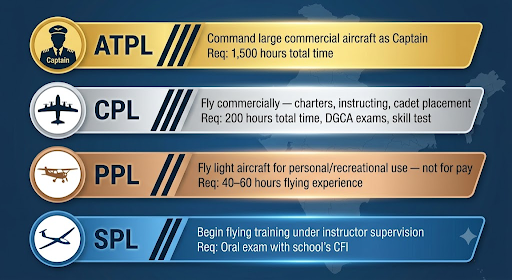
Becoming a pilot in India isn’t about earning a single licence. It involves four key licences, each representing a different stage of your training and career. Understanding this progression helps you see what you can actually do at each stage, rather than focusing only on the exams and requirements you need to complete.Image reference:
Licence What it unlocks Typical requirement
SPL (Student Pilot Licence) Begin flying training under instructor supervision
Oral exam with your school's Chief Flying Instructor
PPL (Private Pilot Licence) Fly light aircraft for personal/recreational use — not for pay 40–60 hours flying experience
CPL (Commercial Pilot Licence) Fly commercially — charters, instructing, cadet placement with airlines 200 hours total flying time, DGCA theory exams, skill test
ATPL (Airline Transport Pilot Licence) Command large commercial aircraft as Captain
1,500 hours total flying time
How to Become a Commercial Pilot in India: Step by Step
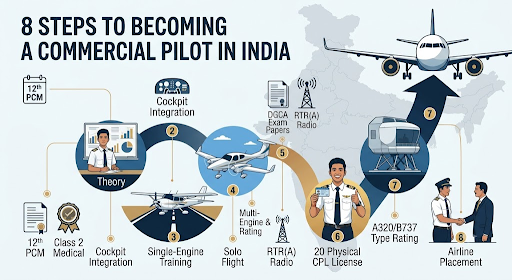
Eligibility and Medicals
Class 12 PCM (or the NIOS cleared equivalent), DGCA Computer Number, Class 2 Medical is good enough to start and Class 1 medical required just before CPL is issued.
Ground school
Theory will cover air navigation, aviation meteorology, air regulations, aircraft systems and engines, performance calculations etc. Here at FSTC ground school is being taught on line with the flights rather than in a block before the flight training starts. So theory and cockpit practice are correlated from the start.
Single-Engine Flight Training
We teach you how to fly small single-engine aircraft like Cessna 172 and Piper Archer. Solo flying, Navigation and a basic understanding of aircraft instruments will be acquired at this stage.
Multi-Engine and Instrument Rating
You move on to flying twin-engine aircraft like Diamond DA42 and Tecnam P2006T, and learn to operate the aircraft solely by reference to aircraft instruments. It’s the real thing that we encounter flying for an airline.
DGCA Examination and RTR(A)
You have theory exams and the radio telephony (restricted) exam required to communicate with the ATC (Air Traffic Control) throughout India.
CPL issued
After completing 200 hrs of flight training, all DGCA exams passed, and a valid Class I medical is on hand, DGCA issues the commercial pilot’s license (CPL).
Type Rating
A Commercial Pilot’s Licence (CPL) does not qualify anyone to fly an aircraft like A320 or a Boeing 737. Type rating can be done on particular aircraft like A320 or B737, depending on your career goals and airline opportunities. You will undergo some ground schooling on specific aircraft systems, and simulator training on Level D Full Flight Simulators, followed by a skill test and Line Flying Under Supervision (LFUS) in the airline.
Airline Placement
The obtained Type Rating can be utilized for applying in airlines for a First Officer (FO) position. This would entail interviews, Simulator Assessments, Airline Selection, etc.
Related: How long does it take to become a commercial pilot in India
How to Become a Pilot in India After 12th?
If you are taking up pilot training immediately post-Class 12, this is the path ahead. (For a deeper, step-by-step breakdown of this exact path, see FSTC's dedicated guide: How to Become a Pilot After 12th.)
- Lock in Physics & Math in Class 12- or apply to NIOS now, if you are not already doing them.
- Obtain a Class 2 medical certificate, before enrolling anywhere. It is the quickest and the least expensive path to rule out any disabling illness early.
- Apply for a DGCA computer number.
- Enroll in a DGCA flying school.
- Work your way from the Students Pilot License (SPL) through to the Private Pilot License (PPL - 40-60 hrs) and toward the 200 hr Civil Pilot License (CPL).
- Pass through the five DGCA theory exam for Air Navigation, Meteorology, Air Regulations, Technical General & Specific and the RTR examination.
- Apply for the CPL when you turn 18 with all hour and exam requirements completed.
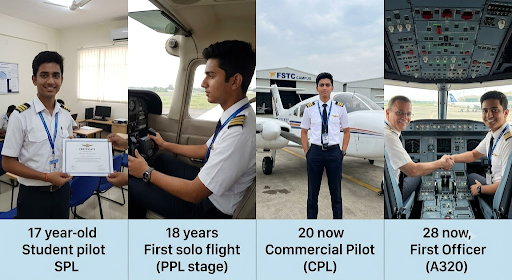
For someone taking this path directly from Class 12 with minimal hindrances, this realistically means possessing a CPL by 19-20 yrs of age. With a career where time and hour accumulation compound over the decades, that initial advantage is definitely not insignificant.
How to Become a Pilot in India After 10th?
- The eligible students after 10th can opt for Indian Air Force as they can apply for National Defense Academy after passing in NDA entrance exam.
- Eligibility criteria: 16.5 to 19.5 years, Physics & Mathematics at 12th class level for flying cadre.
- On the other hand, those who wish to take up CPL, after 10th class level, one must proceed to complete Class 12 (preferably PCM).
- There are certain aviation institutions that provide foundation courses after 10th class.
Note: 10th pass candidates cannot opt for CPL training directly but can plan in advance.
How Much Does It Cost to Become a Pilot in India?
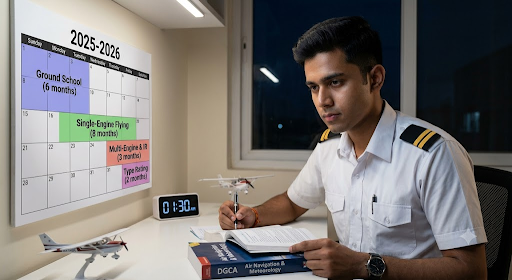
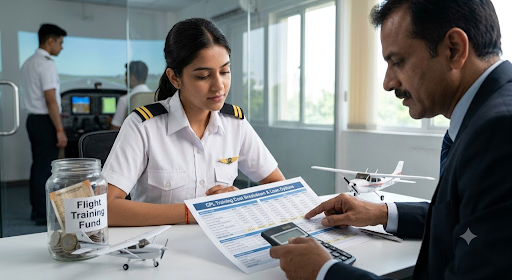
The total CPL course fees in India with ground school training and the complete 200 hours of flying usually falls somewhere between ₹35 lakhs and ₹60 lakhs depending on the flying school, aircraft and the efficiency of the student pilot in completing his flying hours.
This cost usually includes ground school training and study material, all single and multi-engine flying hours, DGCA and RTR examination fees and medical examination fees.
Type rating training is not included in the above cost and is charged separately depending upon the type of aircraft and simulator on which training has to be done after obtaining the CPL license.
So, how much does it actually cost to become a pilot in India if budget is the main obstacle? For students whose main concern is cost, there are three ways out
- Full funding route through NDA/AFCAT
- Education loan route or
- Slow and steady accumulation of hours by instructing or charter flying in between training.
We don’t recommend the method of enrolling in any flying school without getting the fees structure in detail beforehand.
How Long Does It Take to Become a Pilot in India?
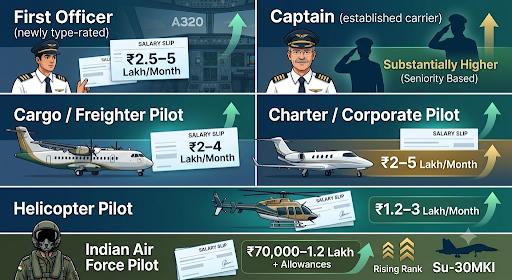
Normally, most of the students take 12 to 24 months to complete their CPL. If one needs to do a type rating course too, then additional time of 8 to 16 weeks has to be added to the above period.
Therefore, considering everything, one can say that it will take approximately 18 months to 2 years to become a pilot in India.
Students, who join immediately after 12th and do not have any delays, tend to fall in the 18-month bracket. The causes of delay include, monsoon disruption, re-attempt on DGCA theory paper and aircraft/simulator unavailability at busier flying schools.
Pilot Salary in India
Role Typical Monthly Salary
First Officer (newly type-rated) ₹2.5–5 lakh
Captain (ATPL holder, established carrier) Substantially higher, scaling with seniority and aircraft type
Cargo / Freighter Pilot ₹2–4 lakh
Charter / Corporate Pilot ₹2–5 lakh
Helicopter Pilot ₹1.2–3 lakh, sector-dependent
Indian Air Force Pilotn ~₹70,000–1.2 lakh + allowances, rising with rank
Why Choose FSTC to Become a Pilot in India?
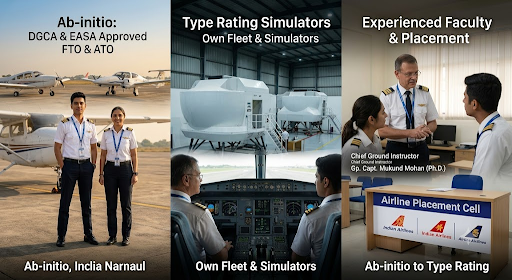
The only stand-alone Approved Training Organisation which simultaneously runs its own flying training organisation. From single engine ab-initio flights till Airbus A320 and Boeing 737 type ratings, all at one campus network.
- DGCA & EASA approvals, which are a rare combination held by few training organizations of India.
- Trained by flight instructors who average 35 years of experience in aviation, some of whom are ex-Indian Air Force instructors like the MD, Capt. Dilawer Singh Basraon & Chief Ground Instructor Gp. Capt. Mukund Mohan, Ph.D.
- Trained in FSTC’s own aircraft fleet - Cessna 172, Piper Archer, Diamond DA-42, Tecnam P2006T – and in its own Level D simulators - A320, B737, ATR 72-600, Dash Q400 – with campuses in Gurugram, Mumbai, Hyderabad, Narnaul, and Bhiwani.
- Aspiring pilots who join FSTC join an organization which trains, tests & type rates all in one campus.
Choosing the right aviation academy can make a significant difference to your training experience
FAQs on Becoming a Pilot in India (2026)
What is the minimum requirement to become a pilot in India?
Class 10+2 with Physics and Mathematics. Arts and Commerce students can pass these two subjects through NIOS to still be eligible under the present rule.
Am I eligible to become a pilot in India after 12th even if I have not studied Science?
No, according to the present rule but this is expected to change with the notification of DGCA’s proposal. This has not been implemented till date.
Is JEE required to become a pilot?
No. JEE has nothing to do with becoming a pilot. Important are Class 12 PCM (or equivalent cleared through NIOS) + DGCA medical clearance + Admission to a flying school.
How much does it cost to become a pilot in India?
It costs between ₹35 lakh and ₹60 lakh for the complete CPL with type rating training costing extra.
Is type rating compulsory after CPL?
Yes. With CPL one gets the right to fly commercially but for the particular aircraft which airlines want a pilot to fly, one needs to get the specific type rating for A320, B737, ATR, etc.
How much time does it take to become an airline ready pilot?
12-24 months for CPL, and 8-16 weeks for type rating - in all, about 18 months to 2 years.
Can I become a pilot in India at zero cost or low cost?
Yes, if you join IAF through NDA (post 12th) or AFCAT (post graduation) where all training is sponsored and one gets paid salary while undergoing training. In case of civil aviation there are education loan options and EMI finance.
Is there any difference in becoming a pilot if a woman wants to pursue this profession?
No, the eligibility, training, and licensing are exactly the same. There are many Indian airlines that organize recruitment drives which encourage female pilots.
Ready to Become a Pilot in India?
Pursuing piloting starts with making one decision - whether you are eligible for training or not.
FSTC trains pilots right from ab initio to airline ready type ratings with DGCA and EASA approval, using their own fleet and simulator.
Contact FSTC now and take your first informed step towards a career in flying.
For Flying School: marketing@fstcfto.in | +91 8527698320 / +91-9289634111
For Type Rating: info@fstc.in | +91-9871101630 / +91-9871178320