
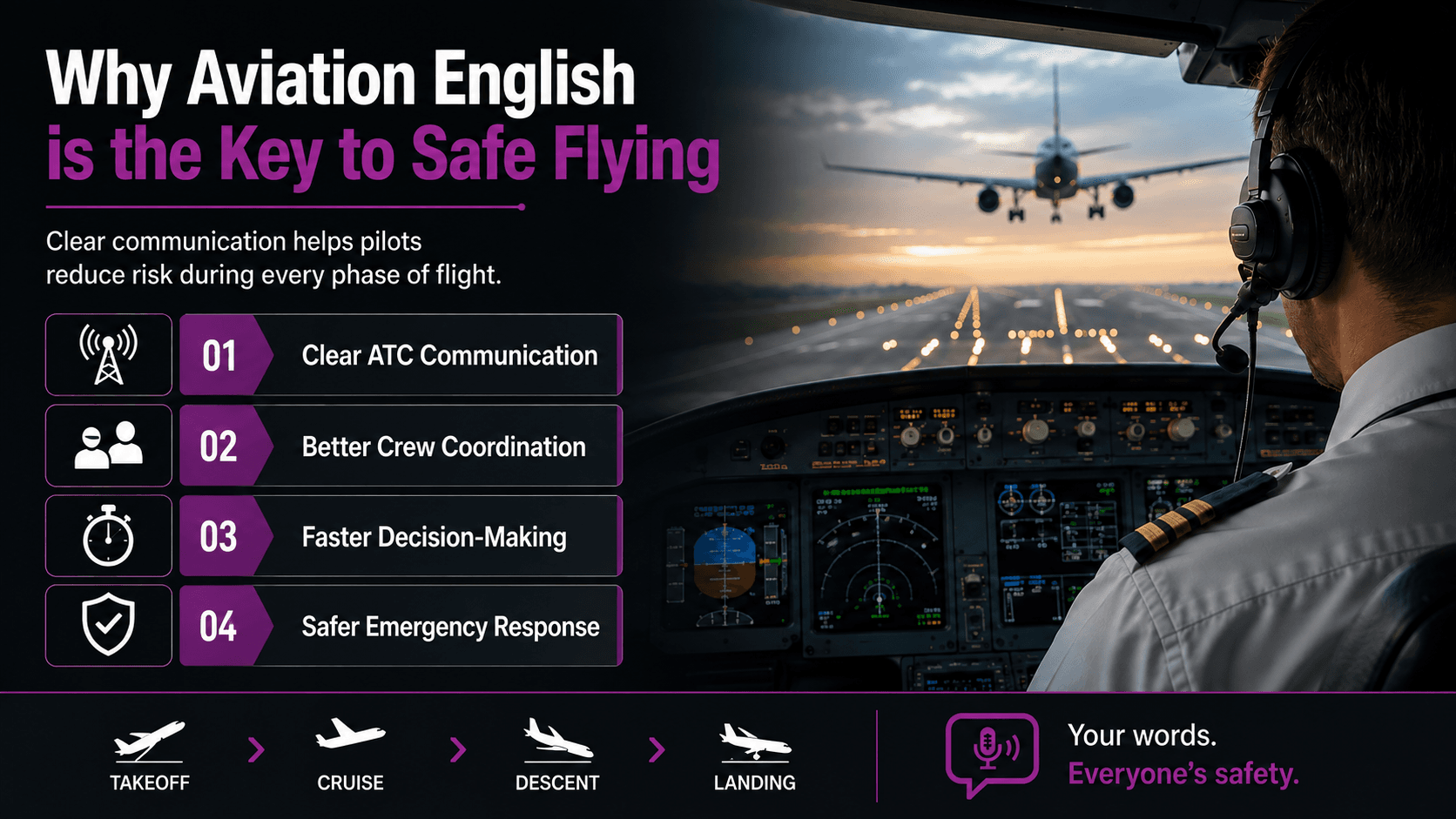
Why Aviation English is the Key to Safe Flying
Aviation is one of the most safety-focused industries in the world. Every flight depends on accurate decision-making, teamwork, technical knowledge, and effective communication between pilots, air traffic controllers, and aviation professionals.
Although aircraft technology and safety systems continue to advance, human communication remains a crucial part of safe flight operations. A pilot’s ability to understand instructions and convey information clearly can directly influence flight safety.
A misunderstood instruction, unclear radio transmission, or incorrect interpretation of critical information can create operational challenges and increase safety risks.
This is why Aviation English Language Proficiency (AELP) Training is considered a critical skill for professional pilots.
Aspiring commercial pilots must develop Aviation English skills during pilot training, as it is not only a regulatory requirement but also an essential professional responsibility.
What is Aviation English?
Aviation English is a specialised form of English used by pilots, air traffic controllers, and aviation professionals for clear and effective communication during flight operations.
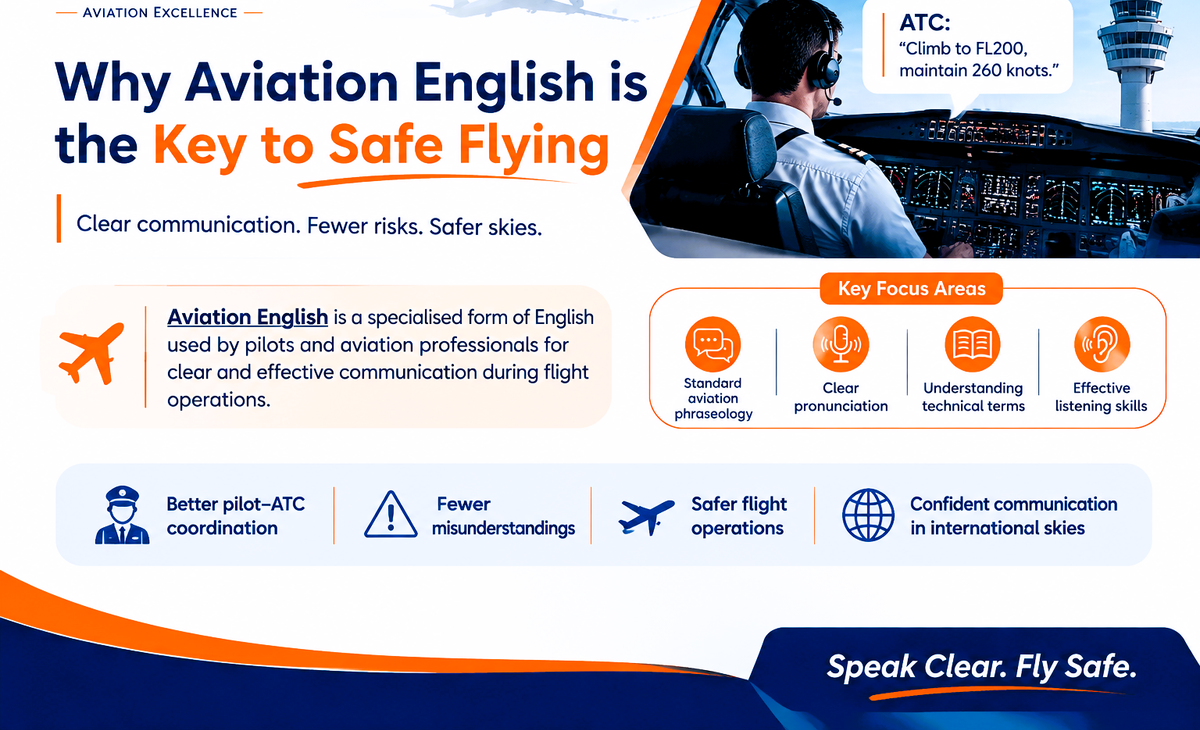
Infographic explaining Aviation English with a pilot, ATC communication, aviation terminology, and safe flying benefits
Unlike general English used in everyday conversations, Aviation English focuses on safety-critical communication.
It includes:
- Standard aviation phraseology
- Clear pronunciation
- Understanding technical aviation terms
- Effective listening skills
- Communication during normal and emergency situations
- Ability to exchange information accurately
It is an essential operational skill that helps pilots understand instructions, share important information, coordinate with crew members, manage abnormal situations, and operate safely in an international aviation environment.
The main objective of Aviation English is to reduce communication-related risks by helping aviation professionals from different countries, cultures, and language backgrounds exchange critical information accurately.
Aviation English is particularly important in pilot–air traffic controller communication, where messages are often exchanged quickly and under pressure. In such situations, even a small misunderstanding can impact flight operations, making clear, accurate, and confident communication a vital part of aviation safety.
What is the difference between Aviation English vs General English?
A pilot does not need to speak perfect academic English. Many pilot students assume that good conversational English automatically means they are prepared for aviation communication. However, Aviation English requires a different skill set.
For example, in everyday English, someone may say:
“Please go higher.”
In aviation communication, a pilot and controller would use precise terminology:
“Climb and maintain Flight Level 350.”
The difference is accuracy. Aviation communication must remove ambiguity.
The Evolution of Aviation English and ICAO Language Proficiency Standards for Pilots
The development of Aviation English is closely connected with the growth of international aviation and the increasing need for safe communication between pilots and air traffic controllers worldwide.
During the early years of aviation, communication practices varied between countries, and pilots often relied on local languages or regional procedures. As commercial aviation expanded after World War II, aircraft began crossing international borders more frequently, creating the need for a common communication language.
In 1951, the International Civil Aviation Organization (ICAO) recognised the importance of using a common language for international aeronautical communications and recommended English as the standard language for global aviation communication.
However, simply using English was not enough. Aviation safety depends on the ability to communicate clearly, accurately, and effectively. Several aviation accidents demonstrated that language barriers, unclear pronunciation, and misunderstandings could contribute to serious operational risks.
These incidents highlighted that pilots and air traffic controllers required more than basic English knowledge. They needed the ability to:
- Understand aviation messages accurately
- Communicate clearly during normal and emergency situations
- Handle different accents and communication styles
- Explain unexpected situations using clear language
Recognising these challenges, ICAO introduced formal Language Proficiency Requirements (LPRs) in 2003, which became applicable from 2008. These requirements established global standards to assess the communication abilities of pilots and air traffic controllers involved in international operations.
ICAO developed these standards through ICAO Document 9835 – Manual on the Implementation of ICAO Language Proficiency Requirements, which defines the assessment framework and proficiency criteria.
Aviation English proficiency is evaluated across six key areas:
- Pronunciation
- Structure
- Vocabulary
- Fluency
- Comprehension
- Interaction
Today, Aviation English proficiency is recognised as an essential competency for professional pilots. It is not only a regulatory requirement but also a critical safety skill that supports effective decision-making and teamwork in modern aviation.
Importance of Effective Pilot–ATC Communication
The communication between pilots and air traffic controllers is one of the most important safety processes in aviation.
Air traffic controllers provide pilots with essential information such as:
- Take-off and landing clearances
- Altitude instructions
- Weather updates
- Traffic information
- Route changes
- Emergency assistance
Pilots must understand these instructions correctly and respond appropriately.
A small misunderstanding involving altitude, runway information, or navigation instructions can create serious operational risks.
For example:
ATC instruction:
“Descend and maintain 5,000 feet.”
The pilot must clearly understand the instruction and confirm it correctly.
Effective pilot–ATC communication helps maintain:
- Aircraft separation
- Safe airport operations
- Efficient traffic flow
- Accurate decision-making
Communication is not just a routine part of flying; it is a safety barrier that protects every flight.
Aviation Accidents That Highlight the Importance of Aviation English
Aviation communication follows strict procedures because even a small misunderstanding can contribute to serious safety risks. Several historical incidents have demonstrated why Aviation English proficiency, standard phraseology, and effective pilot–ATC communication are essential.
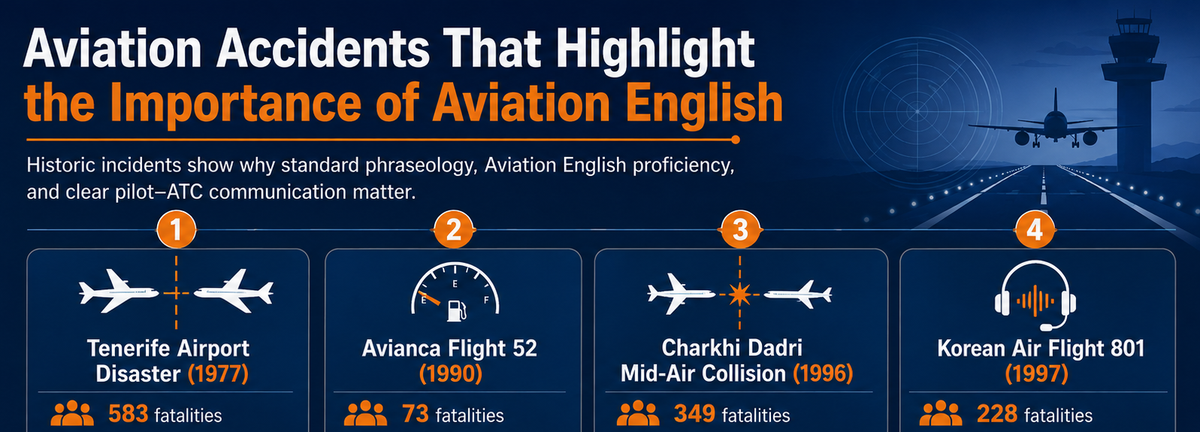
Infographic showing four major aviation accidents with aircraft, fuel gauge, collision, and pilot headset icons
Tenerife Airport Disaster (1977)
The Tenerife airport disaster remains one of the most studied aviation accidents in history. Two Boeing 747 aircraft collided on the runway at Los Rodeos Airport, resulting in 583 fatalities. Communication misunderstandings between pilots and air traffic controllers were among the contributing factors.
Avianca Flight 52 (1990)
Avianca Flight 52 crashed near New York after running out of fuel, resulting in 73 fatalities. The investigation identified communication challenges between the flight crew and air traffic control. The crew communicated their fuel situation, but the urgency of the situation was not clearly understood.
Charkhi Dadri Mid-Air Collision (1996)
The Charkhi Dadri collision between a Saudi Arabian Airlines Boeing 747 and a Kazakhstan Airlines aircraft over India resulted in 349 fatalities. The investigation identified communication difficulties related to altitude instructions as one of the contributing factors.
This incident remains highly relevant for Indian aviation professionals.
Korean Air Flight 801 (1997)
Korean Air Flight 801 crashed during approach to Guam International Airport, resulting in 228 fatalities. While several factors contributed to the accident, communication and coordination challenges within the cockpit highlighted the importance of effective crew communication.
These events show that advanced aircraft technology alone cannot eliminate human communication risks. Pilots and controllers must have the ability to exchange information clearly and accurately.
This is why Aviation English Language Proficiency (AELP) training remains a critical part of professional pilot preparation.
Common Communication Errors in Aviation
Even experienced aviation professionals can encounter communication challenges, especially during high-workload situations, international operations, or emergency conditions.
Some common communication challenges include:
- Misunderstanding instructions: Incorrectly interpreting altitude, heading, runway, or clearance instructions can create serious operational risks. Pilots must carefully listen, confirm information, and use proper readback procedures to ensure instructions are understood correctly.
- Pronunciation and accent differences: Aviation involves professionals from different countries and language backgrounds. Differences in pronunciation, accents, or unclear speech can make radio communication difficult to understand, especially during critical situations.
- Limited aviation vocabulary: Aviation uses specialised terminology that may not be familiar through general English knowledge. Pilots must understand technical terms, standard phraseology, and operational expressions used during flight operations.
- Ineffective communication during emergencies: Emergency situations require pilots to communicate quickly, calmly, and accurately. The ability to clearly describe problems and provide essential information to controllers and crew members is critical for effective decision-making.
- Incorrect or incomplete readback: Readback is an important safety practice where pilots repeat instructions received from air traffic controllers. Incorrect or incomplete readback can lead to misunderstandings and increase operational risks.
Aviation English Language Proficiency (AELP) training helps pilots develop the listening, speaking, and interaction skills required to overcome these challenges and communicate confidently in real-world aviation environments.
How AELP Training Improves Flight Safety
Aviation English Language Proficiency (AELP) training focuses on developing the communication skills required for safe and effective aviation operations. It goes beyond general English training by preparing pilots to communicate accurately in real-world flight environments.
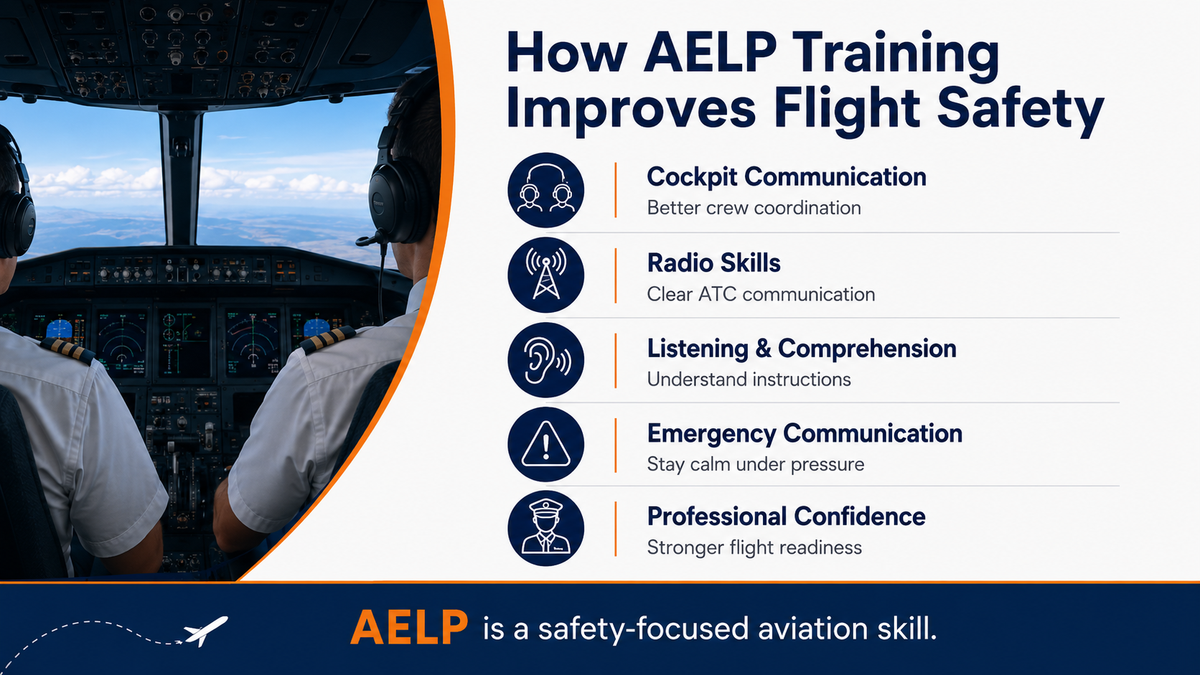
Pilots in cockpit with AELP flight safety skills infographic
DGCA AELP training and testing help pilots improve:
- Cockpit communication: Pilots learn how to exchange information clearly with other crew members, coordinate actions, and maintain effective teamwork during normal operations and unexpected situations.
- Radio communication skills: Students develop confidence in communicating with air traffic controllers by practising standard aviation phraseology, proper readback procedures, and accurate message delivery.
- Listening and comprehension skills: Pilots improve their ability to understand different accents, speaking styles, and operational instructions from aviation professionals around the world.
- Emergency communication: Training prepares pilots to communicate calmly and effectively during high-pressure situations where clear information exchange is essential for decision-making and safety.
- Professional aviation confidence: Strong communication skills help pilots perform better during flight training, simulator sessions, airline assessments, and future multi-crew operations.
AELP is not simply a language training programme. It is a safety-focused aviation skill that helps pilots communicate effectively, improve situational awareness, and operate confidently in the global aviation environment.
Why Aviation English is Important During CPL Training
During the Commercial Pilot Licence (CPL) training course, students use Aviation English throughout their learning journey.
It supports a better understanding of the flying courses:
Training Stage Importance
Ground Classes Understanding aviation subjects
Radio Telephony Communicating with ATC
Flight Training Managing real communication
Simulator Training Practicing operational scenarios
Airline Preparation Building professional confidence
Students who develop strong communication skills early often adapt better to airline-style operations.
Why choose FSTC for AELP Training in India?
FSTC, one of the leading pilot training institutes in India, provides professional aviation training solutions designed to prepare pilots for modern airline operations.
The aviation industry requires pilots who combine technical capability with strong communication skills. FSTC focuses on developing industry-relevant competencies that support safe and professional flying.
AELP training at FSTC helps aspiring pilots strengthen:
- Aviation communication skills
- Radio communication confidence
- ICAO language proficiency preparation
- Operational understanding
- Professional cockpit communication
Students beginning their aviation journey should develop strong Aviation English skills as an important step towards becoming confident and safety-focused pilots.
Frequently Asked Questions About Aviation English
What is Aviation English?
Aviation English is a specialised form of English used by pilots and aviation professionals for safe communication during flight operations.
Why do pilots need Aviation English?
Pilots need Aviation English to communicate clearly with air traffic controllers, crew members, and aviation teams worldwide.
What is AELP training?
Aviation English Language Proficiency (AELP) training develops communication skills required for pilots to meet ICAO language standards.
What ICAO English level is required for pilots?
ICAO Level 4 (Operational Level) is the minimum required proficiency level for international aviation communication.
Is Aviation English different from normal English?
Yes. Aviation English focuses on safety-critical communication, aviation terminology, and accurate information exchange.
How does Aviation English improve flight safety?
It reduces misunderstandings, improves pilot–ATC communication, and helps aviation professionals manage routine and emergency situations effectively.
Conclusion
A pilot’s responsibility goes beyond controlling an aircraft.
Aviation English Language Proficiency is therefore not just a regulatory requirement. It is a vital skill that supports safer skies and successful aviation careers.
Contact FSTC today and take the first informed step towards your professional flying career.
Call: +91 8527698320 or +91 9289634111Email: marketing@fstcfto.in
Clear communication is the first step towards safe flying.