
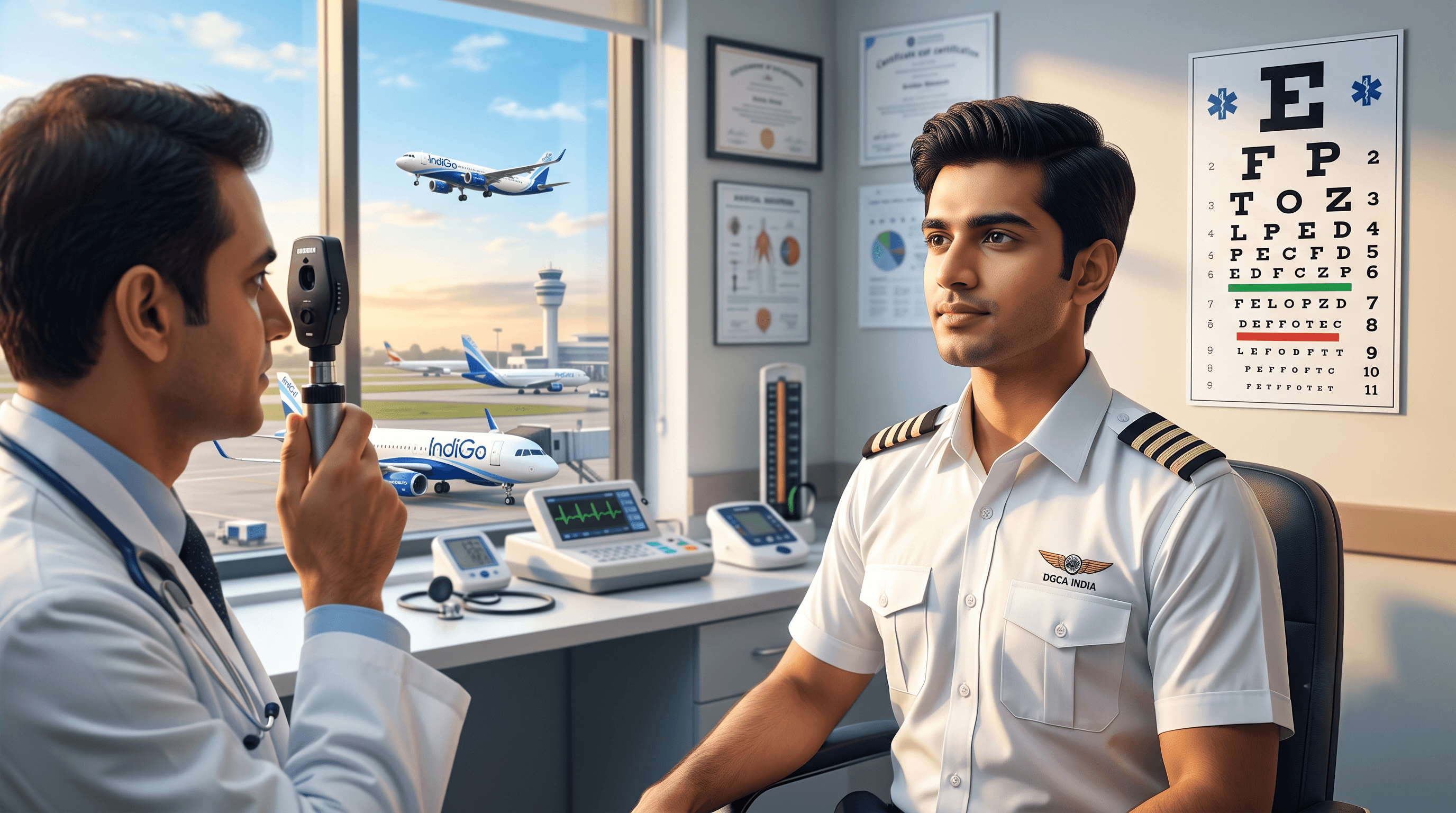
If you're planning to fly commercially in India, there's one milestone that decides everything else: the DGCA Class 1 Medical for Pilots. No amount of ground school prep, simulator hours, or flying school enrollment matters if you can't clear this exam. Yet most aspiring pilots only learn the details after they've already paid admission fees somewhere.
The medical is just one checkpoint in a longer eligibility process. If you're mapping out your full journey - academic requirements, costs, and what a pilot career actually looks like in India, our guide on how to become a pilot in India in 2026 is a good starting point before you commit to any flying school.
This guide walks you through what the Class 1 medical actually involves, how it differs from Class 2, what the tests look like, and the mistakes that trip up first-time candidates.
What Is the DGCA Class 1 Medical?
The DGCA Class 1 medical certificate confirms that you're physically and mentally fit to fly as a commercial pilot. It's issued by the Directorate General of Civil Aviation and is mandatory before you can hold a Commercial Pilot License (CPL) or an Airline Transport Pilot License (ATPL). No airline in India will hire you without a valid one on file.
This is different from the Class 2 medical, which is the entry-level check most students complete before starting flight training on a Student Pilot License. Class 2 looks at basic fitness. Class 1 goes much deeper, and it's conducted only at specific DGCA-authorized centres rather than by any local doctor.
Here's the sequencing that trips people up: you need Class 2 cleared first to get your DGCA file number, but you should upgrade to Class 1 early — ideally before committing to the expensive part of flight training. Plenty of cadets have finished ground classes and flying hours abroad only to discover a disqualifying issue at their Class 1 stage. That's an expensive way to find out.
DGCA Class 1 Medical India: Who Conducts It
Unlike Class 2, your initial Class 1 medical examination in India can't be done by just any DGCA-approved medical examiner. Initial assessments happen at a small number of authorized centres — primarily Indian Air Force medical establishments such as the Air Force Central Medical Establishment in Delhi and the Institute of Aerospace Medicine in Bangalore, along with a few DGCA-empanelled civil hospitals. Slots at these centres fill up fast, often two to three months out, so book through the eGCA portal as soon as your Class 2 clears.
Renewals are usually more convenient. Once you hold an initial Class 1, subsequent renewals can often be completed through empanelled Class 1 examiners closer to home, which is a big part of why getting that first one done right matters so much.
Class 1 Medical for CPL: What the Exam Actually Covers
The pilot medical examination in India for Class 1 is a multi-system evaluation, typically spread across one to two days. Expect it to cover:
- Vision testing: distance and near vision, colour perception, and depth perception. Corrected vision is generally acceptable if it reaches the required standard, but colour blindness is a hard stop for most flying categories.
- Hearing (audiometry): a pure tone audiogram checks whether your hearing falls within DGCA limits.
- Cardiovascular assessment: an ECG at minimum, with an echocardiogram or treadmill test added if your history or initial results warrant a closer look.
- Chest X-ray: to rule out lung abnormalities or infections.
- Blood and urine tests: complete blood count, blood sugar, lipid profile, liver and kidney function.
- Abdominal and pelvic ultrasound: a general check of internal organs.
- Full physical and neurological exam: height, weight, BMI, blood pressure, pulse, and reflexes.
- Psychological assessment: added when the examiner feels it's needed based on history or interview.
Body Mass Index gets more attention than most candidates expect. DGCA generally prefers a BMI between 18 and 25. Fall into the 25–30 range and you may be cleared with a warning; go above 30 and you're likely to be marked temporarily unfit, with a few months given to bring your weight down before a re-check.
Pilot Medical Test Procedure: Step by Step
- Clear your Class 2 medical and get your DGCA file/computer number through the eGCA portal.
- Book your Class 1 slot at an authorized centre well in advance.
- Arrive with documents — your reports are verified at reception before testing begins.
- Go through each test station across the day (or days, for the initial exam).
- Reports get compiled and uploaded to the eGCA portal by the centre.
- DGCA's medical board reviews everything, typically within two to four weeks.
- Get your result: fit, temporarily unfit (with a path to re-evaluation), or permanently unfit.
Medical Fitness for Commercial Pilots: Fit, Unfit, and In Between
Not every health issue ends your ambitions. DGCA separates conditions into three buckets: permanent disqualifications with no waiver (certain heart conditions, colour blindness for full privileges, some neurological disorders), temporary disqualifications that clear up with treatment (an infection, uncontrolled blood pressure, high BMI), and conditions accepted with limitations (corrected vision, mild controlled diabetes in some cases). Being upfront with your examiner about your history matters — hiding something rarely helps and can complicate your file later.
How to Get DGCA Class 1 Medical: Practical Tips
- Don't wait. Get your Class 1 done before you sink money into flight school abroad or a type rating course.
- Use only DGCA-approved medical examiners and authorized centres. A medical done outside this list simply won't be recognized.
- Get lab work done at NABL/NABH-accredited diagnostic centres — reports without proper accreditation get rejected.
- Sort out fixable issues first. If your BMI, blood pressure, or sugar levels are borderline, work on them for a few months before your appointment instead of risking a "temporarily unfit" delay.
- Keep your Class 2 and Class 1 timelines close together so you're not caught mid-training with an expired assessment.
What About Cost and Validity?
Expect the Class 1 medical to cost more than Class 2 — commonly in the ₹15,000 to ₹25,000 range, depending on the centre and any additional tests ordered. The certificate itself is typically valid for a year and needs annual renewal throughout your flying career, with more frequent renewals required as pilots get older.
Final Word
The DGCA Class 1 medical certificate India requires isn't a formality — it's the gate that every commercial pilot passes through, more than once, over an entire career. Treat it as step one rather than an afterthought. Get it early, be transparent with your examiner, and address anything fixable well before your appointment. Everything else in your CPL journey — ground school, flying hours, type rating, airline interviews — depends on that certificate staying valid.
FAQs
1. What is the DGCA Class 1 medical certificate, and why do I need it?
It's the fitness certification required to hold a Commercial Pilot License or Airline Transport Pilot License in India. Without a valid Class 1, no airline can legally roster you, and DGCA won't process your CPL application.
2. What's the difference between DGCA Class 1 and Class 2 medicals?
Class 2 is the basic fitness check needed to start flight training on a Student Pilot License and can be done by DGCA-approved doctors in your city. Class 1 is far more detailed, conducted only at authorized centres, and is mandatory before you can hold a CPL or work commercially.
3. Can I get a DGCA Class 1 medical if I wear glasses or have mild vision issues?
Usually, yes. As long as your vision corrects to the required standard with glasses or contact lenses, it's generally acceptable. Colour blindness, however, is a disqualifying condition for most flying privileges.
4. How long does the Class 1 medical exam take, and how long until I get results?
The initial exam usually takes one to two days at the centre. After that, DGCA's medical board typically takes two to four weeks to review your reports and issue a decision.
5. What happens if I'm declared "temporarily unfit"?
It means a condition needs to be addressed before you can be cleared — for example, high BMI, blood pressure, or an infection. You're usually given a few months to work on it and return for re-evaluation. A "permanently unfit" result is different and generally can't be appealed.