
A Complete Guide to DGCA AELP Training & Testing for Aspiring Pilots in India
A pilot may have excellent flying skills, strong technical knowledge, and extensive flight experience, but communication remains one of the most critical abilities required to operate an aircraft safely.
Every day, pilots communicate with Air Traffic Controllers (ATC), flight crew members, ground teams, and aviation authorities. Since aviation is a global industry, English is used as the international language for aeronautical communication.
However, aviation communication is not the same as everyday English.
The Directorate General of Civil Aviation (DGCA), India, follows the ICAO (International Civil Aviation Organization) Language Proficiency Requirements.
This requirement is fulfilled through the DGCA Aviation English Language Proficiency (AELP) Training and Testing process.
Understanding DGCA AELP requirements is crucial for aspiring commercial pilots in India. Aviation English proficiency plays an important role in meeting licensing requirements and preparing pilots for a professional aviation career.
This blog explains everything about DGCA AELP preparation.
What is DGCA AELP Training?
DGCA AELP stands for Aviation English Language Proficiency.
It is a specialised aviation communication training and assessment programme designed to evaluate whether pilots possess the English language skills required for safe flight operations.
The objective of AELP is not to test general English knowledge. Instead, it assesses a pilot’s ability to use English effectively in real aviation situations.
Aviation communication involves two important elements:
- Standard Aviation Phraseology
- Plain English Communication
Pilots and air traffic controllers use standard ICAO phraseology during routine operations. However, not every aviation situation can be managed through predefined phrases alone.
Why is Aviation English Training Important for Pilots?
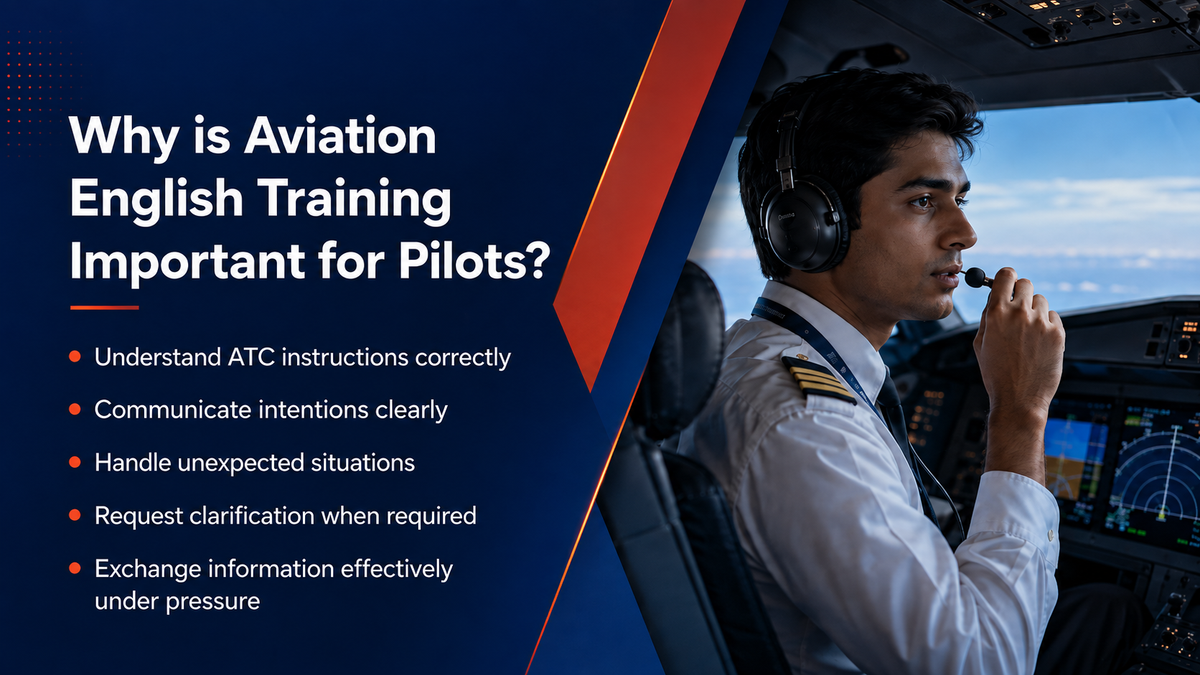
Pilot communicating with ATC during aviation English training
A pilot’s responsibility is not only to fly the aircraft but also to communicate accurate information at the right time.
AELP ensures that pilots can:
- Understand ATC instructions correctly
- Communicate intentions clearly
- Handle unexpected situations
- Request clarification when required
- Exchange information effectively under pressure
Many aviation incidents worldwide have highlighted the importance of clear communication between pilots and controllers.
Therefore, ICAO introduced global language proficiency requirements to reduce communication-related risks and ensure aviation professionals can manage both routine and non-routine situations effectively.
Who Needs DGCA AELP Certification?
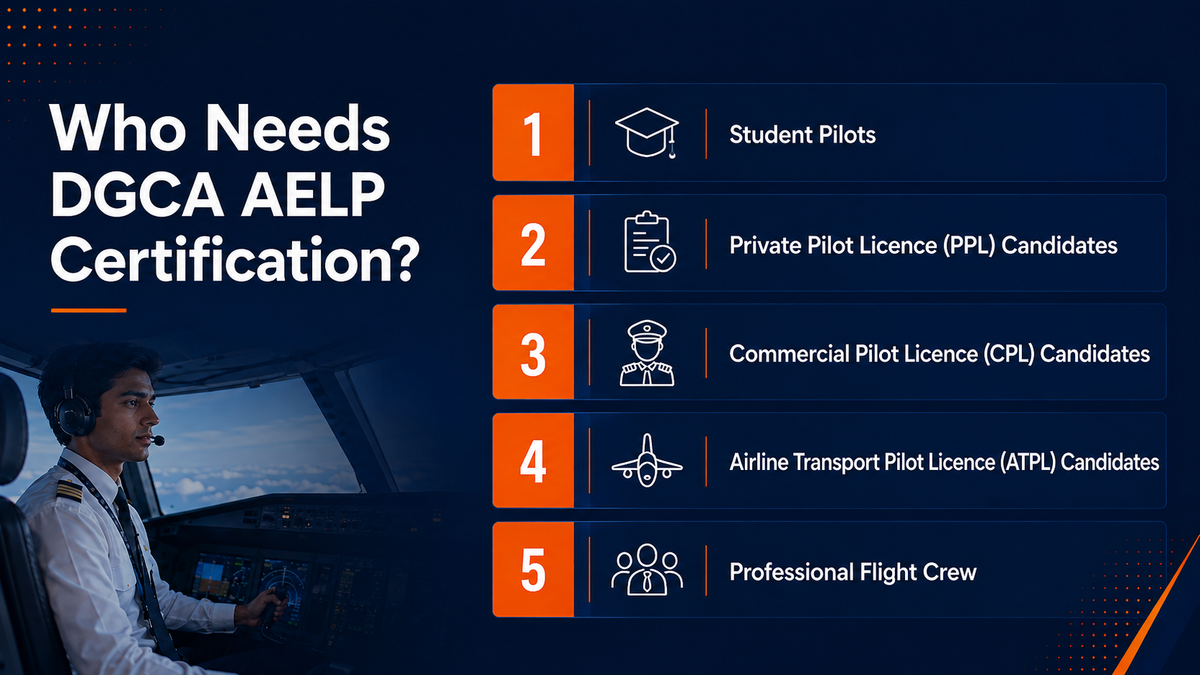
DGCA AELP certification eligibility for pilots and flight crew
DGCA AELP requirements apply to pilots who require aviation English language endorsement for exercising their flying privileges.
This includes: Pilot Category AELP Requirement
Student Pilots Required as part of professional pilot development Private Pilot Licence (PPL) Candidates
Required for licence privileges Commercial Pilot Licence (CPL) Candidates
Mandatory requirement
Airline Transport Pilot Licence (ATPL) Candidates Required for advanced operations
Professional Flight Crew
Required to maintain language proficiency
Achieving the required AELP level is an important milestone in a pilot training course. This helps candidates move closer to building a successful airline career.
Eligibility Criteria for DGCA AELP Training
Candidates interested in Aviation English Language Proficiency training must meet the requirements defined by DGCA-approved AELP Training and Testing Organisations.
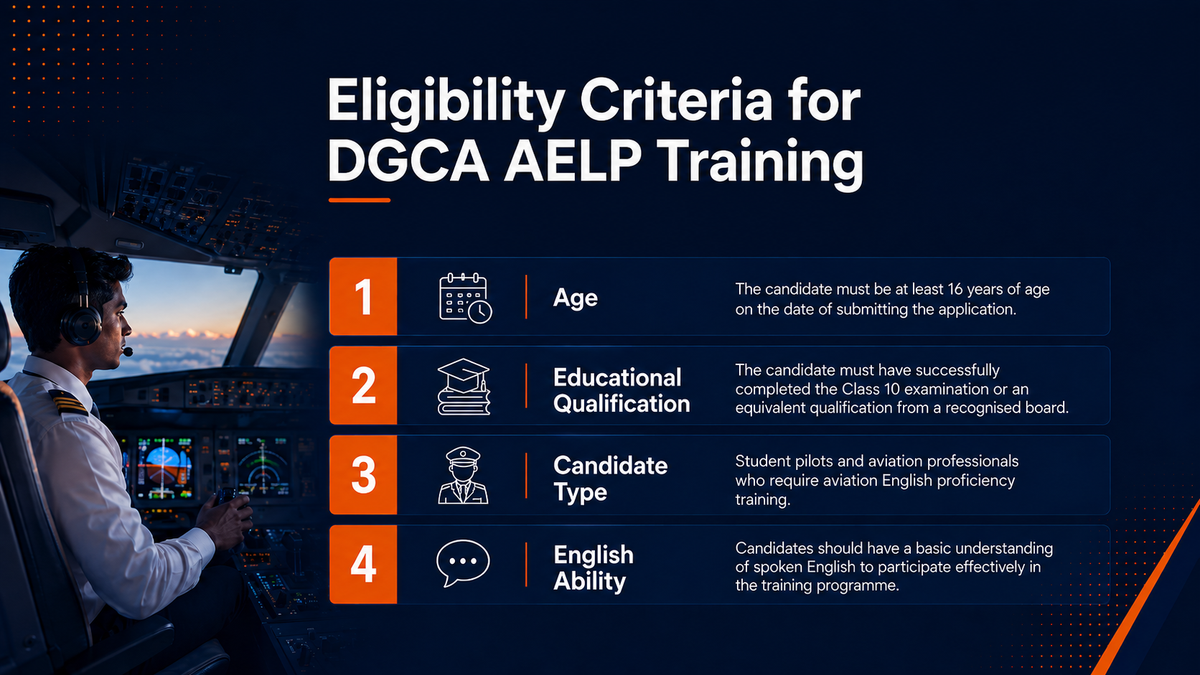
Eligibility criteria for DGCA AELP training
The general eligibility criteria include:
- Age: The candidate must be at least 16 years of age on the date of submitting the application.
- Educational Qualification: The candidate must have successfully completed the Class 10 examination or an equivalent qualification from a recognised board.
- Candidate Type: Student pilots and aviation professionals who require aviation English proficiency training.
- English Ability: Candidates should have a basic understanding of spoken English to participate effectively in the training programme.
A candidate does not need to have perfect English skills before starting AELP training. The programme is designed to develop aviation-specific communication skills and prepare students to communicate confidently in professional flight environments.
What Does DGCA AELP Training Include?
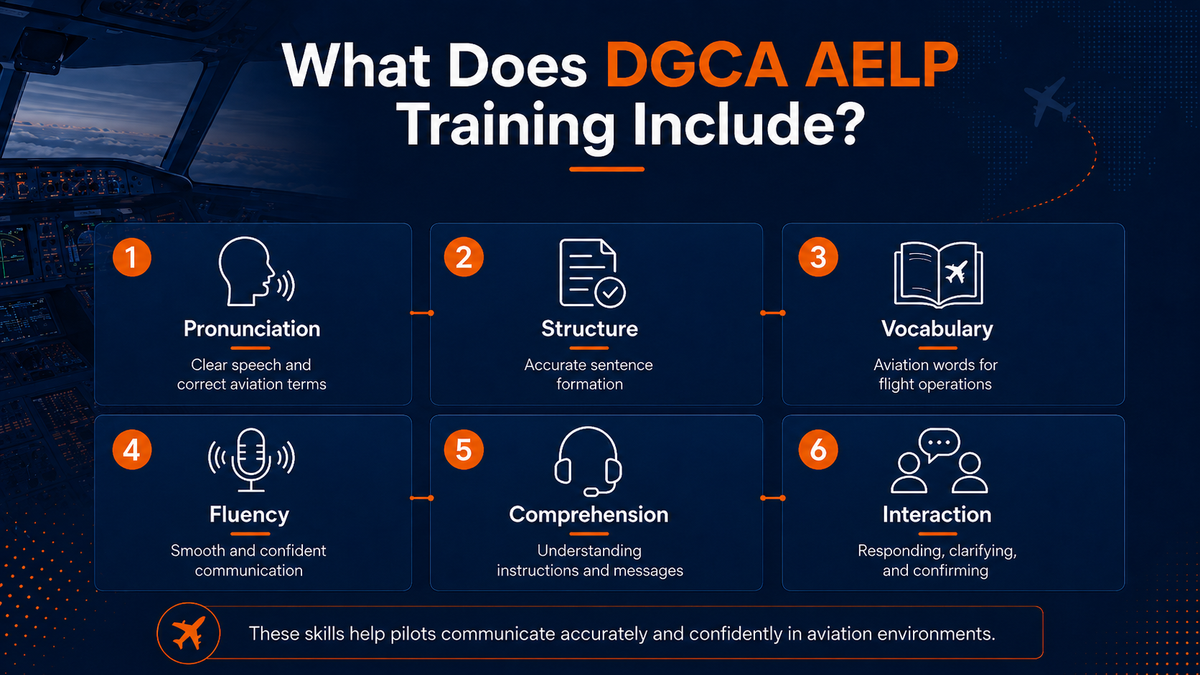
Six key components of DGCA AELP training for pilots
The DGCA AELP Training Syllabus is designed according to the ICAO Language Proficiency Requirements and focuses on the development of communication skills.
The training focuses on the six language proficiency areas defined by ICAO:
- Pronunciation
- Structure
- Vocabulary
- Fluency
- Comprehension
- Interaction
Each area plays an important role in helping pilots communicate accurately and confidently in aviation environments.
Pronunciation Training
Clear pronunciation is the foundation of effective aviation communication. Since pilots communicate with aviation professionals from different countries and language backgrounds, their speech must be easily understood without ambiguity.
The pronunciation module helps candidates improve:
- Clarity of speech
- Correct pronunciation of aviation terms
- Stress, rhythm, and intonation
- Ability to communicate without causing misunderstanding
The objective is not to remove a candidate’s natural accent. It is to ensure that their communication remains clear and easily understandable in an international aviation environment.
Structure and Sentence Formation
Accurate sentence formation helps pilots deliver information clearly, especially during critical situations.
This part of AELP training focuses on improving the candidate’s ability to use English structures correctly while communicating aviation-related information.
Training includes:
- Formation of clear and meaningful sentences
- Correct use of grammatical structures
- Improving accuracy during communication
- Reducing errors that may affect understanding
Pilots must be able to explain situations clearly.
Aviation Vocabulary Development
A strong aviation vocabulary allows pilots to communicate technical information accurately and efficiently.
This module focuses on developing familiarity with words and expressions commonly used in flight operations.
The training covers communication related to:
- Aircraft operations
- Airport procedures
- Weather conditions
- Navigation
- Flight planning
- Technical situations
- Emergency scenarios
Candidates also learn how to explain information using alternative words when they cannot recall a specific term, which is an important communication skill evaluated during AELP assessment.
Fluency Development
Fluent communication allows pilots to share information quickly and confidently during flight operations.
This section helps candidates develop the ability to communicate smoothly without unnecessary pauses or hesitation.
The training focuses on improving:
- Speaking flow
- Confidence during conversations
- Ability to describe situations naturally
- Organisation of thoughts while communicating
Effective fluency is especially important during unexpected situations where pilots need to provide accurate information within limited time.
Comprehension and Listening Skills
Understanding information correctly is just as important as communicating it clearly.
Pilots must be able to accurately interpret instructions, reports, and messages received from ATC and other aviation professionals.
This module includes practice in:
- Listening to aviation communication
- Understanding different speaking styles and accents
- Interpreting instructions correctly
- Responding appropriately to operational situations
Candidates are trained to understand both routine communications and unexpected scenarios that may occur during flight operations.
Interaction Skills
Effective aviation communication depends on proper interaction between pilots and other aviation personnel.
This section focuses on developing the ability to participate in conversations, exchange information, and manage communication challenges effectively.
Candidates learn how to:
- Respond appropriately to questions
- Confirm important information
- Request clarification when required
- Handle misunderstandings
- Maintain effective communication during challenging situations.
Strong interaction skills help pilots build safer communication practices and respond confidently in real-world aviation environments.
Duration of DGCA AELP Training
Under revised DGCA regulations, candidates are required to undergo a minimum of 30 hours of Aviation English Language Proficiency (AELP) training before appearing for the AELP test.
DGCA AELP Levels
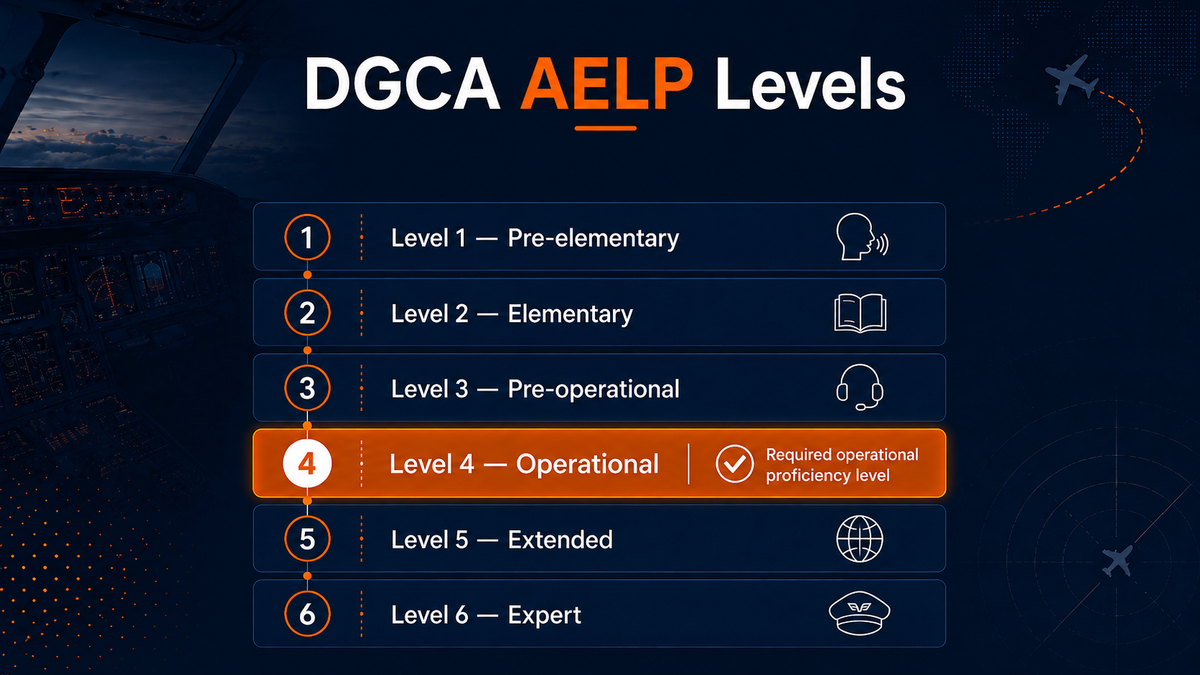
DGCA AELP English proficiency levels
The ICAO Aviation English Language Proficiency system has six levels.
A pilot must demonstrate the required operational proficiency level to receive an English language endorsement.
Level
Description
Level 1
Pre-elementary
Level 2
Elementary
Level 3
Pre-operational
Level 4
Operational
Level 5
Extended
Level 6
Expert
What is ICAO AELP Level 4 (Operational Level)?
ICAO AELP Level 4 is the minimum proficiency level required for pilots.
A pilot with Level 4 proficiency can:
- Communicate effectively in routine situations
- Handle unexpected aviation situations
- Understand aviation-related conversations
- Respond clearly using appropriate language
Most student pilots preparing for CPL training in India aim to achieve at least Level 4 proficiency.
What is ICAO AELP Level 5 (Extended Level)?
ICAO AELP Level 5 represents a higher level of English proficiency.
Pilots achieving Level 5 generally demonstrate the following:
- Better fluency
- Improved understanding of complex situations
- More accurate communication
- Stronger ability to handle unusual scenarios
The validity period for higher levels is generally longer compared to Level 4.
What is ICAO AELP Level 6 (Expert Level)?
ICAO AELP Level 6 is the highest aviation English proficiency level.
A Level 6 pilot demonstrates:
- Excellent pronunciation
- Advanced vocabulary
- Strong comprehension
- Natural communication ability
Pilots at this level are considered expert users of aviation English.
DGCA AELP Certification and Validity
After successfully completing the AELP assessment, candidates receive an aviation English language proficiency endorsement according to their achieved ICAO level.
The validity depends on the proficiency level achieved.
ICAO Level
Validity Period
Level 4
Generally valid for 3 years
Level 5
Generally valid for 6 years
Level 6
Lifetime validity
Pilots must maintain their language proficiency status to continue exercising their licence privileges.
DGCA AELP Test Format
The DGCA AELP Test is conducted through DGCA-approved AELP Training and Testing Organisations and authorised language assessment bodies. Qualified AELP examiners conduct the assessment and evaluate candidates based on the language proficiency standards established by DGCA and ICAO.
The assessment measures a candidate’s ability to communicate effectively in real aviation situations. Unlike academic English examinations, the AELP test focuses on practical communication skills required for safe flight operations.
The key areas evaluated during the assessment include:
Assessment Area
Evaluation
Listening
Understanding aviation communication
Speaking
Clear verbal communication
Vocabulary
Correct aviation terminology
Fluency
Smooth communication
Comprehension
Understanding information accurately
Interaction
Appropriate responses
Why Choose FSTC for DGCA AELP Training?
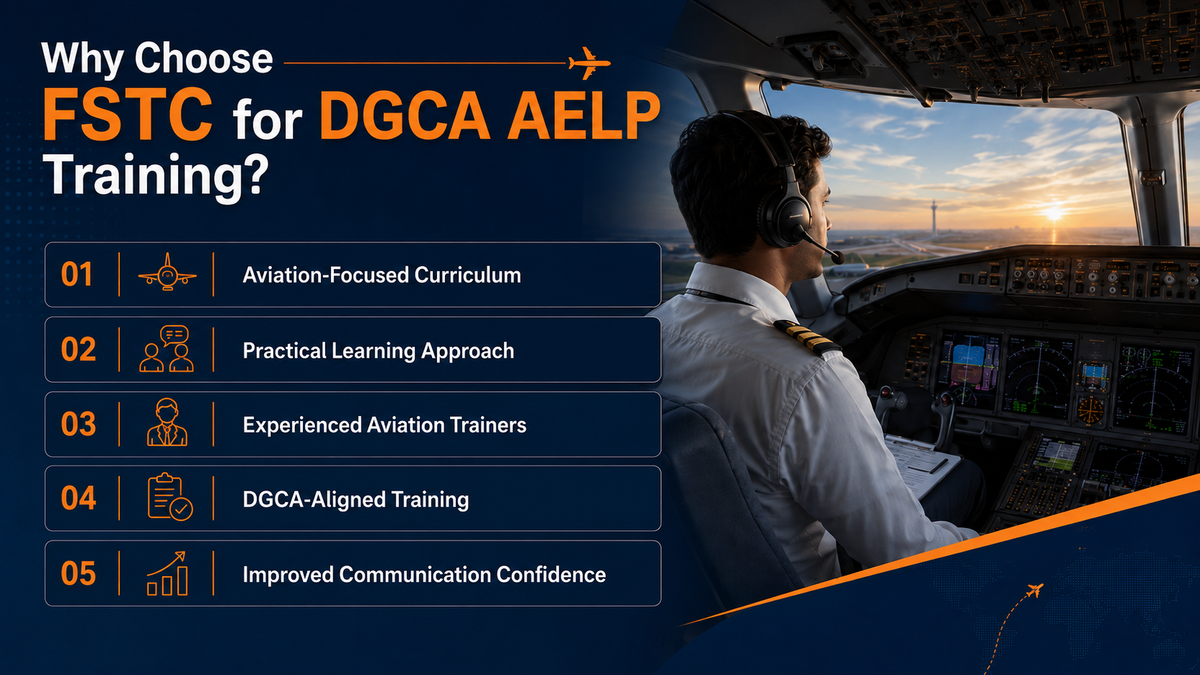
Why choose FSTC for DGCA AELP training
Choosing the right aviation training organisation plays an important role in your AELP preparation and overall pilot training journey.
FSTC, one of the top pilot training organisations in India, offers a structured DGCA AELP Training programme designed to help aspiring pilots meet aviation English proficiency requirements. The programme focuses on building practical communication skills that pilots need during real-world flight operations.
Key reasons to choose FSTC for AELP Training include:
- Aviation-Focused Curriculum: Training aligned with real-world aviation communication requirements.
- Practical Learning Approach: Hands-on practice with flight scenarios, aviation discussions, and operational situations.
- Experienced Aviation Trainers: Guidance from professionals with knowledge of aviation communication standards.
- DGCA-Aligned Training: Preparation designed according to DGCA and ICAO Aviation English Language Proficiency requirements.
- Improved Communication Confidence: Develop clear, professional communication skills required for a successful aviation career.
FSTC helps aspiring pilots develop the communication skills required to take the next step towards a successful aviation career.
Frequently Asked Questions About DGCA AELP Training
Is AELP mandatory for CPL pilots in India?
Yes, Aviation English Language Proficiency (AELP) certification is mandatory for CPL pilots in India. Pilots must achieve at least ICAO Operational Level 4 proficiency to meet the required standard for aviation communication.
What is the minimum passing level for DGCA AELP?
The minimum passing level for the DGCA AELP Test is ICAO Level 4 (Operational Level).
Can I take AELP training during CPL training?
Yes, candidates can complete AELP training during their CPL training journey. Many aspiring pilots complete their Aviation English Language Proficiency training alongside their flight training and ground classes.
Is AELP difficult?
AELP is not difficult when candidates prepare with the right approach.
The assessment does not test advanced English grammar or academic writing skills. It evaluates whether a pilot can communicate clearly and effectively in aviation situations.
How long is AELP Level 4 valid?
ICAO Level 4 (Operational Level) AELP certification is generally valid for three years.
DGCA AELP training & testing free
No, DGCA AELP training and testing are generally not free.