
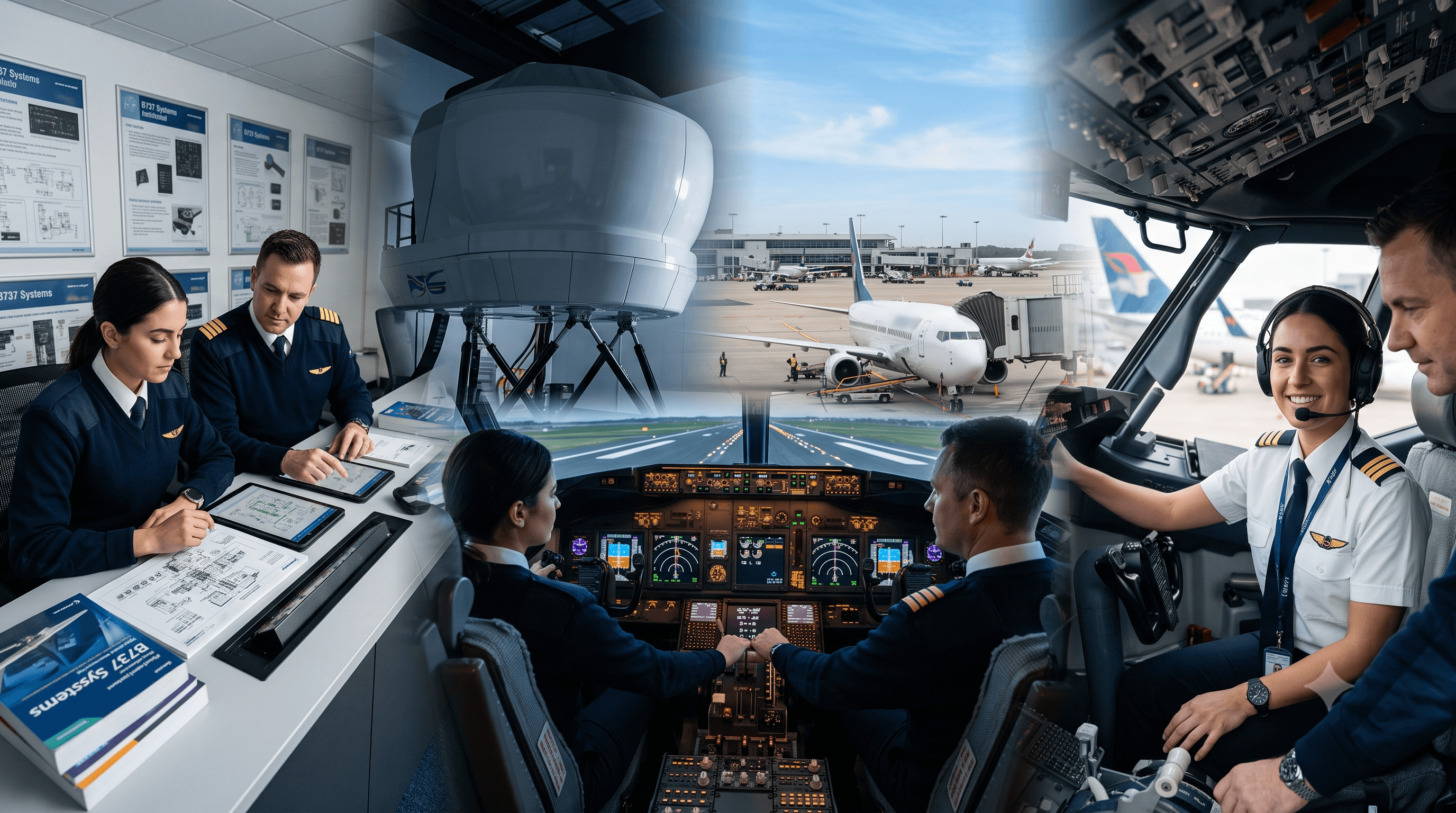
If you've just finished your CPL and started looking at airline job postings, you've probably noticed a line that shows up almost everywhere: "Type rating required." For most new pilots in India, that phrase is the first real introduction to type rating training, and also the first source of a lot of confusion. What actually happens during this course? How long does it take? Is it just ground classes, or do you get into a simulator too?
This guide walks through the entire journey, from your first day of ground school to the moment you're signed off to fly a specific aircraft type.
What Is Type Rating Training, Exactly?
A commercial pilot license and instrument rating qualify you to fly, but not to fly any particular aircraft. Every large aircraft, whether it's an Airbus A320 or a Boeing 737, has its own systems, cockpit layout, and handling characteristics. Type rating training is the specialized course that certifies you to operate one specific aircraft type, and it's mandatory before an airline will put you in the right seat.
In India, this training has to be conducted at a DGCA-approved type rating training organization, and the certificate you walk away with is recognized under DGCA regulations. Airlines won't accept a type rating from an academy that isn't approved, so checking this is the first thing to confirm before enrolling.
Stage One: Ground School
Every type rating course begins with ground school, and it's more intense than most students expect. This isn't a few lectures spread over a week. Depending on the aircraft and the academy, ground school for something like an A320 type rating training program typically runs four to six weeks, often longer for the Boeing 737 type rating training track.
During this stage, you'll go through:
- Aircraft systems: hydraulics, electrical, fuel, pressurization, and avionics, taught system by system until you can explain how each one fails and what backs it up
- Performance and limitations: weight and balance, takeoff and landing performance charts, and the specific numbers that define the aircraft's operating envelope
- Normal and abnormal procedures: the flows and checklists you'll use on every flight, plus the abnormal and emergency procedures for when something goes wrong
- Regulations and company-specific SOPs: if the training is tied to a particular airline, you'll also learn their standard operating procedures
Ground school ends with a written exam, and most academies require a strong pass before moving you into simulator training. This isn't a formality. Instructors want to know you actually understand the aircraft before you touch the controls.
Stage Two: Fixed Base and Procedures Trainers
Before stepping into a full-motion simulator, most type rating programs use a fixed-base simulator or a cockpit procedures trainer. Think of this as a rehearsal space. The instrument panel matches the real aircraft exactly, but there's no motion, so the focus stays entirely on button sequences, checklist flows, and building muscle memory for switch positions.
This stage matters more than students usually give it credit for. By the time you get into the full simulator, you shouldn't be hunting for switches. Your hands should already know where everything is.
Stage Three: Full Flight Simulator Training
This is the part everyone looks forward to. Flight simulator training for pilots at this level uses a full-motion, Level D simulator, which is certified to replicate the real aircraft closely enough that regulators treat simulator hours as equivalent to actual flight hours for licensing purposes.
Sessions typically run four hours each, with two pilots trading the roles of pilot flying and pilot monitoring. A typical A320 or 737 type rating includes somewhere between 30 and 40 simulator hours, broken into sessions that build in difficulty:
- Basic handling and normal procedures
- Instrument approaches and autopilot management
- Abnormal situations: engine failures, hydraulic issues, electrical faults
- Emergency scenarios: rejected takeoffs, engine fires, decompression
- Line-oriented flight training, which simulates a complete flight from gate to gate with realistic complications
By the final sessions, you're not just executing procedures. You're managing workload, communicating with a crew, and making decisions under pressure, which is really the whole point of the course.
Stage Four: Skill Test and Licensing
Once simulator training is complete, you sit a skill test conducted by a DGCA-approved examiner. This test covers normal procedures, abnormal handling, and at least one full emergency scenario, and it's evaluated against a strict standard. A pass here gets the type rating endorsed on your license.
Some academies also build in a type rating practical training phase involving supervised line flying or base training on the actual aircraft, depending on what the specific type and regulatory pathway require.
Choosing the Right Type Rating Academy in India
Not all programs are built the same, and the gap between a good one and a mediocre one shows up fast once you're in a real cockpit. When comparing a type rating course in India, look at:
- DGCA approval status, confirmed directly rather than taken on faith
- Simulator access and whether it's in-house or outsourced to another facility
- Instructor experience, ideally with actual line flying background on the type
- Placement support or airline tie-ups, since some academies train specifically for a partner airline's fleet
- Batch size, since smaller batches usually mean more simulator time per student
Wrapping Up
Type rating training is where classroom knowledge turns into an actual, usable skill. It's demanding, and it should be. You're being certified to fly an aircraft carrying hundreds of people. Whether you're eyeing an A320 type rating training program or the Boeing 737 track, understanding each stage of the journey helps you walk in prepared and choose an academy that actually gets you ready, not just certified.
Frequently Asked Questions
1. How long does type rating training usually take?
Most programs run between six and ten weeks total, combining ground school, procedures trainer sessions, and full simulator training. The exact timeline depends on the aircraft type and how the academy schedules its batches.
2. Do I need a job offer before starting a type rating course?
Not always. Some pilots complete a type rating on their own and then apply to airlines, while others get sponsored or self-funded type ratings tied directly to a specific airline's fleet. Both routes are common in India, though airline-sponsored ratings often come with better job security.
3. What's the difference between an A320 and a Boeing 737 type rating?
Beyond the obvious differences in systems and cockpit layout, the two aircraft have different automation philosophies. Airbus relies more heavily on fly-by-wire protections, while Boeing's 737 gives pilots more direct control feel. Neither is harder to learn, but they do require different mental models.
4. Can I fail a type rating course?
Yes. Both the written exams and the final skill test have to be passed to a certain standard. Academies usually build in remedial simulator sessions if a student is struggling, but consistent underperformance can mean recycling through part of the course or, in rare cases, discontinuing.
5. Is simulator training the same as flying the real aircraft?
For licensing purposes, yes. Level D full-motion simulators are certified closely enough to the real aircraft that regulators count simulator hours toward your type rating requirements. That said, most airlines still require supervised line flying after the type rating is issued, before you fly unsupervised.