
Diamond DA42 Aircraft: Specifications, Features, and Role in Pilot Training
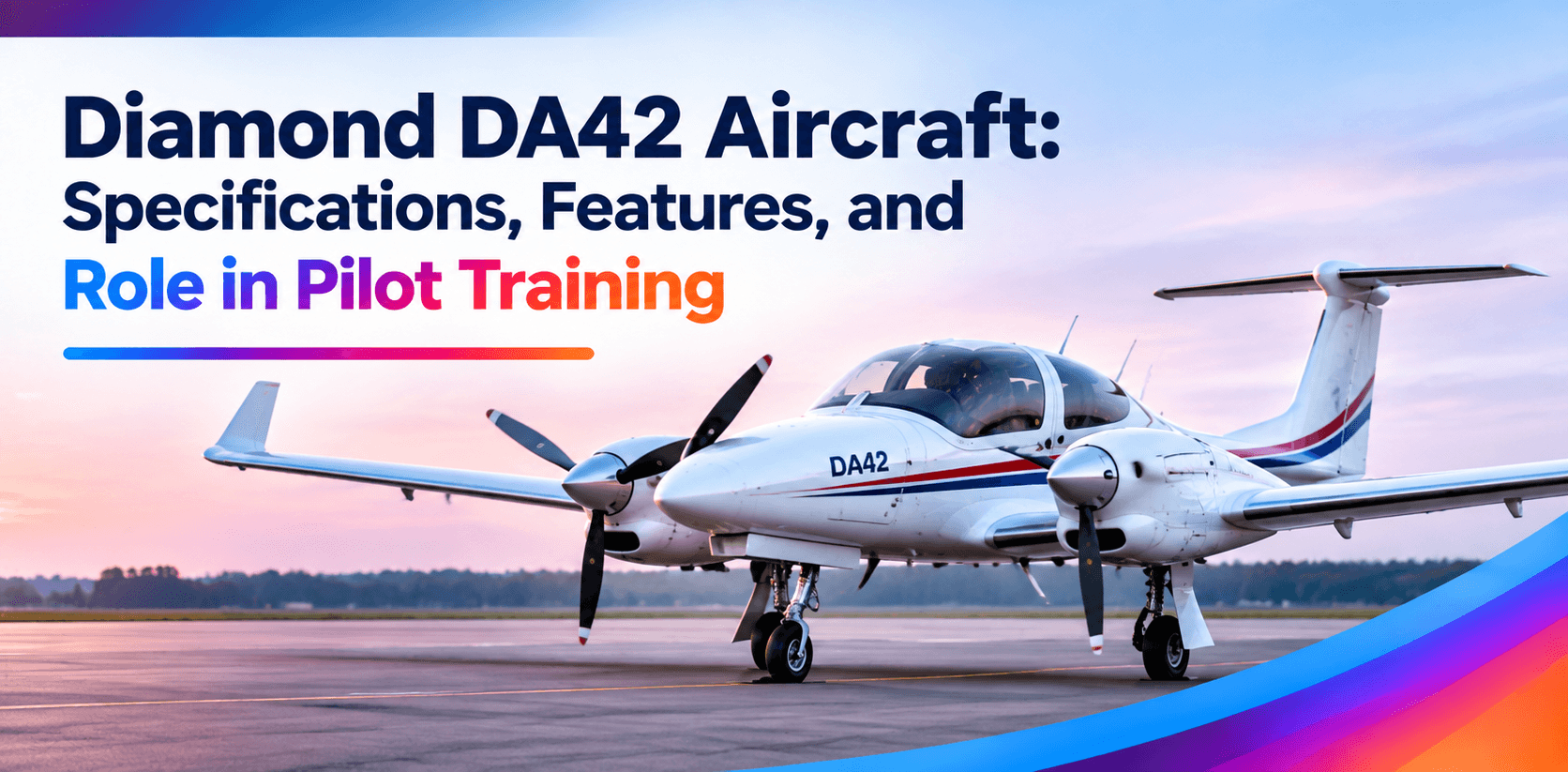
The Diamond DA42 is a four-seat, twin-engine piston aircraft used for multi-engine and instrument training. Its electronic engine controls, glass cockpit, and retractable landing gear help students learn aircraft systems, performance planning, and workload management. FSTC lists the DA42 NG in its training fleet.
What are the Different Variants of the Diamond DA42?
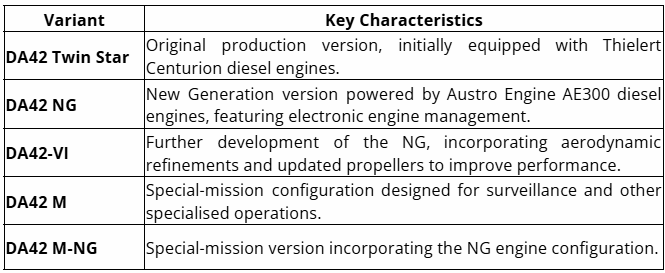
The Diamond DA42 aircraft family includes several variants developed for different engine configurations and operational requirements. The main variants include:
Diamond also offers the DA42 MPP (Multi-Purpose Platform), designed for aerial surveillance, mapping, environmental monitoring and other data-collection missions. It can accommodate specialised sensors and mission equipment.
The European Union Aviation Safety Agency (EASA) lists four certified models under the DA42 type certificate: DA42, DA42 M, DA42 NG and DA42 M-NG. The DA42-VI is Diamond's commercial designation for a further development of the NG rather than a separately listed model in this type-certificate document.
The DA42 NG is one of the twin-engine aircraft available in FSTC's training fleet.
Diamond DA42 Aircraft Specifications
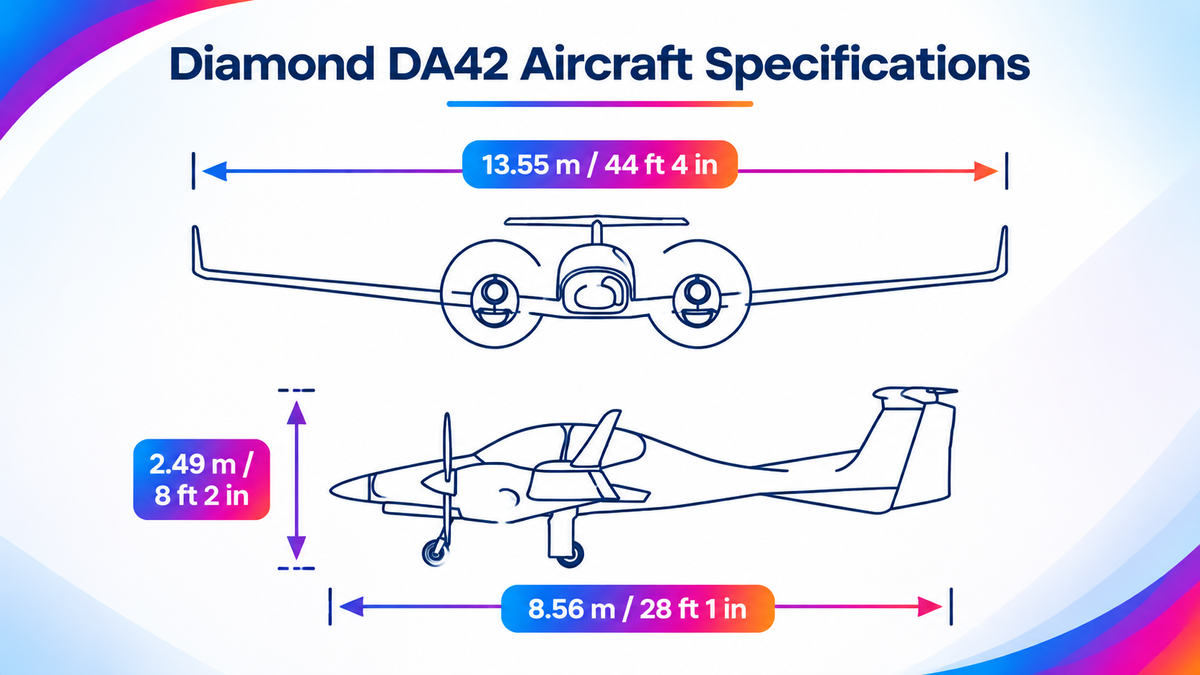
Technical diagram showing the Diamond DA42 aircraft’s dimensions, including wingspan, length, and height.
The Diamond DA42 combines two Austro AE300 diesel piston engines with a four-seat cabin, a glass cockpit, and retractable landing gear. Its specifications cover engine performance, fuel capacity, aircraft weight, cruising speed, and operating range.
The following table presents the manufacturer's published DA42 specifications.
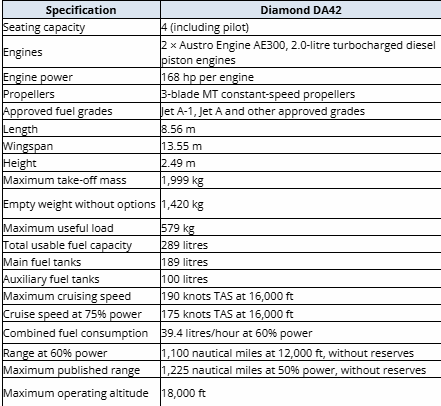
These figures represent the manufacturer's published specifications for the listed DA42 configuration.
Understanding DA42 Speed, Range, and Loading
How Fast can a DA42 Fly?
DA42's maximum cruising speed is 190 knots true airspeed (TAS) at 16,000 ft and maximum continuous power. Its published cruise speed at 75% power is 175 knots TAS at the same altitude.
True airspeed measures the aircraft's speed through the surrounding air. Actual groundspeed will vary depending on wind conditions.
How Far can a DA42 Fly?
According to Diamond's technical specifications, the DA42 has a published range of 1,100 nautical miles at 60% power and 12,000 ft, including climb and auxiliary fuel but excluding reserves.
Its maximum published range is 1,225 nautical miles at 50% power and Flight Level 180, also including climb but excluding fuel reserves. These figures represent different operating conditions and should not be treated as guaranteed flight distances.
The aircraft's published fuel consumption is 39.4 litres per hour for both engines combined at 60% power. Actual consumption varies with power settings, altitude, aircraft loading, and operating conditions.
Can Four Adults Fly a DA42 with Full Fuel?
The DA42 has four seats and a maximum useful load of 579 kg. Its total fuel capacity is 289 litres, equivalent to approximately 231 kg at the manufacturer's stated fuel mass.
After accounting for full usable fuel, approximately 348 kg remains for occupants and baggage. Actual loading must account for installed equipment, individual aircraft weight and balance, and the approved Aircraft Flight Manual (AFM).
How much Runway does a DA42 Need?
Diamond publishes the following runway performance figures for the DA42 under specified conditions:
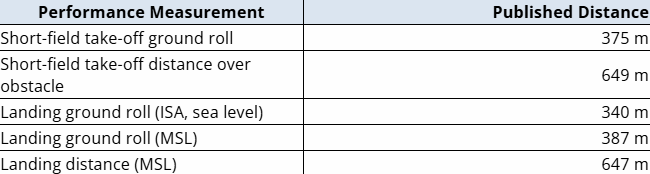
These figures are based on the manufacturer's stated conditions and procedures. Actual take-off and landing distances depend on aircraft mass, temperature, airfield elevation, wind, runway slope, and surface conditions.
Pilots should use the applicable AFM performance charts when planning a flight rather than treating published distances as universal runway requirements.
Which Features make the DA42 Useful for Pilot Training?
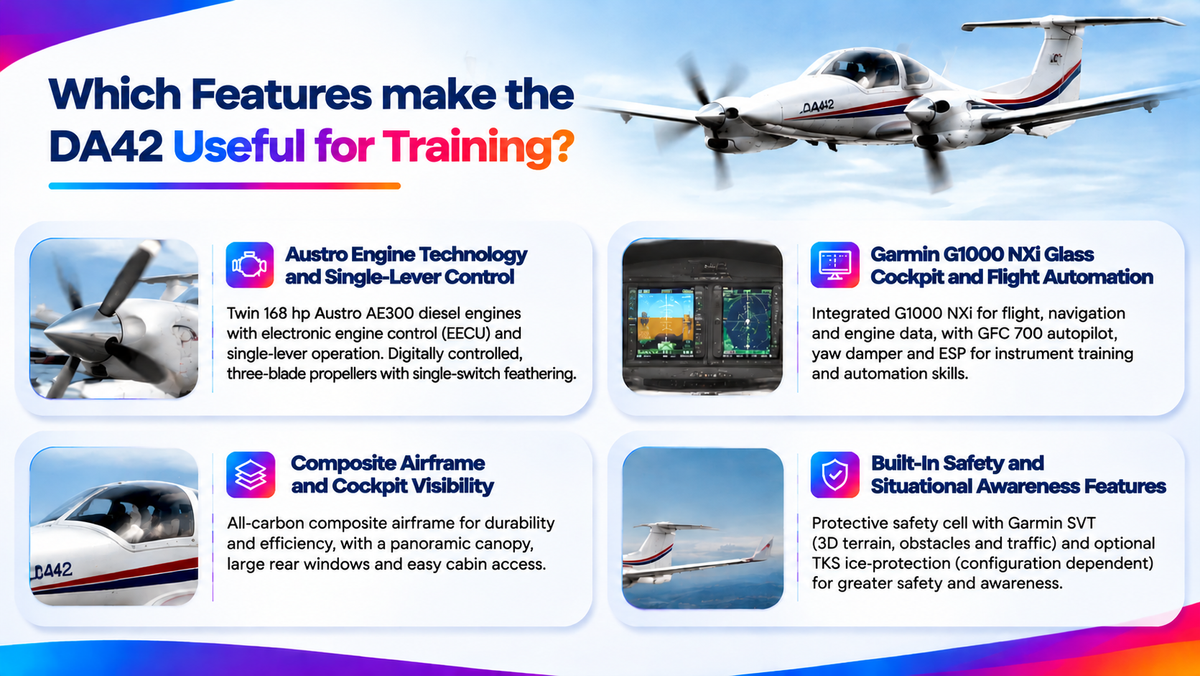
Infographic highlighting the Diamond DA42’s key training features, including diesel engines, Garmin G1000 NXi cockpit, composite airframe, and safety systems.
The DA42 combines several features that make it suitable for developing multi-engine flying skills. Its electronic engine controls, integrated glass cockpit, autopilot, and retractable landing gear give students practical experience with aircraft systems, instrument monitoring, and cockpit procedures. These features also help prepare pilots for the additional responsibilities involved in operating a twin-engine aircraft.
Austro Engine Technology and Single-Lever Control
The DA42 uses two Austro Engine AE300 diesel engines, each producing 168 hp. Each engine features a single power lever and an electronic engine control unit (EECU), which manages engine operation digitally. This eliminates the need for separate manual throttle, propeller, and mixture controls.
The three-blade MT hydraulic constant-speed propellers are also digitally controlled, with propeller feathering activated through a single switch. These features introduce students to electronic engine management, propeller control and the systems involved in operating a twin-engine aircraft.
Garmin G1000 NXi Glass Cockpit and Flight Automation
The DA42 features an integrated Garmin G1000 NXi glass cockpit, combining flight, navigation and engine information across electronic displays. Its standard equipment includes the three-axis GFC 700 Automated Flight Control System, yaw damper and Electronic Stability and Protection (ESP).
These systems help students develop instrument-scanning techniques, understand navigation information, and monitor aircraft performance. The autopilot and stability features also introduce them to flight automation and the importance of monitoring automated systems while maintaining control of the aircraft.
Composite Airframe and Cockpit Visibility
Diamond describes the DA42 as having an all-carbon composite airframe designed for durability, aerodynamic efficiency, and occupant protection. Its panoramic wraparound canopy and large rear windows provide broad visibility from the cockpit. Diamond’s training-aircraft overview explains these design features.
The forward-opening canopy and large rear door also provide convenient access to the cabin and rear seating area. These design features help students become familiar with cockpit layout, aircraft access, and the visibility considerations involved in flight operations.
Built-In Safety and Situational Awareness Features
Safety is another important part of the DA42's design. Diamond highlights its protective safety cell, composite airframe structure, and combination of active and passive safety features. The Garmin Synthetic Vision Technology (SVT), where equipped, provides a three-dimensional representation of terrain, airports, obstacles and traffic using information from the G1000 system's database.
Certain DA42 configurations also offer the TKS ice-protection system, which uses fluid to protect the wings, tail, propellers and windshield. Its availability and operating approval depend on the aircraft's installed equipment and applicable certification.
Together, these systems introduce pilots to aircraft protection features, situational awareness tools, and the importance of understanding equipment limitations during flight planning.
What do Students Learn during DA42 Training?
Training on the DA42 helps students develop the knowledge and practical skills required to operate a twin-engine aircraft. The training combines aircraft systems knowledge, multi-engine handling, instrument flying, and in-flight decision-making.
Aircraft Systems and Pre-Flight Preparation
Students learn how the DA42's engines, fuel system, electrical systems, landing gear, and avionics operate. They also study aircraft limitations, performance calculations, and pre-flight inspection procedures. This knowledge helps them understand the aircraft's operating requirements before applying them during flight exercises.
DGCA CPL syllabus and study-plan guide further explain how aircraft-specific study fits within the Commercial Pilot Licence (CPL) theory pathway overseen by India’s Directorate General of Civil Aviation (DGCA).
Multi-Engine Aircraft Handling and Performance
A major part of DA42 training involves understanding how a twin-engine aircraft behaves during normal and abnormal operations. Students develop skills in aircraft control, engine management, asymmetric thrust, and directional control. They also learn how aircraft weight, altitude, and environmental conditions affect performance, particularly when one engine becomes unavailable.
Instrument Flying and In-Flight Decision-Making
Students practise controlling the aircraft using flight instruments, following navigation procedures and conducting instrument approaches. These exercises also develop their ability to manage radio communications, checklists and multiple cockpit tasks while maintaining awareness of the aircraft's flight path.
Instructor debriefings help students review their performance, understand errors and identify areas requiring further practice. Particular attention is given to aircraft handling, procedural accuracy, situational awareness and decision-making.
Is the Diamond DA42 Safe for Pilot Training?
The Diamond DA42 incorporates several design features intended to protect occupants and support safe aircraft operations. These include a protective cabin structure and energy-absorbing seating elements designed to help reduce the effects of impact forces.
However, aircraft design alone does not determine how safely training is conducted. Regular maintenance, qualified instructors, appropriate weather assessments, adherence to operating procedures, and student proficiency all contribute to a safe training environment. Prospective students should also review the training organisation's maintenance practices, safety procedures and instructor qualifications before choosing a programme.
Can the DA42 Fly on One Engine?
A DA42 can continue flying on one engine when its performance and operating conditions permit. An engine failure does not, however, guarantee that the aircraft can maintain altitude or continue climbing.
Aircraft weight, altitude, temperature, configuration, and pilot handling all influence single-engine performance. Losing one engine also creates unequal thrust, affecting directional control as well as the power available for climbing. These are important considerations in multi-engine training.
Engine-out exercises should be conducted with a qualified instructor, following the procedures and limitations in the aircraft’s approved Aircraft Flight Manual (AFM). General guidance cannot replace the instructions for the specific aircraft.
Can the DA42 Fly in Cloud, at Night or in Icing Conditions?
Appropriately equipped and approved DA42 aircraft can fly in cloud under Instrument Flight Rules (IFR) and operate at night. These operations remain subject to the aircraft’s limitations, the pilot’s qualifications and the applicable operating requirements. EASA’s certification document identifies day, night and IFR capabilities for the DA42 family.
The DA42 is also approved for flight into known or forecast icing conditions when fitted with the approved liquid-fluid ice-protection system under Major Design Change OÄM 42-054. Pilots must follow the applicable Aircraft Flight Manual (AFM) and ice-protection supplement, including their operating limitations. This approval should not be interpreted as permission to fly in every weather condition.
How does FSTC use the DA42 in its CPL Programme?
FSTC includes the Diamond DA42 in the multi-engine component of its Commercial Pilot Licence programme with Multi-Engine and Instrument Rating (CPL+ME+IR). The course structure includes 200 hours of aircraft flying, comprising 185 single-engine hours and 15 multi-engine hours. Both the Diamond DA42 and Tecnam P2006T are listed as aircraft used for the multi-engine training.
Our guide to CPL training in India explains the wider qualification pathway, including ground school, flying training, and assessments. Progression to airline aircraft such as the Airbus A320 or Boeing 737 requires a separate aircraft-specific type rating; DA42 training does not replace that qualification. FSTC’s type-rating guide explains this next stage and its training requirements.
What does DA42 Training Cost in India?
DA42 training fees depend on the school, training purpose, and inclusions.
The Indira Gandhi Rashtriya Uran Akademi (IGRUA) mentions the following rates under its endorsement and renewal fee structure:
Training Facility Published Rate per Hour
Diamond DA42 aircraft ₹45,000
Diamond DA42 simulator ₹12,000
Applicable GST of 18% is charged separately. These are IGRUA-specific rates and not standard market prices or FSTC training fees.
What should you include in an FSTC Training Fee Enquiry?
FSTC's DA42 training allocation forms part of its broader CPL programme. Students should request an itemised quotation covering:
- Aircraft flying hours and simulator hours separately.
- Aircraft allocation between the DA42 and Tecnam P2006T.
- Instructor, briefing and assessment charges.
- Fuel, applicable taxes and airport-related charges.
- Additional flying hours and repeat assessment fees.
- Accommodation and travel expenses, where applicable.
The overall course fee should also be checked to establish which aircraft and simulator sessions are already included. This helps students understand the actual cost of their multi-engine training.
Turn Aircraft Research into a Training Decision
The right aircraft matters most when it is supported by a clear syllabus, suitable instruction, and useful feedback. Ask FSTC about its multi-engine training and request the planned aircraft allocation, hour breakdown, and complete fee inclusions before choosing your course.