
CPL Training Course in India: Eligibility, Fees, Duration & Career Guide
Becoming a commercial pilot is not simply about learning how to fly an aircraft. You must meet the educational and medical requirements prescribed by the Directorate General of Civil Aviation (DGCA), pass the required examinations, complete structured flying training and demonstrate that you can operate an aircraft safely.
A Commercial Pilot Licence, commonly called a CPL, allows you to fly professionally and receive payment for your work as a pilot. It is the main licence required by candidates who want to progress towards airline, charter, corporate or other commercial flying careers in India.
The journey to becoming a pilot usually begins after Class 12. A complete CPL training course in India normally covers DGCA ground classes, theory examinations, radio telephony preparation, single-engine flying, multi-engine flying, instrument training, simulator sessions and practical skill tests.
Here is the CPL journey in one line:
Class 12 with Physics and Mathematics → DGCA medical → Computer number → Ground school and exams → 200 hours of flying → Skill tests and radio telephony requirements → CPL issue → Type rating or airline preparation
If you're still weighing whether pilot training is the right path for you, it's worth starting with the bigger picture first. Our guide on how to become a pilot in India in 2026 walks through eligibility, realistic fee expectations, and long-term career outcomes, useful context before diving into the CPL-specific details below.
Overview of CPL course in India
CPL course Requirement Key Information
Regulatory authority Directorate General of Civil Aviation, India
Minimum age for CPL application 18 years
Educational qualification 10+2 or equivalent with Physics and Mathematics
College degree required No
Medical requirement DGCA medical fitness; Class 1 should be completed before CPL issuance
Minimum flight time 200 hours
Important theory areas Air Navigation, Aviation Meteorology, Air Regulations and Aircraft & Engines
Typical FSTC CPL duration Approximately 12–18 months
Current listed FSTC CPL fee ₹64 lakhs
FSTC course format CPL with Multi-Engine and Instrument Rating, ground school, aircraft training and simulator training
What is a CPL Training Course?
A CPL training course prepares a student to meet the knowledge, experience and skill requirements for a Commercial Pilot Licence.
The licence allows its holder to exercise commercial flying privileges, subject to the aircraft ratings, medical validity and operating conditions recorded on the licence. It is different from a Private Pilot Licence, which is primarily intended for private flying.
A CPL is an important professional qualification, but receiving the licence does not automatically make someone an airline First Officer. Airline-focused candidates may also require a Multi-Engine endorsement, Instrument Rating, aircraft type rating and successful completion of an airline’s technical, aptitude, simulator and interview assessments.
FSTC offers a CPL+ME+IR programme, which means the course is designed to include the Commercial Pilot Licence pathway along with Multi-Engine and Instrument Rating training.
What is a Commercial Pilot Licence?
A Commercial Pilot Licence is a professional pilot licence issued by DGCA. It gives its holder commercial flying privileges, subject to the aircraft ratings, medical validity and other endorsements recorded on the licence.
A CPL is different from a Private Pilot Licence (PPL). A PPL is mainly intended for private flying and does not provide the same commercial privileges. A CPL is the more suitable route for students whose long-term goal is to work as a professional pilot.
However, receiving a CPL does not automatically place a candidate inside an airline cockpit. Airline candidates may also need:
- A valid Instrument Rating.
- Multi-Engine endorsement.
- A rating for the aircraft they will operate.
- Airline aptitude and psychometric assessments.
- Simulator assessments.
- Technical and human-resource interviews.
- Employer-specific training and checks.
FSTC’s integrated CPL+ME+IR programme prepares aviation students for airline career opportunities.
CPL eligibility in India
Before joining a flying school, you must carefully satisfy the eligibility requirements. Medical or document problems discovered after paying a large training fee can delay the pilot training course and create avoidable financial pressure.
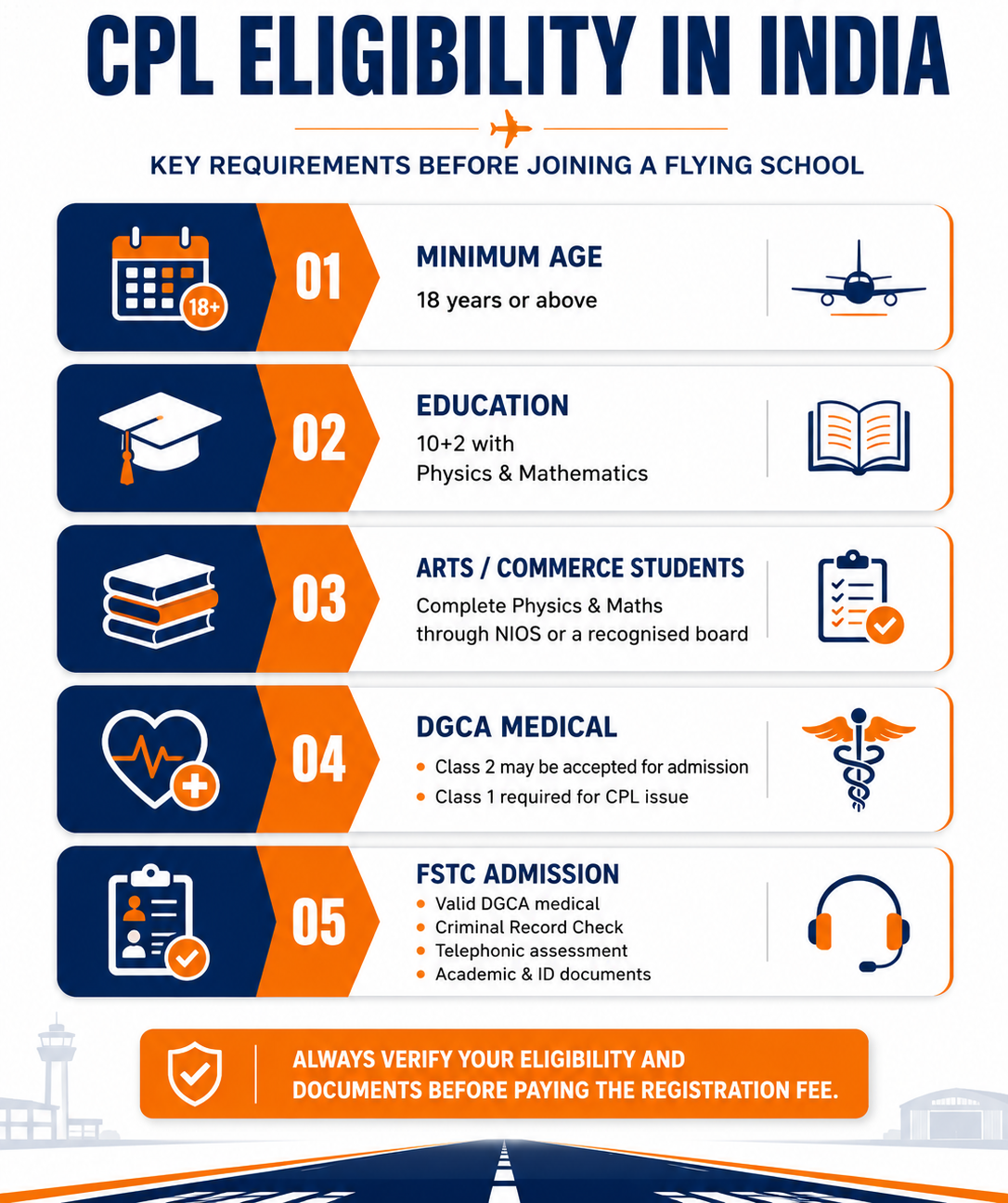
Infographic listing 5 CPL eligibility requirements in India
Minimum age for CPL
You must be at least 18 years old on the date of your CPL application.
DGCA Pariksha does not prescribe a maximum age for registering as a flight crew candidate. However, candidates must continue meeting the applicable medical standards, and individual employers may have their own recruitment conditions.
Educational qualification
A CPL applicant must have passed 10+2 or an equivalent examination with Physics and Mathematics from a recognised board or university.
A college degree is not a DGCA requirement for issuing a CPL. A graduation programme may still be useful as an additional academic qualification or backup career option, but it is separate from the licensing requirement.
Can arts or commerce students become pilots?
Students from arts or commerce backgrounds should not assume that the Physics and Mathematics rule has already been removed.
A proposal to relax the subject requirement was reported in 2025, but the current DGCA Pariksha eligibility information continues to require 10+2 Physics and Mathematics for flight crew candidates other than the PPL category. Therefore, a non-science student should complete the required subjects through the National Institute of Open Schooling (NIOS) or another recognised board or equivalent route and verify the documents with DGCA before paying a training fee.
DGCA medical fitness
Medical fitness should be one of your first steps in pilot training and not something left for later.
A Flying Training Organisation (FTO) accepts a valid Class 2 medical certificate at the time of admission. However, a valid Class 1 medical certificate is required for the issuance of a CPL.
Completing the DGCA Class 1 medical early is the safer approach for a CPL candidate.
Completing the Class 1 medical examination early is the safer approach for CPL candidates. Since pilot training involves a significant financial commitment, completing this process before intensive flight training begins can help reduce uncertainty.
DGCA revised parts of its medical assessment process with effect from 1 September 2025. Candidates should always follow the latest DGCA medical notices and use authorised medical examiners rather than relying on outdated checklists.
Additional FSTC admission requirements
FSTC’s published CPL requirements also include:
- A valid DGCA medical certificate.
- A Criminal Record Check or basic disclosure certificate.
- Successful completion of a telephonic assessment.
- Required academic and identification documents.
The admission-stage requirement and the licence-issue requirement are related but not identical. Candidates should obtain a written admission checklist for their specific batch before paying the registration amount.
How to become a commercial pilot in India
The process for obtaining a CPL involves more than filling out a flying-school application form. Candidates should complete the process in the correct order to reduce medical, documentation and financial risks.
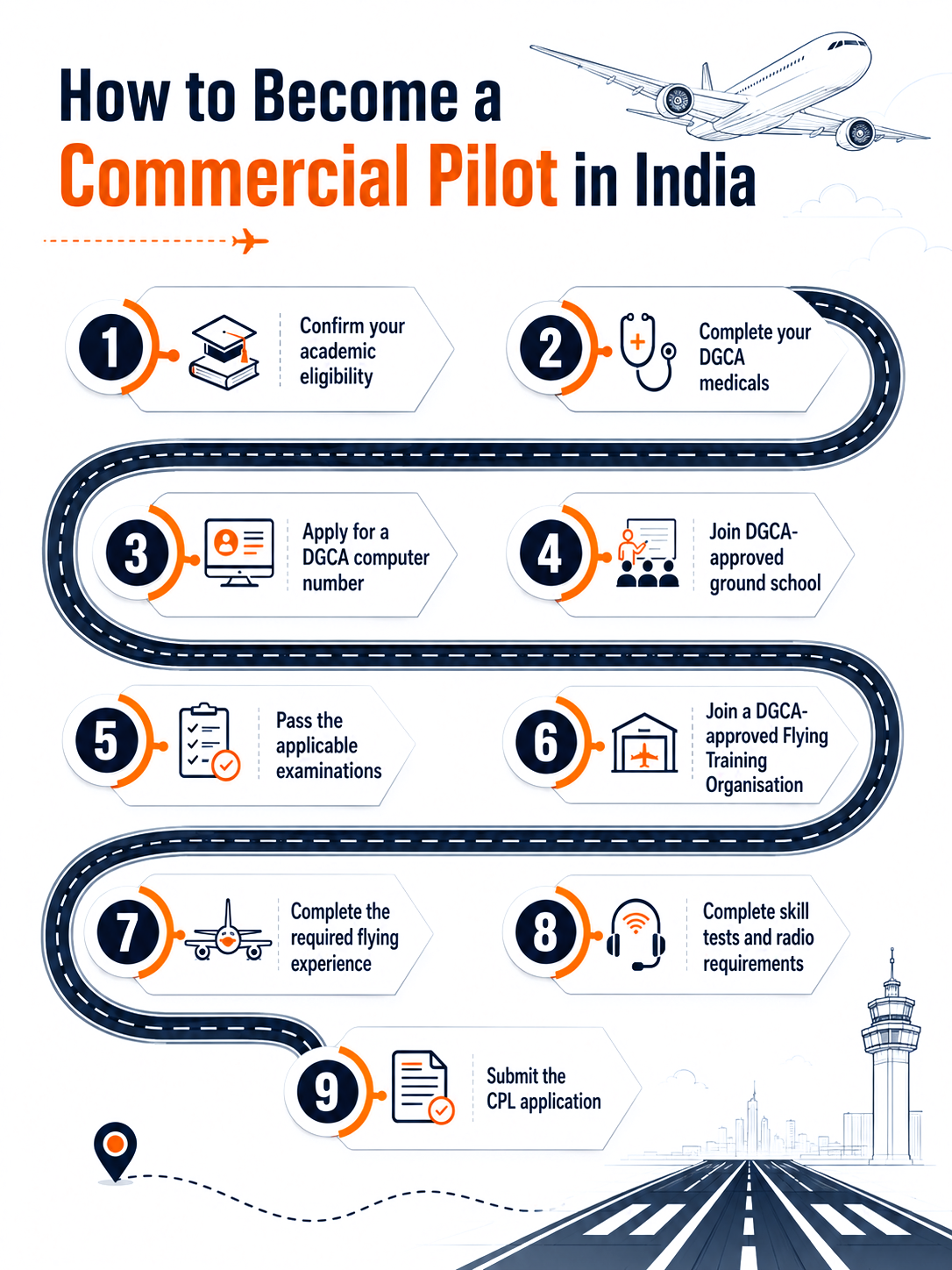
9-step roadmap infographic on how to become a commercial pilot in India, from academic eligibility to CPL application submission
Step 1: Confirm your academic eligibility
Collect your Class 10 and Class 12 certificates and confirm that Physics and Mathematics appear in your qualifying documents.
Students with an international qualification or a non-standard academic route may require equivalence or document verification. Complete this process early because document queries can affect the computer-number application and exam registration.
Step 2: Complete your DGCA medicals
Begin with the medical process before making a major payment to the best flying school in India. Medical fitness is not just an admission formality; it is a continuing part of a professional pilot’s career.
Candidates commonly begin with a DGCA Class 2 medical and then proceed to the initial Class 1 medical.
Always use a DGCA-empanelled medical examiner, evaluation centre or authorised facility. Inform the examiner honestly about your medical history, previous treatment and current medication.
Step 3: Apply for a DGCA computer number
The computer number is your permanent identification number for DGCA flight crew examinations. A candidate is authorised to hold only one computer number, and the same number is used for the relevant flight crew examination categories.
Your flying school or ground-school team may guide you with the documentation, but the information submitted remains your responsibility. Ensure that names, dates of birth and academic details match across your documents.
Step 4: Join DGCA-approved ground school
Ground school builds the theoretical foundation required before and during flight training.
DGCA’s CPL syllabus covers areas such as:
- Air Navigation.
- Aviation Meteorology.
- Air Regulations.
- Technical General.
- Aircraft-specific Technical.
- Radio Telephony.
FSTC is a leading pilot training institute for aspiring commercial pilots seeking structured and comprehensive ground-school preparation. It provides a minimum of 150 hours of ground training covering the required subjects, along with focused preparation for DGCA and Radio Telephony examinations.
FSTC provides an aviation-focused learning environment with an experienced team of instructors. Its integrated CPL training pathway helps students build the technical knowledge needed for professional flight training.
Step 5: Pass the applicable examinations
Aviation candidates must pass the required DGCA pilot exams and complete the applicable radio telephony examination and licensing process.
The current DGCA Pariksha fee for a flight crew online examination is ₹2,500 per paper. The payment is non-refundable if an application is rejected, which makes document accuracy rather important.
Candidates should verify their documents and examination category before making payment.
Step 6: Join a DGCA-approved Flying Training Organisation
A Flying Training Organisation, or FTO, provides the aircraft training required to build your flight experience.
Do not select an FTO using price alone. Compare:
- DGCA approval status and published ranking.
- Operational aircraft and serviceability.
- Student-to-aircraft and student-to-instructor access.
- Average flying frequency.
- Availability of night and instrument training.
- Multi-engine aircraft access.
- Weather and airspace conditions.
- Training records and logbook support.
- Fee inclusions and exclusions.
- Skill-test and licence-application assistance.
- Actual completion timelines—not just brochure timelines.
DGCA’s published April 2026 ranking places FSTC Flying School Pvt. Ltd. in Category B. Rankings are periodic and can change, so candidates should check the latest DGCA publication when comparing flying schools.
Step 7: Complete the required flying experience
The CPL flying requirement is more detailed than simply “complete 200 hours.” The hours must include specific categories of experience.
DGCA flying-hour requirements for CPL
Flight experience
Minimum requirement
Total flight time
200 hours
Pilot-in-Command time
100 hours
Recent PIC time
15 hours within the six months before application
Cross-country time as PIC
20 hours
Qualifying long cross-country flight
At least 300 nautical miles, with full-stop landings at two different aerodromes
Instrument time
10 hours
Instrument time permitted on an approved simulator
Up to 5 hours
Night flying
5 hours
Night take-offs and landings as PIC
At least 10 take-offs and 10 landings
These figures come from Section J of Schedule II of the Aircraft Rules. Additional training may be required for specific ratings, endorsements, proficiency or course design.
Step 8: Complete skill tests and radio requirements
A CPL applicant must demonstrate the required procedures and manoeuvres to an authorised examiner. The licensing rules also require a current flight radio telephone operator licence for operating radio telephone equipment on board an aircraft.
Radio telephony should not be treated as a last-minute formality. Clear communication, standard phraseology and situational awareness are essential cockpit skills.
Step 9: Submit the CPL application
After completing the academic, medical, examination, experience, radio and skill requirements, the candidate can submit the CPL application through the prescribed DGCA process.
Before submission, check:
- Logbook totals and signatures.
- Recency requirements.
- Skill-test documents.
- Medical validity.
- Examination results.
- Radio-telephone qualification.
- Identity and academic documents.
- Aircraft endorsement documentation.
- Applicable online records.
FSTC assists candidates with medicals, exam applications, logbooks and licence issuance documentation.
What does the FSTC CPL course include?
FSTC offers an integrated Commercial Pilot Licence programme with Multi-Engine and Instrument Rating training. The course also includes structured ground school and simulator sessions to help students build both theoretical knowledge and practical flying skills.
Training component FSTC course structure
Ground school Minimum 150 hours
Total aircraft training 200 hours
Single-engine aircraft training 185 hours
Multi-engine aircraft training 15 hours
Simulator training 20 hours
Single-engine simulator 10 hours
Multi-engine simulator 10 hours
Ratings included in course description Multi-Engine and Instrument Rating
FSTC uses aircraft such as the Cessna 172R/S, Piper Archer PA-28, Tecnam P2006T and Diamond DA42 for pilot training. Its published fleet includes the following:
- 11 Cessna 172R/S aircraft equipped with Garmin G1000 avionics,
- four Piper Archer aircraft,
- one Diamond DA42 NG and
- one Tecnam P2006T.
The aircraft assigned to each student may vary depending on the training plan, aircraft serviceability and operational availability.
CPL course fees in India
There is no single nationwide CPL fee. Cost depends on the course structure, aircraft used, fuel and operating costs, multi-engine allocation, simulator time, ground school, additional flying, taxes where applicable, accommodation and other services.
FSTC CPL course fee
FSTC’s current CPL course lists a total course fee of ₹64,00,000, payable in six stages.
Payment stage Listed amount Payment point
Registration or slot booking ₹2,00,000 At slot booking
First instalment ₹12,40,000 Within seven days of submitting documents
Second instalment ₹12,40,000 Before reporting to the flying base
Third instalment ₹12,40,000 On completing 40 flying hours
Fourth instalment ₹12,40,000 On completing 90 flying hours
Fifth instalment ₹12,40,000 On completing 120 flying hours
Total ₹64,00,000
FSTC’s CPL course fees may vary by flying base, aircraft type and multi-engine options. Candidates should therefore request the latest written fee sheet, payment schedule, cancellation conditions and list of inclusions for their intake.
Before joining a CPL course, check exactly what the quoted CPL course fees in India include. Confirm whether ground school, flight training, multi-engine hours, instrument training, simulator sessions, fuel charges, landing fees, skill tests and DGCA examination fees are covered.
You should also ask about the cost of additional flying hours, medical examinations, uniforms, study materials, accommodation, licence documentation, taxes and type rating. A detailed written fee breakdown will help you avoid unexpected expenses during training.
CPL course duration in India
FSTC’s CPL training typically takes 12–18 months to become a commercial pilot in India. This is an estimated duration, not a guaranteed completion date.
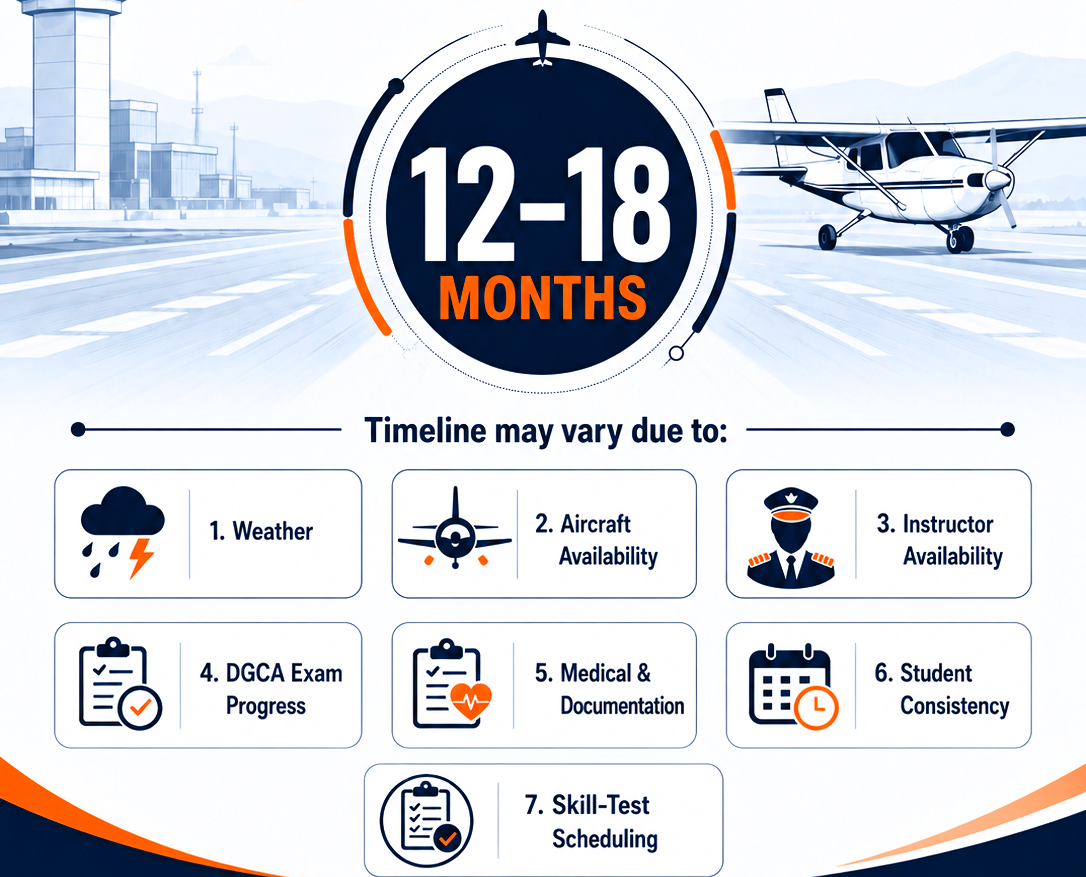
Infographic showing 12-18 month CPL training timeline in India with 7 factors affecting duration
Your actual timeline may be affected by:
Weather conditions: Poor visibility, thunderstorms, strong winds, and seasonal weather can reduce the number of safe flying days.
Aircraft availability: Aircraft require scheduled and unscheduled maintenance. A larger fleet can support continuity of training, but students should still ask about serviceability and the number of active trainees who share the aircraft.
Instructor availability: Flying regularly with suitable instructors helps students maintain continuity and reduces the need to repeat exercises after long gaps.
DGCA examination progress: Delays in clearing papers can affect later training or licensing stages. A planned ground school schedule helps students complete theory and flying in parallel where appropriate.
Medical and documentation delays: Medical reviews, document mismatches and incomplete logbooks can extend the licensing timeline even after flying is complete.
Student consistency: Flying training works best when sessions are frequent. Long breaks can affect skill retention, confidence and the number of revision flights required.
Skill-test scheduling: Aircraft, examiner and weather availability must align for practical checks. The final stage may therefore require flexibility.
How to choose the best CPL training institute in India
“Best flying school” should not mean the academy with the loudest advertisement. It should mean the organisation that fits your training needs, finances and career plan.
Check DGCA approval and ranking: Confirm the legal name of the FTO, its approval status, operating base and latest DGCA ranking. Do not rely only on screenshots forwarded in student groups.
Study the active fleet: Ask for the number of operational single-engine and multi-engine aircraft, average daily utilisation and maintenance arrangements.
FSTC’s published fleet includes Cessna 172 R/S aircraft with Garmin G1000 avionics, Piper Archers, a Diamond DA42 NG and a Tecnam P2006T.
Ask about real flying frequency: The number of aircraft on a website matters less when students cannot access regular slots. Ask how many flights a student generally receives per week and request actual recent completion data.
Compare course inclusions: A CPL-only quotation is not automatically comparable with a CPL+ME+IR programme. Check the number of multi-engine aircraft hours, simulator hours and instrument-training components.
Review the complete training pathway: Students planning to build an airline career should understand the training steps that follow a CPL. FSTC offers both CPL and aircraft type-rating programmes, creating a structured pathway from initial flight training to aircraft-specific preparation.
Its type-rating options include the Airbus A320, Boeing 737 NG, Q400 and ATR 72-600.
Speak with current students: Ask current trainees about
- Average flying frequency.
- Instructor access.
- Aircraft serviceability.
- Hostel and transport arrangements.
- Communication from the administration.
- Additional charges.
- Logbook and licensing support.
- Actual and not advertised completion timelines.
One positive testimonial is encouraging. A consistent pattern across several current students is far more useful.
Why consider FSTC for CPL training?
FSTC is one of the best DGCA-approved flying training institutes in India. It offers structured training, modern aircraft and comprehensive support to help aspiring pilots build a strong foundation for their aviation careers.
The following factors should be considered:
- FSTC’s course combines ground school, single-engine flying, multi-engine flying, Instrument Rating training and simulator sessions in one published programme.
- Students receive exposure to Cessna 172R/S and Piper Archer single-engine aircraft, along with Tecnam P2006T and Diamond DA42 multi-engine aircraft.
- The structured CPL programme provides at least 150 hours of ground training for DGCA subjects and Radio Telephony.
- The course includes 20 simulator hours divided between single-engine and multi-engine training. Simulator sessions can help students practise procedures and develop cockpit discipline in a controlled environment.
- FSTC has multiple approved flying training bases, including Bhiwani, Narnaul and Sholapur. Base allocation depends on the selected programme and slot availability. Candidates should confirm their allocated training base in writing before joining.
- FSTC supports students with medicals, examination applications, logbooks and licence-issue processes.
- Candidates who later require an aircraft type rating training can explore FSTC’s separate A320, B737 NG, Q400 and ATR 72-600 programmes.
- FSTC provides placement assistance and airline preparation to help candidates improve their readiness. However, these services should not be considered a guarantee of employment, as final selection decisions rest with the airlines.
Career options after completing CPL training
A CPL can lead to several professional flying pathways. The career opportunities after getting a CPL depend on aircraft ratings, Instrument Rating, type rating, experience, medical validity, and employer requirements.
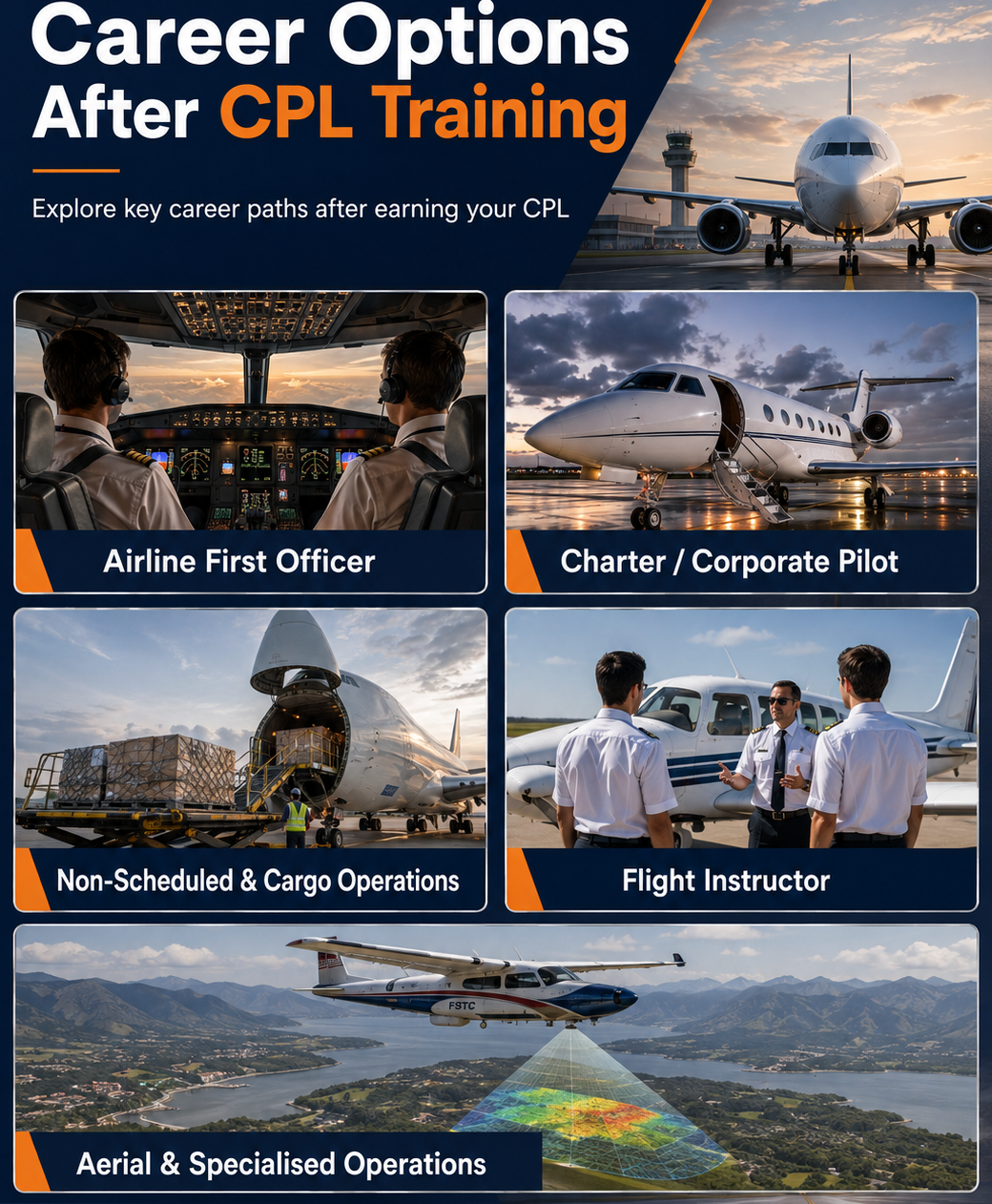
Infographic showing 5 career options after CPL training
CPL holders can explore the following career options:
Airline First Officer
Many candidates aim to become First Officers with scheduled airlines. Depending on the vacancy and airline process, the candidate may need an appropriate type rating after CPL, airline assessments, and operator training.
Charter or corporate pilot
CPL holders may pursue opportunities with charter and corporate operators, subject to aircraft ratings, experience requirements and recruitment conditions.
Non-scheduled and cargo operations
Non-scheduled operators and cargo organisations may recruit pilots for aircraft relevant to their operations. Experience and aircraft-specific requirements vary between employers.
Flight instructor
A pilot may pursue the required instructor rating and build a career training new pilots. Instruction can also help pilots develop communication, decision-making and professional flying experience.
Aerial and specialised operations
Subject to applicable approvals, aircraft ratings and employer requirements, commercial pilots may work in areas such as aerial survey, photography or other specialised operations.
What is the commercial pilot salary in India?
There is no fixed salary for every commercial pilot. A commercial pilot does not receive a fixed salary merely for holding a CPL. Income begins after the pilot secures employment at an airline.
Students should be careful with webpages promising a particular salary immediately after CPL. A new CPL holder, a type-rated trainee, an airline First Officer and an experienced Captain are at completely different career stages.
Recent crowdsourced Glassdoor data for airline First Officers in India includes many reported packages around ₹2–3 lakh per month, although the entries vary considerably by airline, location, experience, aircraft and allowance structure.
Factors affecting commercial pilot salary
A commercial pilot’s earnings depend on the following:
- Employer and type of operation.
- Aircraft type.
- Rank and experience.
- Total and aircraft-specific flight time.
- Employment contract.
- Flying, layover and other allowances.
- Current recruitment conditions.
Common mistakes students should avoid during CPL training
CPL training requires students to manage academics, flying, medical requirements, finances, weather, and documentation at the same time. Avoiding the following mistakes can help students complete their training more effectively:
- Paying before completing medical checks: Complete the required DGCA medical process as early as possible before making a major financial commitment.
- Choosing a flying school based only on fees: A low-cost programme may not be beneficial if flying is irregular or important training components are excluded.
- Ignoring multi-engine and instrument training details: Confirm how many hours are completed in an actual aircraft, how many are completed in a simulator, and which ratings or endorsements are included.
- Delaying theory examinations: Ground-school preparation should progress alongside flight training and should not become a licensing roadblock later.
- Not reading the refund policy: Review registration charges, non-refundable fees, withdrawal conditions and price-adjustment clauses before joining.
- Assuming a CPL guarantees an airline job: A CPL makes you eligible for professional flying opportunities, but airlines still conduct their own assessments, interviews and training.
- Depending on social media for regulatory advice: Refer to DGCA, DGCA Pariksha, eGCA and official academy documents for accurate information. Social media may explain a concept, but it cannot replace official aviation regulations.
Frequently asked questions about CPL Training in India
What is the minimum qualification for a CPL course in India?
You must have passed 10+2 or an equivalent examination with Physics and Mathematics from a recognised board or university.
Can I join a pilot course after Class 12?
Yes. Students can begin the DGCA CPL pathway after completing the required Class 12 qualification, medical process and admission documentation.
Can commerce or arts students apply for CPL training?
They must currently meet the 10+2 Physics and Mathematics requirement. Students who did not study these subjects in school should complete them through an accepted recognised board or equivalent route and confirm DGCA document eligibility.
Is a college degree required to become a commercial pilot?
No. The DGCA CPL education requirement is 10+2 or equivalent with Physics and Mathematics. A degree is optional, although it may provide an additional academic qualification.
What is the minimum age for a CPL in India?
You must be at least 18 years old on the date of applying for the CPL.
How many flying hours are required for CPL?
A minimum of 200 flight hours is required. These hours must include the prescribed Pilot-in-Command, cross-country, instrument and night-flying experience.
Is a type rating compulsory after CPL?
A type rating is needed to operate a specific type-rated aircraft such as an Airbus A320 or Boeing 737. It is a common next step for airline-focused candidates, but the correct timing depends on the airline vacancy, selection route and candidate’s career plan.
Start your commercial pilot career with proper guidance
A CPL training course in India requires careful planning, disciplined study, regular flying and a clear understanding of DGCA requirements.
A successful pilot career begins long before the first solo flight. It begins with accurate information, early medical planning, verified documents, disciplined ground preparation and the selection of a training organisation that can support regular, structured flying.
FSTC’s CPL+ME+IR programme combines 150 hours of ground school, 200 hours of aircraft training and 20 hours of simulator training. Students train on single-engine and multi-engine aircraft and can later explore aircraft type-rating programmes within the broader FSTC training ecosystem.
Before enrolling, speak with the FSTC admissions team, request the latest course brochure and fee sheet, confirm your medical and academic eligibility, and understand each stage from computer number to CPL issue.
Call: +91 8527698320 or +91 9289634111Email: marketing@fstcfto.in
Contact FSTC today and take the first informed step towards your professional flying career.