
DGCA CPL Exam Syllabus, Papers & Study Plan
Preparing for your Commercial Pilot Licence (CPL) can feel confusing before you have even opened a textbook. One website lists five papers, another lists six, and a question bank may divide Navigation into several separate subjects.
The standard Indian CPL training course requires preparation for five core theory papers: Air Navigation, Aviation Meteorology, Air Regulation, Technical General and Technical Specific. Radio telephony has separate examination and licensing requirements. Clearing DGCA (Directorate General of Civil Aviation) theory exam is an essential milestone, but you must also complete the other requirements for licence issue.
This guide explains the DGCA pilot exam syllabus, the distinctions that matter when choosing your papers, and how to turn a large reading list into a manageable study plan.
How Many Papers Are There in the DGCA CPL Exams?
The five core papers cover different parts of a pilot’s theoretical knowledge.
Paper Main focus
Air Navigation Planning and monitoring a flight
Aviation Meteorology Understanding weather and its implications
Air Regulation Aviation rules, procedures and human performance
Technical General Aircraft systems, engines and principles of flight
Technical Specific Knowledge of the particular aircraft type
There are exceptions to the five-paper description. A separate Technical Performance paper applies to specified aircraft categories. Foreign-licence conversion also has a different examination route. Check your category against the DGCA examination eligibility requirements before selecting papers.
This article focuses on students working towards an initial CPL on training aeroplanes.
Where does the RTR (Radio Telephony Restricted) Examination Fit in?
Radio Telephone Operator certification, commonly discussed by students as RTR(A), is separate from the five core CPL theory papers. It should have its own preparation and application plan.
DGCA began conducting the Radio Telephone Operator (Restricted) examination from the December 2025 regular session. Its official examination notice directs candidates to Pariksha for the online examination application.
When preparing for 2026, do not rely on outdated guidance that describes the entire RTR process as a WPC examination. Check the latest DGCA notices for the applicable written and practical examination requirements.
Where Can You find the Official DGCA CPL Exam Syllabus?
The official syllabus for CPL aeroplane examinations is outlined in Civil Aviation Requirements, Section 7, Series B, Part IV. You can access the DGCA CPL and Instrument Rating syllabus here.
Use this document as your primary study reference. Textbooks help you understand the material, while question banks help you practise applying it. Neither should replace the official syllabus when deciding which topics to cover.
Create a simple tracker with four columns:
- Syllabus topic.
- Corresponding textbook chapter or lesson.
- Practice completed.
- Doubts or mistakes still unresolved.
A chapter is not finished simply because you have read it. Mark it complete when you can explain the concept and answer unfamiliar questions without referring to the solution.
What to Study for Each DGCA CPL Theory Paper
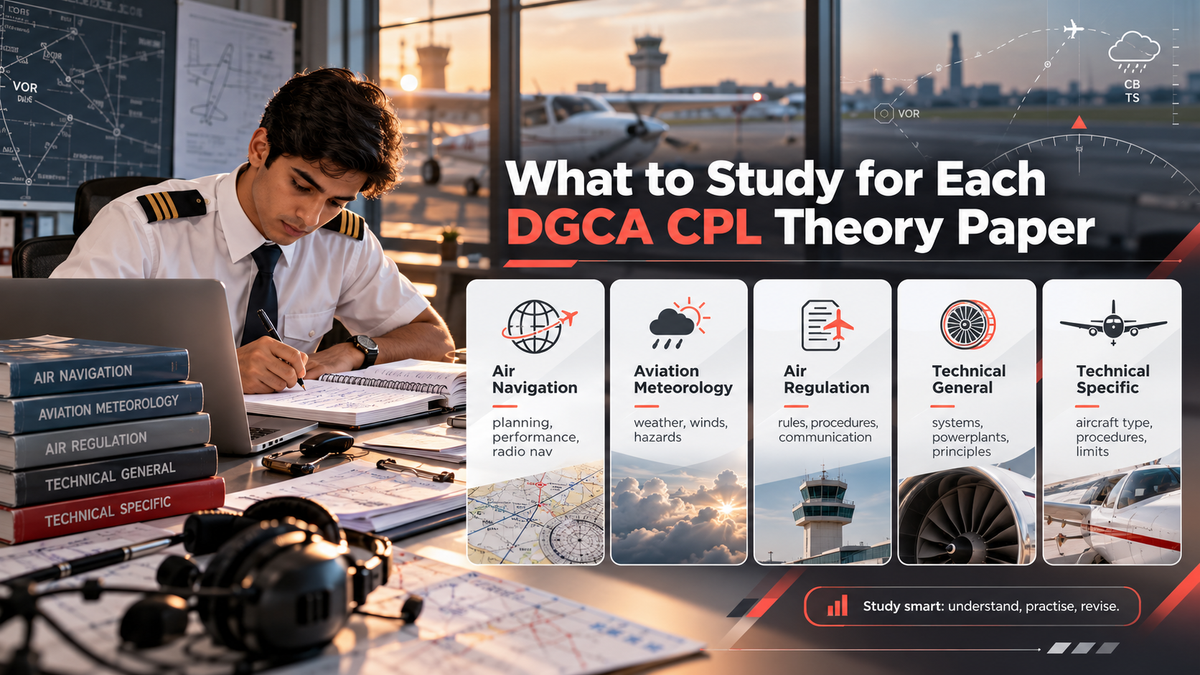
Student pilot studying, with the five DGCA CPL theory papers and their key topics
The DGCA CPL theory examinations cover several areas of aviation knowledge, from navigation calculations and weather interpretation to aviation regulations and aircraft systems. Understanding what each subject involves can help you organise your study plan, choose the right learning resources and identify topics that need more practice.
The following breakdown explains the key areas covered in each paper and offers practical study techniques to help you prepare more effectively.
Air Navigation
Navigation includes general navigation, mass and balance, aircraft performance, flight planning, radio navigation and instrumentation.
It is therefore broader than plotting a route or solving time-and-distance questions.
How to study it: Work through calculations on paper and record units at every step. When an answer is wrong, identify whether the problem was the method, unit conversion, diagram or arithmetic.
For example, before calculating a flight time, estimate whether the answer should be closer to minutes or hours. A rough estimate helps you catch an incorrect calculator entry.
Do not postpone radio aids and instruments until the final revision week merely because your main textbook places them in another volume.
Aviation Meteorology
Meteorology covers the atmosphere, pressure, wind, clouds, fronts, Indian seasonal weather, flight hazards and aviation weather information.
How to study it: Connect each phenomenon to its cause and consequences. Build explanations around questions such as: What conditions produce it? How would you recognise it? Why could it matter to a flight?
Practise interpreting aviation weather reports alongside your theoretical studies. Knowing what an abbreviation stands for is useful, but you should also understand the weather conditions the report describes and their potential implications for a flight.
Air Regulation
This syllabus extends beyond aviation law. It also includes human performance and limitations, operational procedures and communications.
How to study it: Organise notes by situations, such as preparing for departure, operating in controlled airspace or responding to an emergency.
When studying regulations that contain numerical limits, record the conditions under which each limit applies. Memorising a figure without understanding its context can lead to incorrect answers.
Check for relevant amendments as you study. An older syllabus document may remain applicable even when the legislation or procedures it references have changed.
Technical General
Technical General covers airframes, systems, electrics, powerplants, emergency equipment and principles of flight.
How to study it: Draw systems rather than copying long descriptions. Trace the path of fuel or electrical power, then explain what changes when a component fails.
Use a three-question approach:
- What does the component do?
- What indication would suggest a problem?
- How would that problem affect the system?
This develops understanding that remains useful when you move from ground school to aircraft training.
Technical Specific
Technical Specific concerns the selected aircraft and its systems.
How to study it: Confirm the exact aircraft type with your training organisation before booking the paper or buying study material. Use the applicable aircraft manual and approved training references.
Separate limitations, normal procedures, emergency procedures and performance information in your notes. Do not combine figures from different variants simply because they share a familiar aircraft name.
The subject coverage above follows the DGCA CPL syllabus; the study methods are practical preparation suggestions.
DGCA CPL Exam Pattern and Passing Marks
The core theory papers use objective, multiple-choice questions. You need at least 70% in each subject. A high score in one paper cannot compensate for a failed result in another.
The examination requirements also place CPL theory completion within the five years immediately preceding the licence application. Plan your examinations alongside flying training and documentation, rather than treating theory passes as having unlimited validity. These provisions appear in CAR Section 7, Series B, Part I.
Check the instructions applicable to your sitting for paper duration, permitted equipment and marking arrangements. Do not assume that every paper has the same question count or time allowance.
For example, the 2026 examination instructions allow specified navigation computers and calculators for particular papers. That does not mean any calculator is acceptable in every examination.
What Should You Complete Before Booking a DGCA CPL Exam?
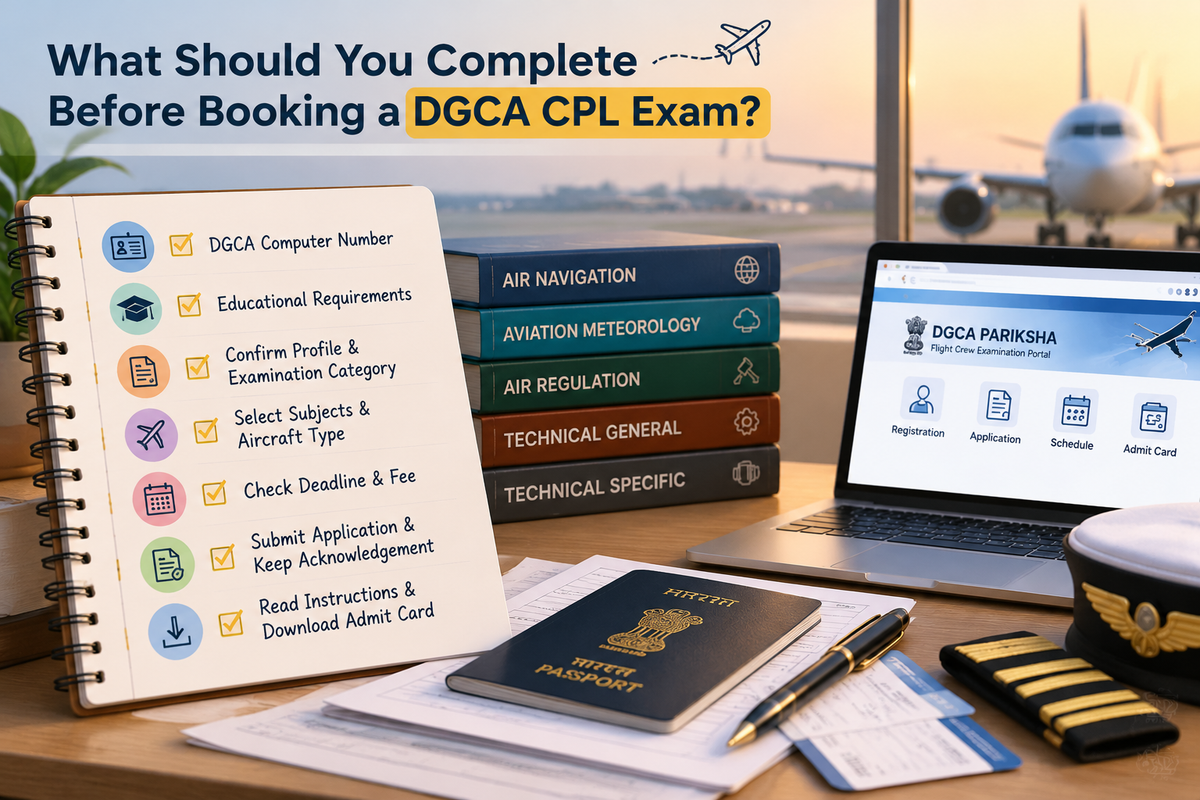
Checklist of steps to complete before booking a DGCA CPL exam, shown with the DGCA Pariksha portal
Begin the administrative work while you study. Leaving it until you feel fully prepared can mean missing an application window.
You need a DGCA Computer Number, your permanent examination identifier. This is different from your eGCA account. CPL candidates must also meet the applicable educational requirements, including recognised 10+2 Physics and Mathematics or an accepted equivalent. The Pariksha Flight Crew FAQs explain these fundamentals.
Use the latest Flight Crew User Manual for the registration process. DGCA announced an updated manual in September 2026, and eligible applicants can now use a DigiLocker-based Computer Number registration route.
Before submitting an examination application:
- Confirm your profile and examination category.
- Select the correct subjects and aircraft type where applicable.
- Check the application deadline and fee shown.
- Complete submission and retain the acknowledgement.
- Read the session instructions and download your admit card when available.
The 2026 examination calendar includes regular and online on-demand sessions. Dates are tentative, so check the current notice board before arranging travel.
Which DGCA CPL Theory Paper Should You Study First?
There is no single preparation order that suits everyone. A useful approach is to start Navigation practice early while choosing one other subject for concentrated study.
If calculations take you longer, give Navigation short, frequent sessions. If you struggle with aircraft systems, introduce Technical General early enough to work through diagrams and questions with an instructor.
Keep Technical Specific aligned with your confirmed aircraft type.
The papers you begin studying first do not have to be the papers you attempt first. Choose an examination based on readiness and availability, rather than a subject’s reputation for being “easy”.
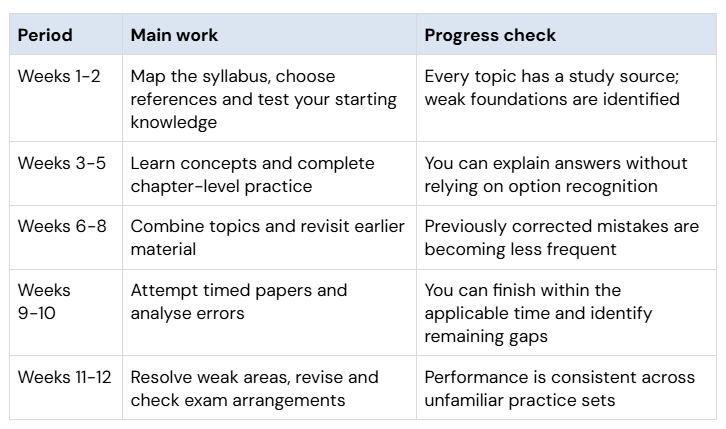
12-Week DGCA CPL Exam Study Schedule for Pilot Aspirants
The following is an illustrative preparation cycle for a selected group of papers, not a promise to clear all CPL requirements in three months.
Start with one primary subject and one supporting subject. Add another only if you have enough time and your progress supports it.
How to Structure Your Daily DGCA CPL Study Schedule
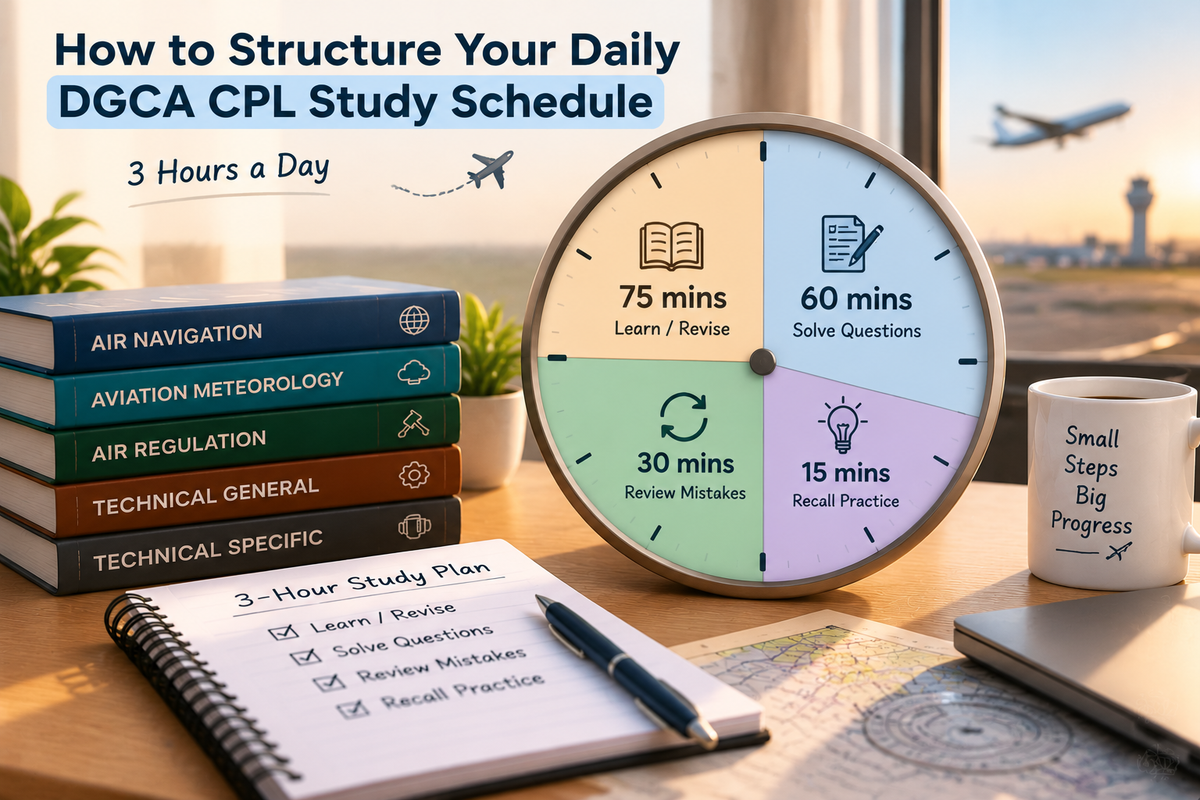
Three-hour daily DGCA CPL study schedule split into learning, practice questions, mistake review and recall
If you can dedicate three hours a day to DGCA CPL exam preparation, divide your time between learning, practising questions and reviewing previous topics.
- 75 minutes: Learn a new topic or revise previously covered material.
- 60 minutes: Solve practice questions independently.
- 30 minutes: Review mistakes and revisit earlier topics.
- 15 minutes: Test your recall without referring to your notes.
Following this schedule for six days a week gives you 18 hours of study per week. If you have less time available, extend your preparation timeline rather than cutting out revision.
If you are starting from scratch late in 2026, your study plan may extend into 2027. Avoid rushing through the syllabus simply to attempt every paper before the end of the year. Consistent preparation and a strong understanding of each subject are more valuable than an arbitrary deadline.
How to Review DGCA CPL Mock Tests Properly
Your mock test score is only the starting point. The real value comes from understanding why you lost marks and correcting those mistakes before your next attempt.
Classify each mistake and decide how to address it.
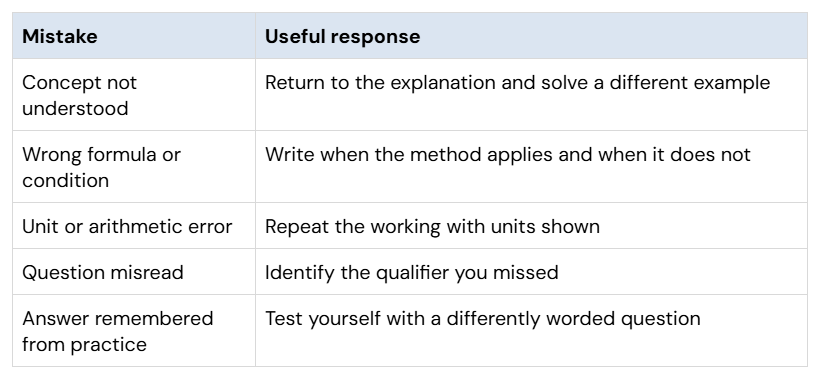
Also review questions you answered correctly by guessing. These can reveal knowledge gaps that your overall score may not show.
As a personal readiness target, aim to score comfortably above the official pass mark across several unfamiliar, timed mock tests. This is a study recommendation and not an additional DGCA requirement or a guarantee of passing.
Which Books and Study Materials Are Best for DGCA CPL Exam Preparation?
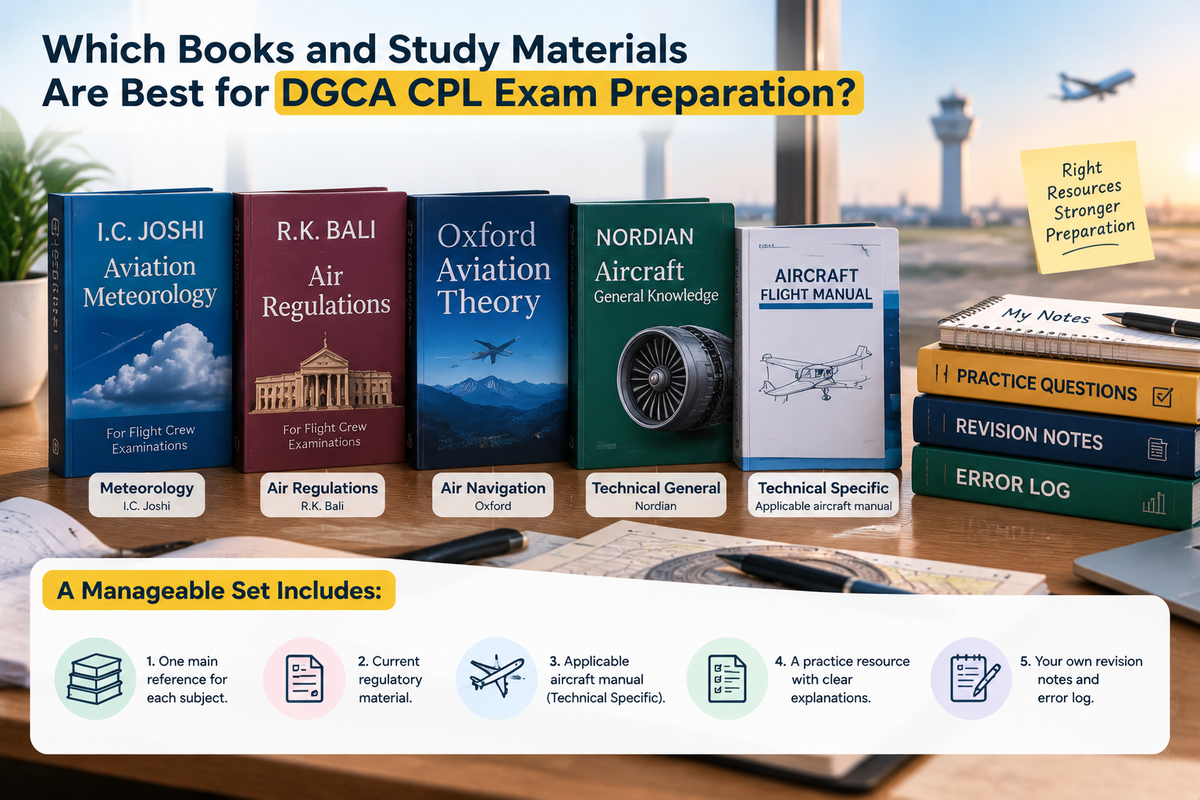
Recommended books for DGCA CPL preparation, including meteorology, air regulations, navigation and technical subjects
Start with the DGCA reference-book list for Flight Crew examinations.
It includes references such as I.C. Joshi for Meteorology, R.K. Bali for Air Regulations, and Oxford, Nordian and other texts across subjects. The list directs candidates to study the relevant topics for their licence category.
You do not need to buy every listed book. A manageable set is:
- One main reference for each subject.
- Current regulatory material.
- The applicable aircraft manual for Technical Specific.
- A practice resource with clear explanations.
- Your own revision notes and error log.
A large folder of downloaded questions is not a study plan. Choose resources you can work through, check and revise.
Plan Your DGCA CPL Ground School Training With FSTC
FSTC’s CPL programme with multi-engine and instrument training includes ground school covering the principal DGCA subjects and radio telephony.
Before enrolling, discuss the teaching schedule, aircraft-specific preparation and how examinations fit around flying. A useful plan should account for your starting knowledge and available time.
Contact FSTC’s admissions team to discuss a ground-school and CPL training pathway suited to your preparation needs.
Phone: +91 85276 98320 or +91 92896 34111
Email: marketing@fstcfto.in and info@fstc.in
Frequently Asked Questions
Can I Prepare Through Self-Study?
Self-study can support your preparation, particularly if you can organise the syllabus and resolve doubts reliably. Structured ground school may help when you need explanations, accountability and feedback. Exam preparation does not replace any training required for licence issue.
Is Navigation Just a Maths Paper?
No. Calculations are important, but the subject also includes radio navigation, instrumentation and flight-planning knowledge. Studying only numerical question banks leaves substantial gaps.
Can I Prepare While Flying?
You can organise theory study alongside training, but protect time for both. Discuss the sequence with your school, especially where examination passes affect progression. Avoid a timetable that leaves you arriving for flight lessons tired or unprepared.