
What is ATPL in India? Requirements and Course Fees (2027)
An Airline Transport Pilot’s Licence, or ATPL, is the licence needed for command of multi-pilot commercial transport aeroplanes in India, alongside the required ratings and command training.
The main eligibility and licensing requirements for an Indian ATPL (Aeroplane) include:
- Applicants must be at least 21 years old.
- Candidates must have completed Class 12 with Physics and Mathematics, or hold a recognised equivalent qualification.
- Must hold a Commercial Pilot Licence (CPL), subject to applicable provisions.
- Should have at least 1,500 hours of qualifying aeroplane flight time.
- Applicants must hold a valid Class 1 medical certificate.
- Must have a current instrument rating on multi-engine aircraft.
- Applicants must hold a valid Flight Radio Telephone Operator's Licence.
- Candidates must meet the minimum ICAO English Language Proficiency Level 4 requirement.
- Applicants must pass the applicable DGCA examinations and meet the prescribed skill-test requirements.
The cost of ATPL training depends on your current qualifications, flying experience, and career goals. The approximate costs for different pilot-training pathways are:
- ATPL Ground Classes: ₹50,000–₹1.50 lakh, depending on the institute, course duration, and examination preparation included.
- CPL Training After Class 12: A student starting after Class 12 must first complete the CPL training pathway. Approximately ₹55–₹65 lakh for the initial commercial pilot training in India, excluding additional expenses such as accommodation, medical examinations, and type rating.
- European ATPL Conversion: Approximately €6,500 (around ₹6–₹7 lakh). Medical examination fees and other excluded expenses may apply.
What is ATPL, and how is it different from CPL?
An Airline Transport Pilot Licence (ATPL) is the highest category of professional pilot licence issued by India's Directorate General of Civil Aviation (DGCA). It qualifies pilots to serve as Pilot-in-Command of multi-pilot commercial transport aircraft, subject to the required ratings, experience, and operational qualifications.
A Commercial Pilot Licence (CPL) allows pilots to undertake commercial flying within the privileges of their licence and ratings. Qualified CPL holders can work as airline First Officers after meeting the airline's recruitment and training requirements. An ATPL provides the licensing qualification required for progressing to command positions on multi-pilot aircraft.
The main differences between these qualifications are the following:
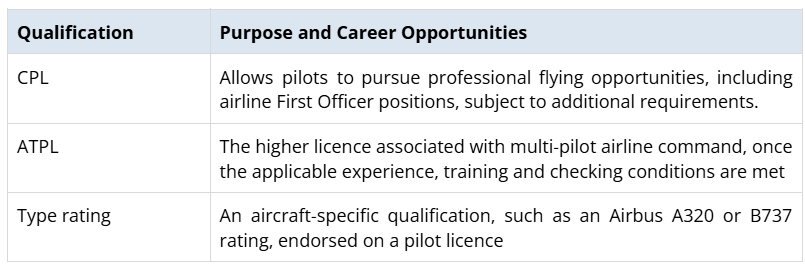
An ATPL and a type rating serve different purposes. Passing ATPL examinations does not automatically add an aircraft type rating to your licence, and completing a type rating does not automatically grant an ATPL. Our guide to type rating in India explains that separate training stage.
What are the ATPL Requirements in India for 2027?
The aeroplane requirements appear in the First Schedule, Section L of the new rules. Helicopter ATPL requirements are separate.
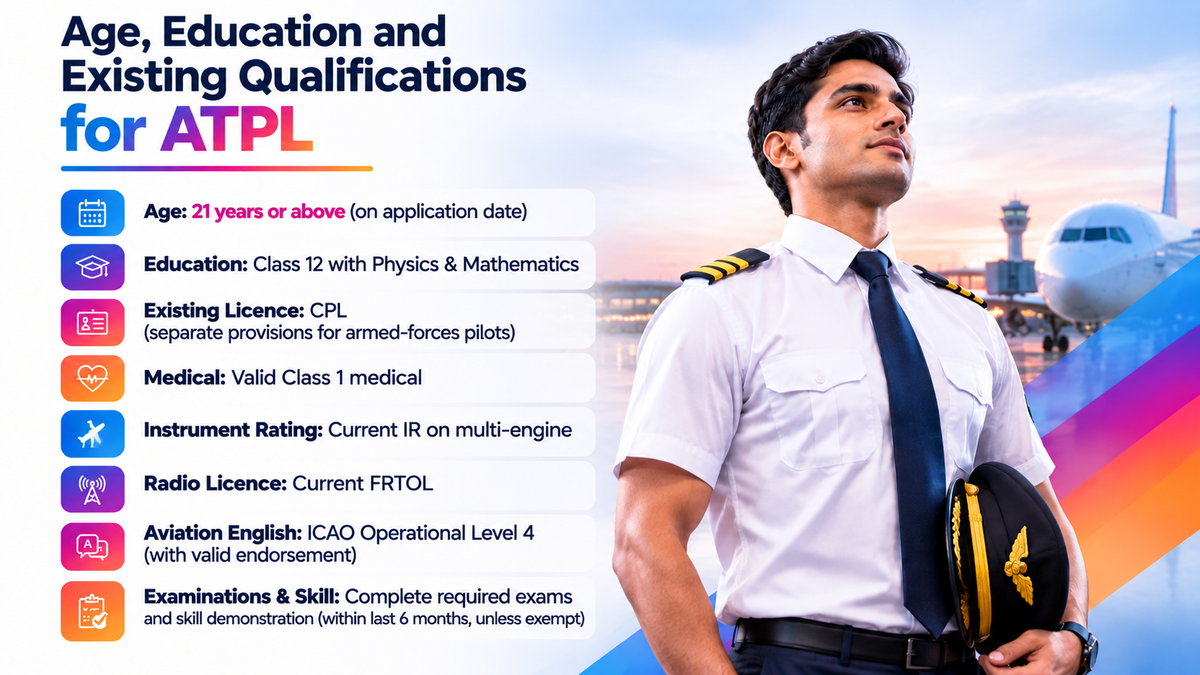
ATPL eligibility requirements in India with a pilot at an airport
Age, Education and Existing Qualifications for ATPL
The standard civilian applicant needs:
Age: At least 21 on the date of the ATPL application.
Education: Class 12 with Physics and Mathematics, or a recognised equivalent.
Existing licence: A CPL. Separate provisions apply to eligible armed-forces pilots.
Medical fitness: The required current Class 1 medical fitness documentation.
Instrument qualification: A current instrument rating on multi-engine aircraft.
Radio qualification: A current Flight Radio Telephone Operator’s Licence.
Aviation English: At least International Civil Aviation Organization (ICAO) Operational Level 4, with a valid language-proficiency endorsement.
Knowledge and skill: The applicable examinations and skill requirements. Required skill demonstrations fall within the six months before application, unless a specified exemption applies.
A university degree is not a mandatory qualification for an ATPL in India. However, individual airlines and training providers may have additional educational or selection requirements.
Medical fitness needs attention throughout your professional flying career and not only before your first flying lesson. DGCA Class 1 medical guide explains the assessment process and the distinction between medical validity and assessment schedules.
English proficiency validity needs its own diary entry. The minimum standard comes from DGCA’s aviation English requirements; our AELP renewal guide explains the renewal process and what to do before an endorsement expires.
How many Flying Hours are required for ATPL?
The notified 2027 rules require at least 1,500 hours as a pilot of aeroplanes, with the following experience within that total:
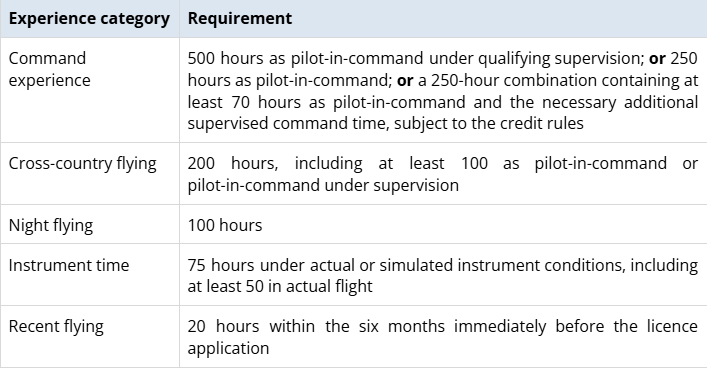
These flying-hour requirements can overlap. For example, a qualifying night cross-country flight may count towards both night flying and cross-country experience. Therefore, the individual categories should not be added separately to the minimum 1,500 hours. The detailed provisions are on page 440 of the official Gazette.
Why your Logbook Total may differ from your ATPL Total
Not every flying hour recorded in your logbook automatically counts in full towards ATPL requirements. Under DGCA rules, ordinary co-pilot flying time on aircraft requiring more than one pilot may receive a maximum of 50% credit towards the total flight-hour requirement.
Pilot-in-Command Under Supervision (PICUS) hours follow separate credit rules. They may receive full credit towards total flying experience, subject to the prescribed conditions, but are subject to limits when calculating Pilot-in-Command experience.
PICUS hours must be completed under the supervision of a suitably qualified check pilot and properly recorded. Simply handling the aircraft controls during a flight does not automatically qualify the time as PICUS.
Have your experience assessed against the applicable DGCA provisions before paying for additional hours or fixing an application date. Simulator hours must also meet the specific credit conditions for the requirement they are intended to fulfil.
Which DGCA ATPL Exams do you need to pass?
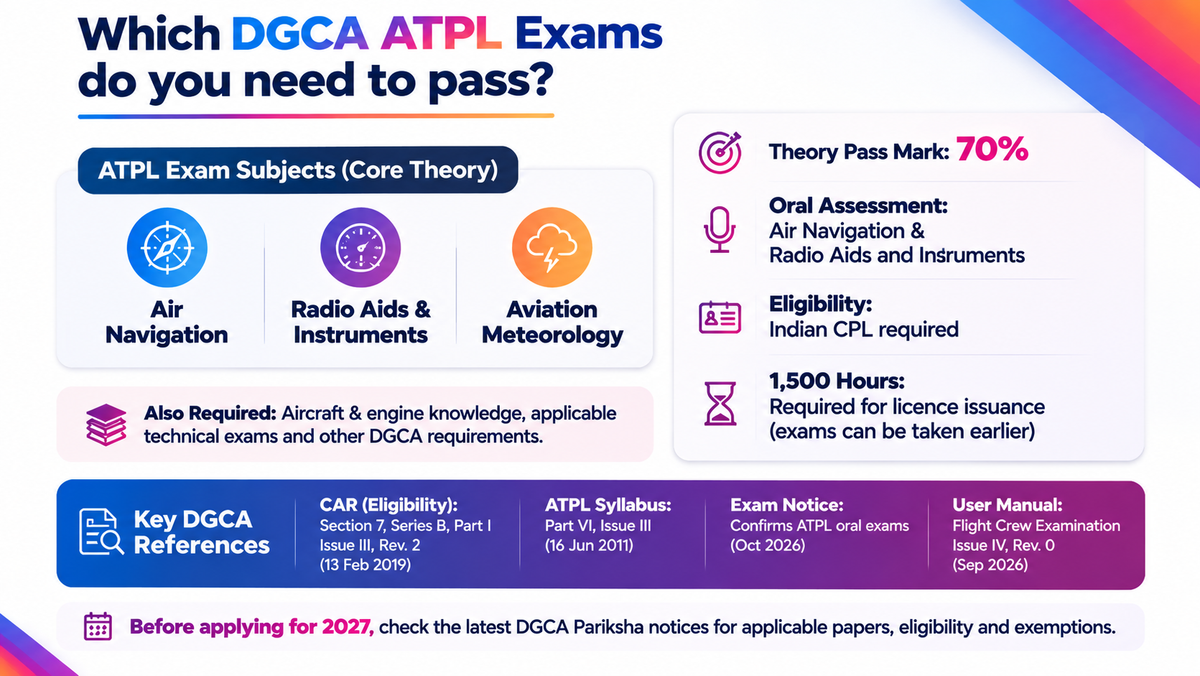
DGCA ATPL exam subjects, 70% pass mark and eligibility infographic
ATPL ground-school packages commonly concentrate on three general subjects:
- Air Navigation: Advanced navigation, planning and flight calculations.
- Radio Aids and Instruments: Navigation aids, instrument systems, and their operational use.
- Aviation Meteorology: Weather knowledge and its application to flight operations.
The complete licensing requirement is broader than a three-subject coaching package. Aircraft and engine knowledge, applicable technical examinations, and other prescribed requirements must also be satisfied. Current CPL holders receive the Air Regulations exemption stated in the new rules.
The theory pass mark is 70%, with oral assessments in Air Navigation and Radio Aids and Instruments. DGCA’s current CAR index lists the examination eligibility CAR, Section 7, Series B, Part I, at Issue III, Revision 2, dated 13 February 2019. The aeroplane ATPL syllabus is listed separately under Part VI, Issue III, dated 16 June 2011, with no revisions listed.
DGCA’s October 2026 examination notice confirms continuing ATPL oral examinations. Application procedures appear in the Flight Crew Examination User Manual, Issue IV, Revision 0, September 2026. The manual and session notices serve a different purpose from the CAR, so check all applicable instructions before applying.
Standard civilian applicants need an Indian CPL to enter the ATPL examination category. The 1,500-hour threshold concerns licence issuance, so eligible CPL holders can prepare and take examinations before reaching that total.
Check the current DGCA Pariksha notices before booking a 2027 sitting. Your applicable papers depend on your licence, aircraft category, existing passes, and exemptions.
What does Frozen ATPL mean in India?
A Frozen ATPL refers to a pilot who has passed the required ATPL theory examinations but has not yet completed all the flying experience and licensing requirements for a full ATPL.
It is an informal industry term, not a separate DGCA-issued licence. Until the full ATPL is issued, the pilot continues to hold their existing licence, usually a CPL.
Passing ATPL theory examinations alone does not grant Captain privileges, replace the required flying hours, or guarantee airline employment.
Integrated or Modular ATPL: What is the Difference?
An integrated ATPL programme combines multiple stages of pilot training into one structured course. A modular programme allows students to complete different stages separately, at their own pace.
Both pathways must meet the applicable DGCA licensing requirements. The difference lies in how the training is organised and not in the requirements for obtaining the licence.
Before enrolling, check what the programme actually includes:
- Training Stages: Does the package include ground classes, CPL training, ratings, and ATPL examination preparation?
- Flying Experience: Does it include opportunities to build the required flying hours?
- Career Pathway: Does it offer flight instructor training or other employment opportunities for gaining experience?
- Licensing Authority: Will you receive an Indian DGCA licence or a licence issued by another aviation authority?
- Fees and Conditions: What are the payment terms, selection requirements, refund policies, and exit conditions?
Some programmes advertised as "Zero to ATPL" cover only the initial training and examination stages, while others include additional experience-building opportunities. Completing a course does not automatically guarantee a full ATPL or an airline job.
What are ATPL Course Fees in India for 2027?
There is no single ATPL course fee that covers every applicant. Published Indian ground-school examples reviewed list ₹50,000 and ₹1.50 lakh, but these are coaching prices with different inclusions. They do not represent the total cost of obtaining an ATPL or a verified market-wide fee range.
Published ATPL Ground-School Fee Examples
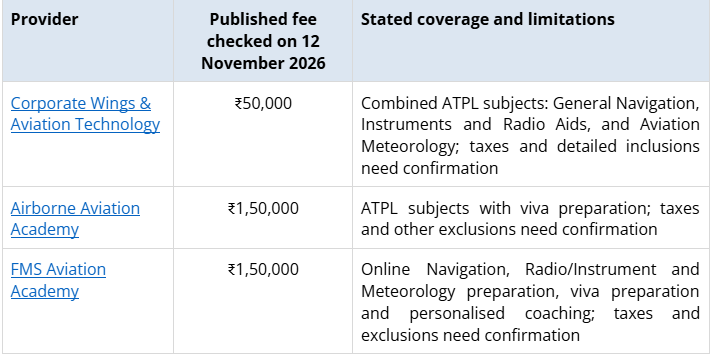
Compare the subjects, teaching format, access period, and viva preparation before deciding which price meets your needs.
DGCA ATPL Examination and Licence Charges
The DGCA charges separate fees for ATPL examinations and licence issuance. Under the notified fee schedule, the applicable charges include:
- Regular Online Examination: ₹2,500 per paper.
- Online On-Demand Examination: ₹5,000 per paper.
- ATPL Licence Issuance: ₹5,000.
The September 2026 examination manual also lists ₹500 per oral paper for the second and third ATPL oral examination attempts. Applicants should confirm the fee and availability for their particular attempt when applying.
For example, appearing in three regular online examination papers once would cost ₹7,500 in total. This excludes oral examinations, repeat attempts, licence issuance, private coaching and other training expenses.
These are government charges, separate from private ATPL ground-school fees. If a training provider quotes several lakh rupees for an "ATPL examination and upgrade package", ask for an itemised breakdown of tuition, simulator sessions, additional flying, and DGCA charges.
The complete fee schedule is available under Rule 120 of the Bharatiya Vayuyan Niyam, 2026.
What other expenses should you include in your ATPL Budget?
Apart from ground-school fees and DGCA examination charges, your total ATPL budget may include several additional expenses. Request an itemised quotation covering:
- Tuition, study material, question-bank access and oral examination preparation.
- Taxes, repeat classes and course-extension charges.
- Any required flying, simulator sessions, skill tests and examiner charges.
- Medicals, document processing, travel and accommodation.
- Any type-rating or conversion training that is outside the course.
The total cost also depends on your existing flying experience. A CPL holder who has already completed the required ATPL flying hours may only need examination preparation and licence-related expenses. A pilot with a flying-hour shortfall may need additional experience-building and training.
A fixed “complete ATPL cost” is unreliable unless it is based on your actual licence and logbook.
Do you have to pay for all 1,500 Flying Hours?
No. You do not necessarily have to pay for all 1,500 flying hours yourself. After obtaining the required licence and ratings, pilots can build qualifying flying experience through employment. Working as an airline First Officer is one possible route, while becoming a flight instructor requires a separate instructor qualification and an appropriate appointment.
The useful question is how much creditable experience you still need, in which categories, and how you will gain it. Multiplying 1,500 by an aircraft rental rate does not produce a meaningful ATPL budget for every pilot.
Review your experience first, then price any genuine shortfall.
Can you start an ATPL Course after Class 12?
You can start planning your professional pilot pathway after Class 12, but you cannot move directly from school to an issued Indian ATPL through a short theory course.
The standard civilian route starts with CPL training. You then develop the qualifications and experience needed for your intended flying work, while planning ATPL examinations at a suitable stage.
FSTC’s Commercial Pilot Licence programme is relevant to this starting stage. Its CPL examination syllabus and study-plan guide explain the earlier theory preparation.
How long does it take to get an ATPL?
Ground-school duration and licence completion are different timelines. A provider may schedule theory classes over weeks or months, while your eligibility depends on experience, examinations, current documents, and any required checks.
Start by identifying the requirement that will take you the longest to complete.
An experienced first officer may need examination preparation and a document review. A newly qualified CPL holder still needs a realistic experience-building pathway. Those candidates should not receive the same completion estimate.
The new rules place the relevant ATPL examinations within the five years immediately preceding the licence application. Passing papers very early can create avoidable retakes if your experience takes longer to build.
Oral re-attempts have a shorter limit. The examination CAR allows two additional attempts after a failed first oral, within two years of the relevant theory result. Failing all three oral attempts requires a fresh theory examination in that subject, even if those two years have not elapsed.
How do you apply for an Indian ATPL?
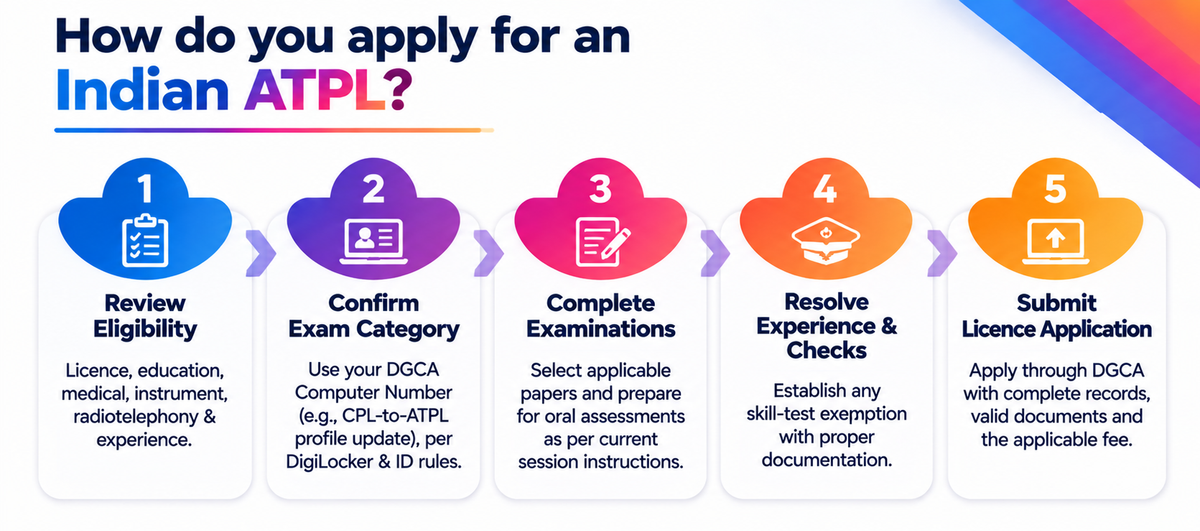
Five-step process to apply for an Indian ATPL
Pilots can begin preparing their ATPL application while completing the required flying hours and examinations. The process generally involves the following steps:
- Review your eligibility. Check your licence, education, medical, instrument, and radiotelephony documents, along with the creditable experience breakdown.
- Confirm your examination category. Use your existing DGCA Computer Number. Eligible Indian licence holders can use the CPL-to-ATPL profile update process, subject to the stated DigiLocker and identity conditions.
- Complete the applicable examinations. Select papers and prepare for oral assessments according to your category and the current session instructions.
- Resolve experience and checking requirements. Establish any skill-test exemption properly rather than assuming it applies.
- Submit the licence application. Follow DGCA’s current licensing process with complete records, valid supporting documents, and the applicable fee.
Updating your DGCA examination profile does not upgrade your CPL to an ATPL. The full licence is issued separately after DGCA verifies that all applicable licensing requirements have been fulfilled.
Does FSTC offer an ATPL Conversion Programme?
Yes, FSTC provides an EASA ATPL conversion programme for existing ICAO ATPL holders with a multi-pilot type rating and at least 500 hours on type. EASA is the European Union Aviation Safety Agency; this pathway concerns conversion to the European licensing framework.
The published programme fee is €6,500 (approximately ₹6.76 lakh) and includes an English Language Proficiency check and simulator skill check at FSTC India. EASA Class 1 medical fees are excluded.
This conversion price does not describe beginner training or a standalone DGCA ATPL ground-school course. Confirm your eligibility and the complete conversion scope before comparing it with Indian theory-coaching fees.
Match your training to your next flying role
Your next course should address the qualification you actually need. A school-leaver, a CPL holder preparing for airline operations, and an experienced ATPL holder considering EASA conversion are at different stages.
Share your current licence, ratings, flying-hour summary, and intended career move with FSTC’s training team.
Ask which of its programmes fits that next step and request an itemised quotation before committing to fees.
Frequently Asked Questions
Do you need an ATPL to become an Airline First Officer?
No. A full ATPL is not mandatory for every airline First Officer position. A pilot holding a CPL can qualify for co-pilot roles, subject to the required aircraft ratings, medical fitness, English proficiency, and airline recruitment requirements.
Does an ATPL automatically make you a Captain?
No. Holding an ATPL does not automatically make a pilot an airline Captain. Pilots must also meet aircraft type-rating requirements, complete command-upgrade training, pass the required checks, and receive a command appointment from their airline.
How long is an Indian ATPL valid?
Under Rule 79 of the Bharatiya Vayuyan Niyam, 2026, an Indian ATPL is valid for 10 years. However, pilots must also maintain valid medical fitness, aircraft ratings, English-language proficiency, and operational currency to exercise their licence privileges.