

Becoming a female pilot after 12th comes down to the same DGCA-regulated path every aspiring pilot follows, Physics and Maths eligibility, medical clearance, flight training, and a Commercial Pilot Licence but for Indian women specifically, that path leads into an industry where they're already flying in far greater numbers than their counterparts in most other countries.
What actually decides whether you get there isn't your gender. What makes you succeed here is your understanding of the DGCA system.
If you are wondering how to become a female pilot after 12th in India, there is a procedure which includes fulfilling the eligibility criteria, acquiring the required medical clearance, going through flight training from an authorized institution, passing the required tests, and finally acquiring the Commercial Pilot Licence (CPL).
What are the eligibility criteria, entry criteria, medical test, training procedure, costs, and job opportunities that one has to go through? Here's exactly how to become a female pilot after 12th in India, starting right after your board exams.
How to Become a Female Pilot After 12th in India (2027).
To become a female pilot after 12th in India, you need Class 12 with Physics and Maths (or the NIOS bridge-course equivalent), 200 flight hours in a DGCA approved flying training school and a Commercial Pilot License (CPL). The actual training takes 18-24 months, but considering the medicals, examinations and time gap, the entire process takes around 2-3 years. The total cost of this process comes to ₹35-60 lakhs.
How to Become a Female Pilot in India: The Licenses You'll Need
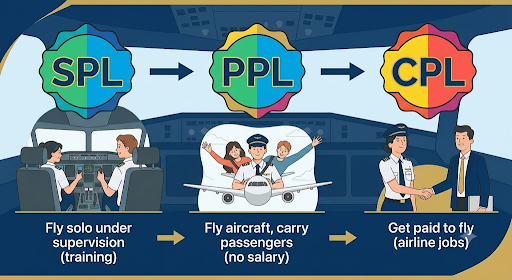
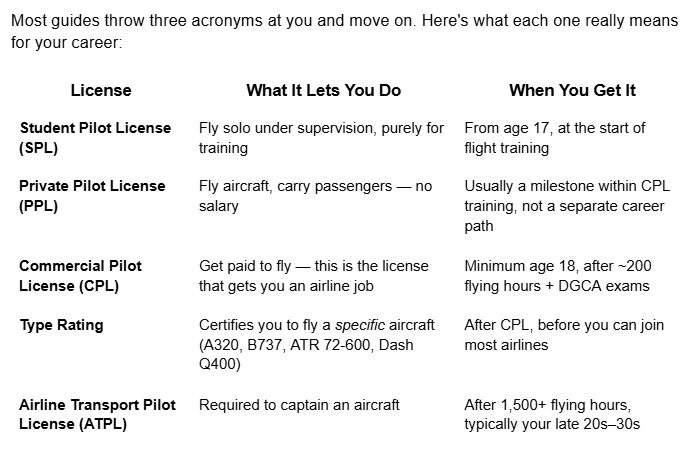
The thing that escapes the attention of most students is the fact that even getting a CPL doesn't automatically make you eligible to enter a commercial airplane's cockpit. The overwhelming majority of airlines currently recruiting female pilots in India require the candidates to have a type rating of the particular model of the aircraft used by the airline – for example, A320 for IndiGo and Air India or B737 for Akasa and SpiceJet, etc.
Pilot Eligibility for Female Candidates After 12th
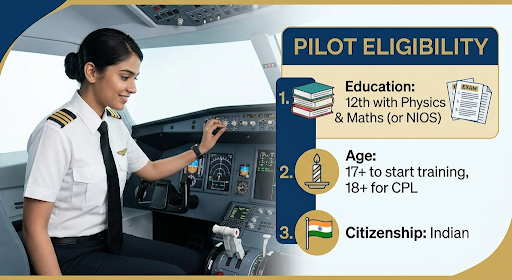
There is no gender-based discrimination on the part of the DGCA. The eligibility criteria for female pilots are exactly the same line for line as that for male pilots.
Educational qualification
- Class 12th in Physics and Mathematics, minimum 50–55%, average (depends upon school)
- From Commerce or Arts? Not a problem; clear Physics and Mathematics through NIOS and be eligible
Age
- Minimum 17 years for starting training (SPL)
- Minimum 18 years for obtaining CPL
- No upper age limit for training; although airlines prefer candidates below 35 years of age during hiring
Medical fitness
- Class 2 Medical Certificate for starting training (eye, ear, heart, general health)
- Class 1 Medical Certificate is mandatory before exercising CPL privilege — that is the tougher criteria
Other requirements
- Citizenship of India (or foreign candidates need to pursue a different path)
- Background clearance from police
- Passport, Aadhaar, Class 10/12 mark sheets
Physical Fitness for Pilot in India for Female Candidates
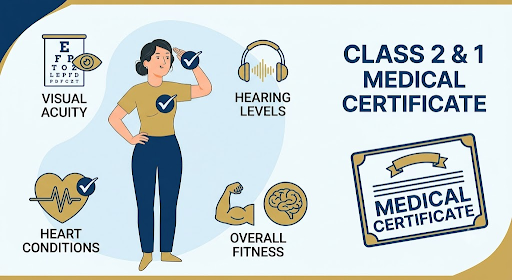
This happens to be one of the most searched and yet the most misunderstood questions. There is no separate physical fitness requirement for pilots in India as per gender. Every individual, irrespective of their gender, must pass the same Class 1 & Class 2 Medicals, which comprise of the following tests:
- Visual Acuity (corrected through lenses/glasses under the DGCA regulations)
- Hearing levels
- Heart related conditions
- Overall physical and psychological fitness
There is no separate criterion regarding height, weight, and strength for female candidates. Once you have cleared the DGCA medical, you will have cleared the physical fitness requirement for being a pilot in India. Period. Anyone looking up physical fitness for pilot in India for female may consider the standard Class 1/Class 2 Medical as their complete answer.
How to Become a Female Pilot After 12th Science Stream
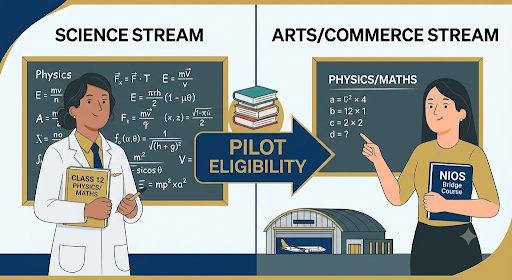
If you have a Science stream background and Physics and Mathematics at 12th grade, you qualify for the basic eligibility requirement automatically, which is the most straightforward way on the path to becoming a female pilot after 12th.
However, if you have a Commerce or Arts background, it doesn't necessarily mean your road ends here, since it is possible to clear the subjects of Physics and Mathematics independently through NIOS (National Institute of Open Schooling). There are numerous pilots in service who have never studied Physics and Mathematics at school at all.
How to Become a Commercial Female Pilot After 12th: The Full Roadmap
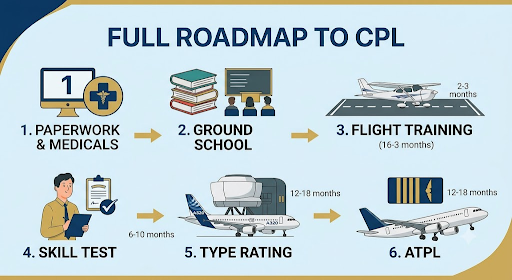
There are some clearly defined DGCA stages required to become a commercial pilot. Here is the complete roadmap from beginning to end.
Phase 1 — Paperwork & Medicals (2–3 months)
- Apply for DGCA Computer Number through Pariksha DGCA website – this is your registration number for all the DGCA theoretical examinations
- Get Class 2 Medical examination done at an approved centre; initiate your Class 1 medical procedure in parallel so that you don’t get stuck on this later
- Shortlist and enroll in a DGCA approved Flying Training Organisation (FTO)
Phase 2 — Ground School (4–6 months)
There are 5 DGCA theoretical subjects – you have to clear 70%+ marks in each of them:
- Air Navigation
- Air Regulations
- Aviation Meteorology
- Technical General
- Technical Specific (Aircraft and Engines)
- Also need to clear RTR(A) – Restricted Radio Telegraphist’s License
Phase 3 — Flight Training (12–18 months)
Minimum requirement of DGCA is 200 flight hours including:
- Minimum requirement of DGCA is 200 flight hours including:
- 100 flight hours as Pilot-in-Command (Solo Flight Hours)
- 50 Cross-country solo flights
- 40 hours instrument flying (up to 20 hours can be simulator training)
- 10 hours night flying
- 10-15 hours on multi-engine aircraft
It depends entirely on the availability of the school's aircraft and the weather conditions at the base of the flying school – something that most people never budget for in advance, and should ask when shortlisting schools.
Phase 4 — Skill Test & License Issuance
After clearing the examinations and completing hours, the final skill test is conducted by a DGCA appointed examiner. Passing this, submitting your log book and other documents, you get your license issued within a few weeks. This is the point where you will become a commercial pilot – your CPL is what makes you employable as a commercial female pilot after 12th.
Phase 5 — Type Rating (the step most students underplan for)
This is the stage where you specialize on the aircraft you wish to fly in airline. Popular aircraft choices in India are: A320, B737NG, ATR 72-600 and Dash Q400. Type rating requires the use of a level D full flight simulator and at this stage many pilots discover that their flight school doesn’t provide one – this means another admissions process, fee and delays of months at some other institute.
Phase 6 — ATPL (later in your career)
Once you cross 1,500 flying hours, you become eligible to upgrade to an ATPL and eventually command an aircraft. Most pilots reach this milestone in their late 20s or 30s.
Related: How long does it take to become a commercial pilot in India
FTO vs FTO + ATO: What You Need to Know Before Choosing a Flying School
Here is the real difference that makes the total cost, schedule, and stress different.
Pilot training in India is divided between two kinds of DGCA/EASA-certified institutes:
- FTO (Flying Training Organization) takes you from zero hours until CPL — Cessna/Piper time.
- ATO (Approved Training Organization) provides Type Rating via Full Flight Simulator of certain commercial aircraft.
Almost all flying schools in India are either this or that. This leads to the situation where an average student completes CPL in School A, and then he or she needs to independently search, apply and pay in another organization (School B) for Type Rating, and in many cases face delays in schedules, repeated bureaucracy and lack of simulator slots during the peak hiring period.
There are some institutes that have both FTO and ATO (FSTC is one of such institutes), which gives a possibility to train from first solo flight in Cessna 172 to Type Rating in A320, B737NG, ATR 72-600, Dash Q400 simulator without changing institute.
So when comparing the best flying schools in India, you may ask this one simple question: "Are you the owners of both flying school and simulator center, or I need to find Type Rating somewhere else?"
How to Become a Pilot After 12th in India: Cost and Financing
Complete CPL course in India (classes + flight hours + multi engine) costs around ₹35 - 60 lakh, which is generally divided as:
Component Approx. Cost
Ground classes ₹2–3 lakh
Flying training (single-engine, 200 hrs) ₹26–30 lakh
Multi-engine training ₹4–5 lakh
Equipment, exams, miscellaneous ₹2–3 lakh
Type Rating is an additional fee on top of that, which varies by many thousands depending on the aircraft – check the cost estimate at your preferred ATOs.
How Women Can Get Financial Support for Pilot Training
- Bank Education Loans for DGCA approved programs – there are many aviation schools that have EMIs tied up with specific banks, which you may want to ask for since that helps with getting approval easier
- WAI Scholarships – WAI Scholarship applications begin mid-year for the following year's scholarship program
- State government schemes (many states run subsidy/merit based schemes for technical/vocational education, including for women)
- DGCA recognized academy scholarship (merit-based)
Post-CPL Career Options as a Female Pilot
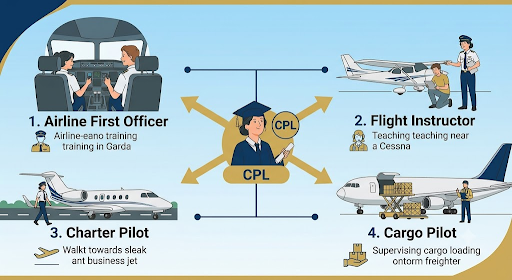
- Airline First Officer – the most typical entry point at IndiGo, Air India, Akasa, SpiceJet, and other scheduled airlines.
- Flight Instructor – several CPL graduates join the profession as flight instructors to earn additional flight hours and train the next generation of women pilots.
- Charter & Business Aviation – operating private jets for corporates/wealthy individuals, typically with more flexible schedules.
- Cargo Pilot – a rapidly growing sector with the rise of e-commerce-based air cargo operations in India.
- Helicopter Pilot – involves getting a separate license/conversion but is definitely worth considering if rotorcraft appeal to you.
- Defence-related jobs and aviation manufacturing jobs – a niche area but one that’s growing rapidly in the context of self-reliant Indian aviation manufacturing through Atmanirbhar Bharat.
Why Join FSTC To Become a Female Pilot in India?
The choice of where to undergo training is more important than most manuals will tell you, especially in terms of how much it costs, how long it takes and how conducive the environment is for women. This is why FSTC stands out when it comes to training women to become pilots.
- DGCA & EASA approval, providing training in compliance with the standards set by Indian and international aviation regulations.
- Most flight training institutes in India are either FTOs or ATOs, but not both. The typical student will undergo his/her CPL at one flight training institute and then independently look for a Type Rating course at another institute but FSTC has both courses under one roof and you can start by flying a Cessna 172 and graduate to flying A320, B737NG, ATR 72-600 or Dash Q400 simulators.
- All kinds of pilot training services provided by one organization – starting from ab-initio single engine flying and CPL training up to Airbus A320, Boeing 737NG, ATR 72-600 and Dash Q400 type rating training.
- Training conducted by aviation experts having years of experience in the field and former Indian Air Force instructors.
- Use of FSTC owned aircraft fleet – such as Cessna 172, Piper Archer, Diamond DA-42 and Tecnam P2006T – to gain experience flying on different kinds of airplanes.
- Level D flight simulators for aircraft like A320, B737, ATR 72-600 and Dash Q400 – to help aspiring female pilots advance from basic flight training to airline specific training.
- Different training centres in Gurugram, Mumbai, Hyderabad, Narnaul and Bhiwani – to provide students with flexibility while choosing training route.
- Train, test and type rate in one network – no need to look for a different organization for each step of pilot training.
Ready to Become a Female Pilot in India?
If you are looking to make it big in commercial aviation, an appropriate training environment plays a significant role. From a pilot to an airline pilot, everything is streamlined through an effective training environment along with experienced faculty, fleet of aircraft and simulators at par with airlines with FSTC.
Get in touch with FSTC today and start making the first step towards your dream job of becoming a pilot.
Flying School: marketing@fstcfto.in | +91 8527698320 / +91-9289634111
Type Rating: info@fstc.in | +91-9871101630 / +91-98711
FAQs on Becoming a Female Pilot in India (2027)
How to be a female pilot after 12th in India?
Finish Class 12 with Physics and Maths (or NIOS equivalent), get yourself a DGCA Computer Number, pass your Class 2 and Class 1 Medicals, join a DGCA-recognized flying school, clock 200 flight hours, and pass your DGCA skill test to earn your CPL.
How to be a pilot in India as a girl, how do I begin?
How to be a pilot in India as a girl begins in precisely the same way as anyone else. Your Class 12 subject choice (Physics/Maths or NIOS equivalent), then registering on the DGCA Pariksha website and passing your Class 2 Medical.
Can a girl be a pilot in India?
Yes, absolutely. DGCA eligibility requirements are completely gender-neutral, and India has the most women pilots in proportion to all countries.
What is pilot eligibility for female candidates in India?
Same as male applicants: 12th (Physics and Mathematics) or NIOS equivalent, minimum age 17 years to join the training and 18 years for CPL, Class 1/2 Medical Certificate and Indian nationality.
Is there a separate physical fitness standard for pilot in India for female candidates?
No. The Class 1 and Class 2 Medical Certificate standards (vision, hearing, cardiovascular fitness, general health) apply identically regardless of gender. There is no separate "female pilot" fitness bar.
How to become a female pilot after 12th science stream, specifically?
Students from the science stream, having studied Physics and Mathematics, fulfill the academic criteria and can apply to a flying school immediately after their 12th results.
How much does it cost to become a pilot in India?
The total cost of CPL training in India would be around ₹35-60 lakh, and the Type Rating will be an extra expense based on the type of plane you want to fly.
Do female pilots get paid less than male pilots in India?
No. There is no difference in pay between male and female pilots in India. It doesn’t depend on gender but on the rank and flight hours. So the First Officer gets the same salary no matter what gender they have, provided they are piloting the same plane for the same airline.
How long does it take to become a pilot after class 12 in India?
The period would take around 2-3 years to complete.