
DGCA Class 1 Medical: Tests, Cost, Validity & Centres
If you want to fly commercially in India, the DGCA Class 1 medical is the milestone that decides everything else. Ground school, simulator hours and flight training mean little if you cannot be declared fit. Yet many aspiring pilots only learn the details after paying admission fees.
The Class 1 medical assesses your fitness through a medical examination, investigations and a review of your health history. Getting the details right helps you avoid unnecessary tests, wrong bookings and delays to your training plans.
This guide covers what the Class 1 medical includes, how it differs from Class 2, what it costs, how long it is valid, where to take it and what to do if you are not declared fit. If you are still mapping your overall journey, start with our guide on how to become a pilot in India in 2026.
What is a DGCA Class 1 medical?
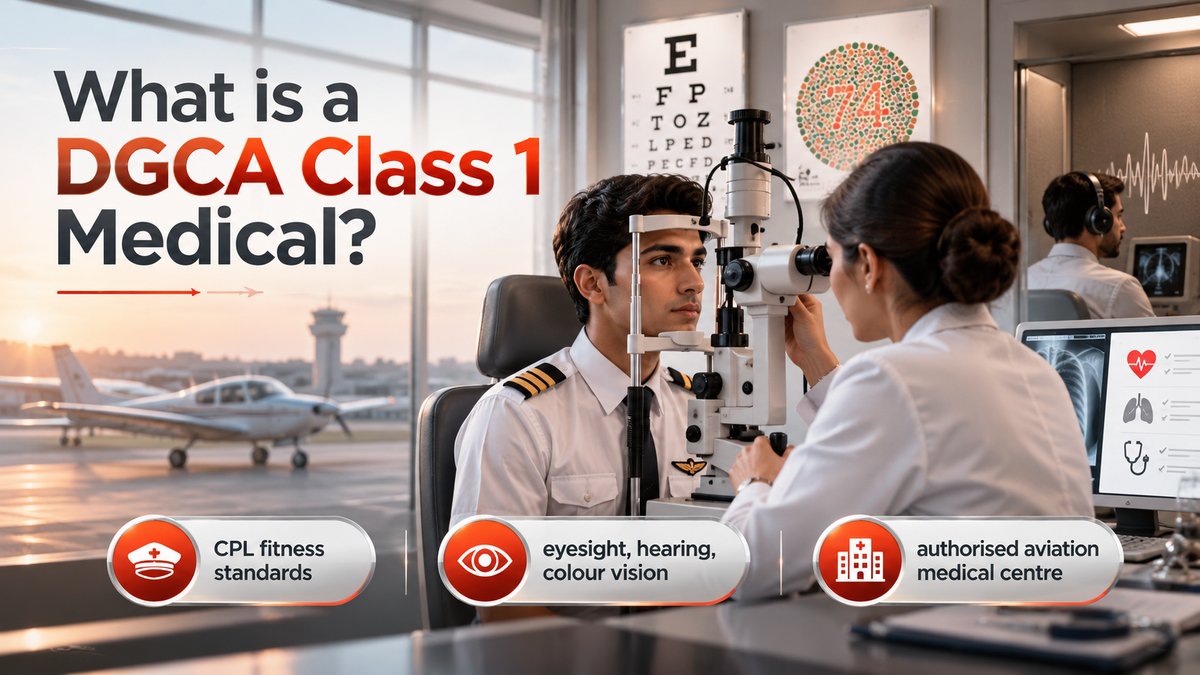
Pilot undergoing an eye test at an authorised aviation medical centre for DGCA Class 1 medical
A Class 1 medical establishes whether you meet the medical fitness standards required for a Commercial Pilot Licence (CPL) and, later, an Airline Transport Pilot Licence (ATPL). It goes beyond a general health check and considers your fitness for flight duties.
The examination covers physical and mental health, eyesight, colour perception and hearing. Your medical history, current treatment and investigation results also form part of the evaluation.
A routine hospital fitness certificate cannot replace this process. You must use a centre or examiner authorised for the specific aviation medical examination you need.
DGCA Class 1 vs Class 2 medical
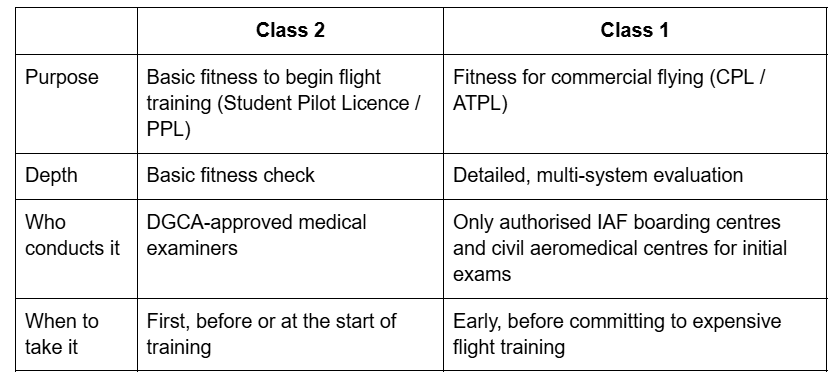
Class 2 lets you start training. Class 1 is the one that lets you work as a commercial pilot, so find out where you stand early.
Is Class 2 required before Class 1? CA-35 explained
Yes, the initial Class 1 pathway requires a valid Class 2 medical. However, you do not necessarily have to wait for a separate DGCA Class 2 assessment before applying. DGCA permits applicants to apply for an initial Class 1 examination using the fit CA-35 certificate issued by their Class 2 medical examiner. This can prevent an unnecessary wait between the two examinations. See the DGCA medical assessment notice.
If you plan a commercial career, consider completing the Class 1 early as part of your financial planning. Plenty of cadets have completed ground classes and flying hours only to discover a disqualifying issue at the Class 1 stage, which is an expensive way to find out. Discuss timing with your Flying Training Organisation (FTO) before making a large, non-refundable payment.
Which tests are included in a DGCA Class 1 medical?
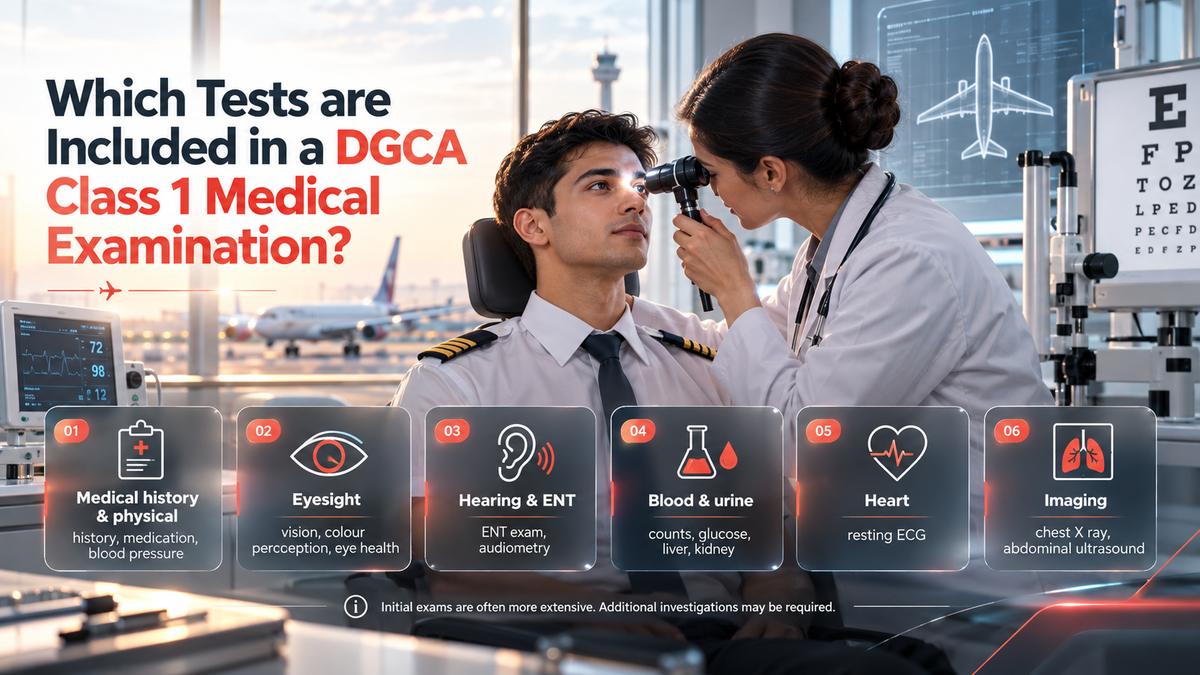
Doctor examining a pilot’s eyes, with icons showing the tests in a DGCA Class 1 medical examination
The examination combines specialist consultations, physical assessments and diagnostic tests. An initial examination is more extensive than some routine renewals, and extra investigations may be needed depending on your history and findings.
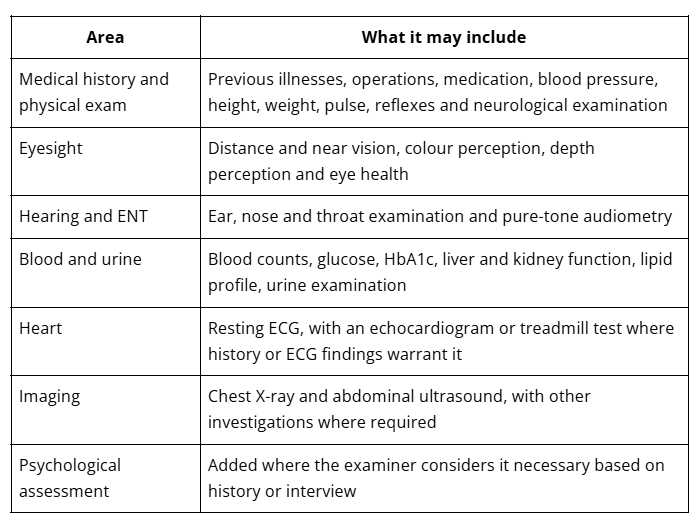
This is an overview, not a list to take to a laboratory. The schedule depends on your examination category, age and medical circumstances. These areas are reflected in the published examination information from Apollo Delhi and Ruby Hall Clinic's aviation medical guidance.
Should you complete tests before your appointment?
Confirm with your designated DGCA medical centre before paying for any tests elsewhere. Some centres organise investigations as part of the appointment, while others require particular reports in advance. At Ruby Hall Clinic, for example, investigations and specialist opinions are normally arranged through the centre.
Buying a generic "pilot medical package" elsewhere can leave you paying twice or arriving with reports the examiner cannot accept. Ask for a written checklist covering which tests to complete, where, and how recent the reports must be.
How much does a DGCA Class 1 medical cost?
The cost depends on the medical centre, examination type and any additional investigations. A published hospital package is a useful starting point, not a fixed fee for every applicant.
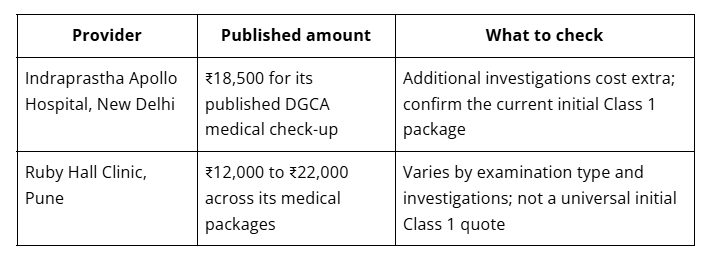
The figures come from Apollo's medical check-up information and Ruby Hall Clinic's medical FAQs. They are hospital-published amounts and not part of FSTC pilot course fees. Before booking, ask for a written breakdown covering:
- The examination and routine investigations
- Any separate administrative or government charges
- Additional specialist consultations and repeat tests
- Whether a booking advance is adjusted against the total
- Cancellation and rescheduling conditions
Budget travel, accommodation and a possible second visit separately. For wider training costs, see our CPL course fees guide.
How long is a DGCA Class 1 medical valid?
Validity is generally 12 months, with shorter intervals depending on age, flying duties or individual medical restrictions.
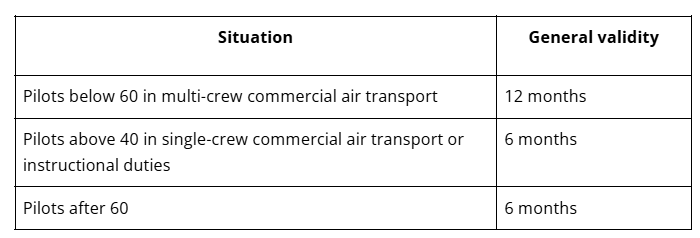
The age-based framework appears in DGCA's medical requirements, while the current DGCA medical directory also identifies the instructional-duty provision. Always follow the expiry date and restrictions on your own medical documents, since an individual assessment may require an earlier review.
Does the DGCA three-year assessment rule extend medical validity?
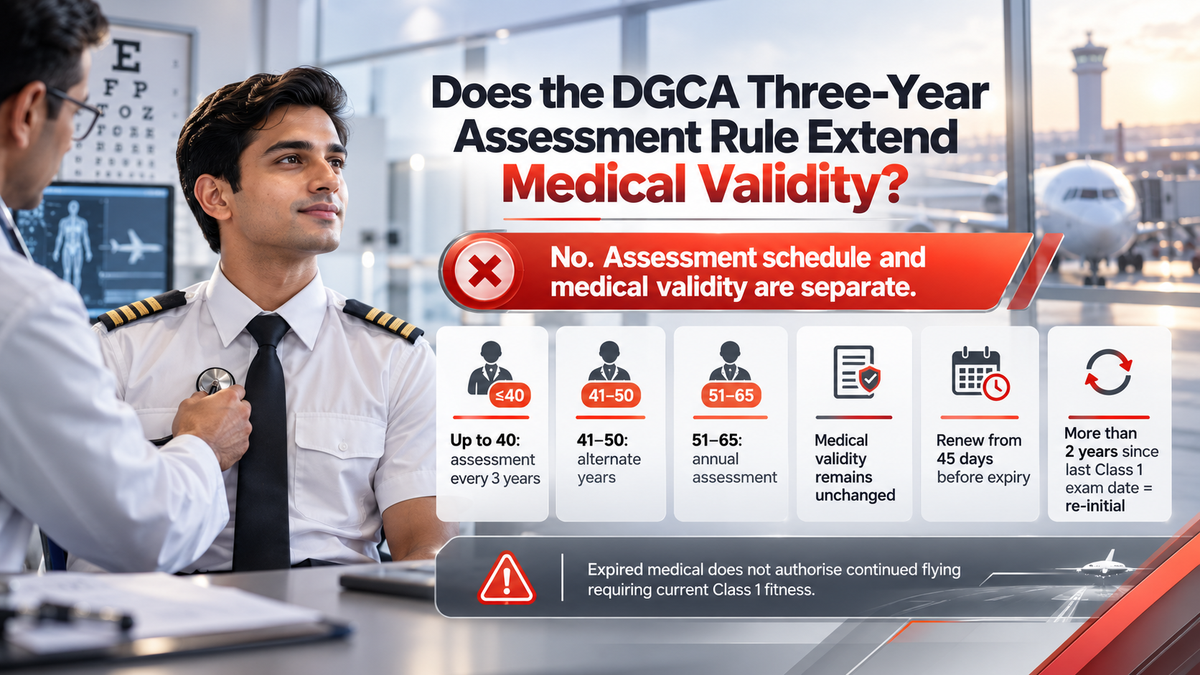
Pilot with doctor and age-wise assessment schedule showing the three-year rule does not extend medical validity
No. The assessment schedule and the validity of your medical certificate are separate matters.
Changes effective from September 2025 allow DGCA assessments for routine Class 1 renewals to be issued every three years up to age 40, in alternate years from 41 to 50, and annually from 51 to 65. The official DGCA notice states that the validity of medical examinations remains unchanged. Initial examinations, re-initial examinations and specified review cases still require assessment as applicable.
For example, a young pilot whose medical expires after 12 months must still renew it on time. The three-year assessment interval does not give three years of medical fitness.
When Should You Renew?
The DGCA directory provides a renewal window starting 45 days before your medical certificate expires. Plan your appointment around your training schedule and the availability of authorised medical examiners to avoid unnecessary delays.
If more than two years have passed since your last Class 1 examination date, the process becomes re-initial. That period is measured from the examination date and not from the expiry date. An expired medical does not authorise continued flying that requires current Class 1 fitness.
Where Can You Get a DGCA Class 1 medical in India?
According to the DGCA directory updated on 27 August 2026, India has three Indian Air Force boarding centres and ten civil aeromedical centres authorised to conduct Class 1 medical examinations.
Indian Air Force Boarding Centres
- New Delhi: Air Force Central Medical Establishment, or AFCME.
- Bengaluru: Institute of Aerospace Medicine, or IAM.
- Jorhat: Medical Evaluation Cell (East), 5 Air Force Hospital.
Civil aeromedical centres
City Listed centres
New Delhi Indraprastha Apollo Hospital; Max Multi Specialty Centre, Panchsheel Park
Gurugram Medanta – The Medicity
Bengaluru Apollo Hospitals, Bannerghatta Road
Chennai Apollo, Greams Road
Hyderabad Apollo Hospitals, Jubilee Hills
Indore Apollo Hospitals, Vijay Nagar
Mumbai Dr. Balabhai Nanavati Hospital; V M Medical Centre, Mirra's Aeromedical Centre
Pune Grant Medical Foundation, Ruby Hall Clinic
The civil aeromedical network is described in the Ministry of Civil Aviation announcement. Nanavati is listed for initial and re-initial Class 1 examinations only. Renewals are available through other listed centres and empanelled examiners, subject to their authorisation. Slots at popular centres can fill weeks ahead, so book early. Before booking, check the latest DGCA Class 1 medical directory for contact details, availability and the categories each centre is authorised to conduct.
How to Prepare and Apply for Your Class 1 Medical
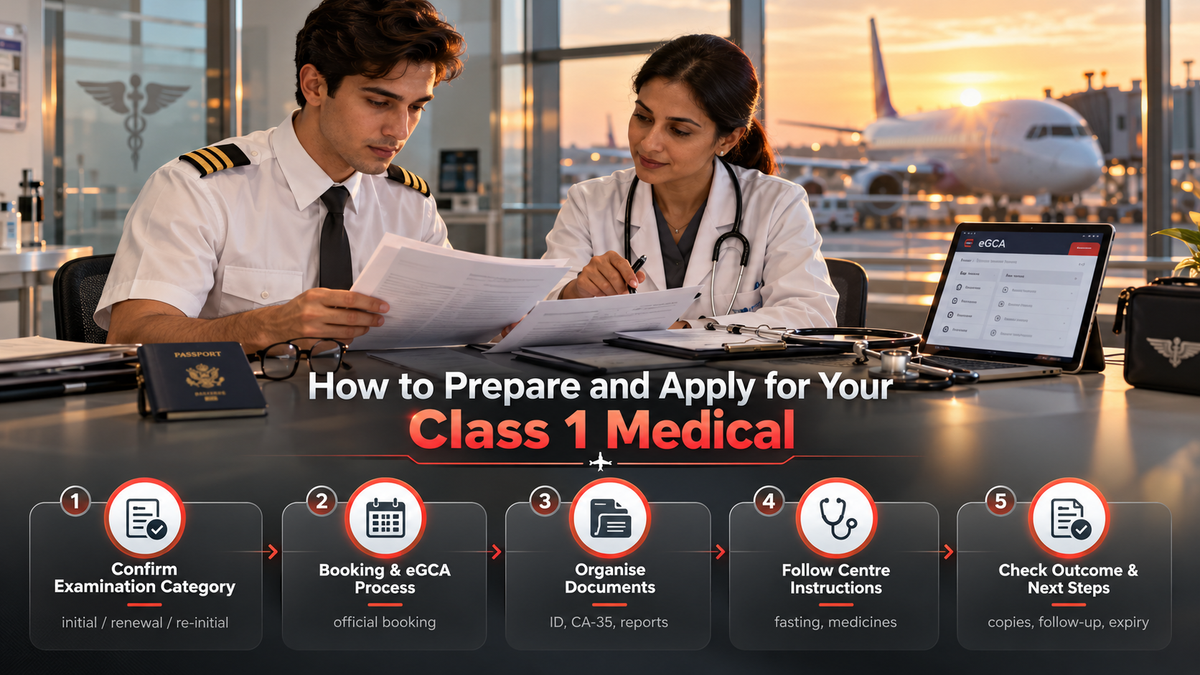
Five-step process to prepare and apply for a DGCA Class 1 medical, from confirming category to checking outcome
- Confirm your examination category. Identify whether you need an initial, renewal, re-initial or review examination. Re-initial, post-temporary-unfitness and special medicals require a DGCA No Objection Certificate through eGCA.
- Confirm the booking process. Contact the centre through its official details and ask how to coordinate the appointment with your eGCA application, which documents to upload and how to pay. Do not make non-refundable travel plans until the appointment is confirmed.
- Organise your documents. Government photo ID, eGCA details, previous CA-35 and assessment where issued, and any requested specialist reports. Keep records of treatment, surgery and medication. If you wear spectacles, bring them and your current prescription.
- Follow the centre's instructions. Confirm fasting requirements and how to manage prescribed medicines. Do not stop treatment on your own to improve a result.
- Declare your history accurately. Be upfront with the examiner. A previous diagnosis or operation needs proper evaluation, and hiding something rarely helps and can complicate your file later.
- Attend the examination. Reports are verified at reception, then you go through each test station over one or more days.
- Check the outcome and next steps. Before leaving, understand what is outstanding: further tests, a specialist opinion, document submission or assessment processing. Keep copies of records and note restrictions and expiry dates.
How Long Does a DGCA Class 1 Medical Examination Process Take?
When planning your DGCA Class 1 medical examination, account for three separate stages: waiting for an appointment, completing the medical tests and receiving the required assessment.
Apollo Delhi advises that the examination process takes at least two days. Additional investigations, if required, may extend your visit. This estimate does not include appointment waiting times or subsequent DGCA processing.
Before booking, ask the medical centre how many days you should plan to stay locally and whether additional visits may be necessary. Avoid committing to a fixed pilot training start date based solely on an assumed medical completion timeline.
What Happens If You Are Not Declared Fit in a DGCA Class 1 Medical?
The outcome of a DGCA Class 1 medical examination may be fitness with conditions, temporary unfitness or permanent unfitness. An additional investigation request alone should not be interpreted as a final rejection.
Ask the medical examiner to explain the written findings, any required treatment or supporting evidence, and the applicable review procedure. If you disagree with the medical decision, an appeal or review mechanism may be available, depending on the circumstances. However, a favourable outcome cannot be guaranteed. Ruby Hall Clinic’s guidance explains the possible outcomes and appeal process.
Medical eligibility is assessed individually against the applicable DGCA standards. Other applicants’ experiences cannot determine whether you will be declared fit.
Common Mistakes First-time Candidates Make
- Paying a non-refundable flight school fee before clearing the medical
- Booking tests at an outside lab without confirming the centre will accept the reports
- Booking the appointment late, then facing a slot wait
- Not declaring past illnesses, surgery or medication
- Stopping prescribed medicine on your own before the examination
- Letting the medical expire mid-training, or waiting past two years and forcing a re-initial
- Assuming the three-year assessment rule extends validity
Plan Your Medical Alongside Your Pilot Training
Medical clearance is one part of a pilot training plan that also includes academic eligibility, course selection and finances.
FSTC offers a CPL programme with multi-engine training, an instrument rating and ground school. Understanding your medical position early helps you plan these stages with fewer unanswered questions.
Contact FSTC’s admissions team to discuss how your medical documentation fits into the enrolment process and your proposed training start date.
Phone: +91 85276 98320 or +91 92896 34111
Email: marketing@fstcfto.in and info@fstc.in
What If You Are Not Declared Fit?
The outcome may be fit, fit with conditions or limitations, temporarily unfit or permanently unfit. A request for additional investigation is not a final rejection.
- Fit with conditions: for example, corrected vision. Note and follow the restrictions on your certificate.
- Temporarily unfit: a condition needs treatment or time before you are re-evaluated.
- Permanently unfit: the examiner will explain the findings in writing.
Ask the examiner to explain the written findings, any required treatment or supporting evidence, and the applicable review procedure. If you disagree with the decision, an appeal or review mechanism may be available depending on the circumstances, but a favourable outcome cannot be guaranteed. Ruby Hall Clinic's guidance explains the possible outcomes and appeal process. Medical eligibility is assessed individually, so other candidates' experiences do not decide yours.
Plan Your Medical Alongside Your Pilot Training
Medical clearance is one part of a plan that also includes academic eligibility, course selection and finances. FSTC offers a CPL programme with multi-engine training, an instrument rating and ground school with multi-engine training, an instrument rating and ground school. Understanding your medical position early helps you plan each stage with fewer unanswered questions.
Contact FSTC's admissions team to discuss how your medical documentation fits into enrolment and your training start date.
Phone: +91 85276 98320 or +91 92896 34111 Email: marketing@fstcfto.in and info@fstc.in
Frequently Asked Questions
What is the DGCA Class 1 medical and why do I need it? It is the fitness certification required to hold a CPL or ATPL in India. Without a valid Class 1, you cannot exercise commercial pilot privileges.
What is the difference between Class 1 and Class 2? Class 2 is the basic fitness check for starting flight training. Class 1 is a more detailed evaluation, conducted at authorised centres for initial examinations, and is required for commercial flying.
What is CA-35? It is the medical certificate issued by your Class 2 medical examiner. A fit CA-35 can be used to apply for the initial Class 1 examination.
Can I attend the Class 1 medical if I wear glasses? Yes. Glasses do not automatically disqualify you. Bring your spectacles and prescription. Eligibility depends on whether you meet the applicable visual standards in the complete examination.
Is colour blindness a disqualifier for pilots in India? Colour vision is part of the examination, and the standard is strict.
Does passing Class 2 guarantee Class 1 clearance? No. Class 1 is a separate assessment of fitness for commercial flying, and passing Class 2 does not guarantee you will meet its standards.
How long does the exam take and when do I get the result? Plan for at least two days at the centre, plus appointment waiting time and DGCA processing. Ask the centre for current timelines.
What happens if I am declared temporarily unfit? A condition needs to be addressed before you can be cleared. Ask the examiner for written findings, the required treatment or evidence, and the review procedure.
Is the Class 1 medical included in flight school fees? Not necessarily. Check your written fee quotation. Hospital fees, renewals, extra investigations and travel may be charged separately unless your agreement says otherwise.