
Are you a flying fanatic, or dreaming of weekend adventures? Or are you aiming for a career in the cockpit with a major airline? Either way, knowing the difference between a Private Pilot License (PPL) and a Commercial Pilot License (CPL) is the crucial first step. Both certifications will get you in the air — but for very different purposes, budgets and career outcomes. This complete guide explains all you need to know about PPL pilot training and CPL training in India.
What Is a Private Pilot License (PPL)?
The private pilot license (PPL) is the first license you can earn that will allow you to legally fly an aircraft for personal, recreational and non-commercial purposes. Once you have a PPL you can fly friends, family, visit beautiful places and enjoy the freedom of flight — all without being paid for it.
The Private Pilot rating is the first step for all of the advanced pilot ratings. Most commercial pilots start their aviation career by taking a private pilot training course before moving on to higher certifications.
PPL: Major Highlights
- Age: 17 years and above
- Minimum flight hours: 40 hours (as per DGCA rules)
- Medical requirement: Class 2 Medical Certificate
- Theory Subjects: 5 papers as prescribed by DGCA
- Cost in India (approximate): Rs.8 to 15 Lakhs
- Duration: 6 – 12 months at an aviation academy for private pilot licence
What Is a Commercial Pilot License (CPL)?
The commercial pilot license (CPL) is the professional license that allows you to fly for hire and reward. If you want to be an airline first officer, charter pilot or cargo aviator, CPL is your ticket to a paid flying career.
To get a CPL you need significantly more flight experience, theoretical knowledge and a stricter medical standard than the PPL. CPL training is rigorous, structured and career focused.
CPL Key Highlights:
- Minimum Age: 18
- Total flight time of at least 200 hours
- Medical requirement: Class 1 Medical Certificate
- Theory subjects: 7 papers as required by DGCA (advanced navigation and meteorology)
- Estimated cost in India: ₹35–60 Lakhs
- Duration: 18-36 months
PPL vs CPL: A Side-by-Side Comparison
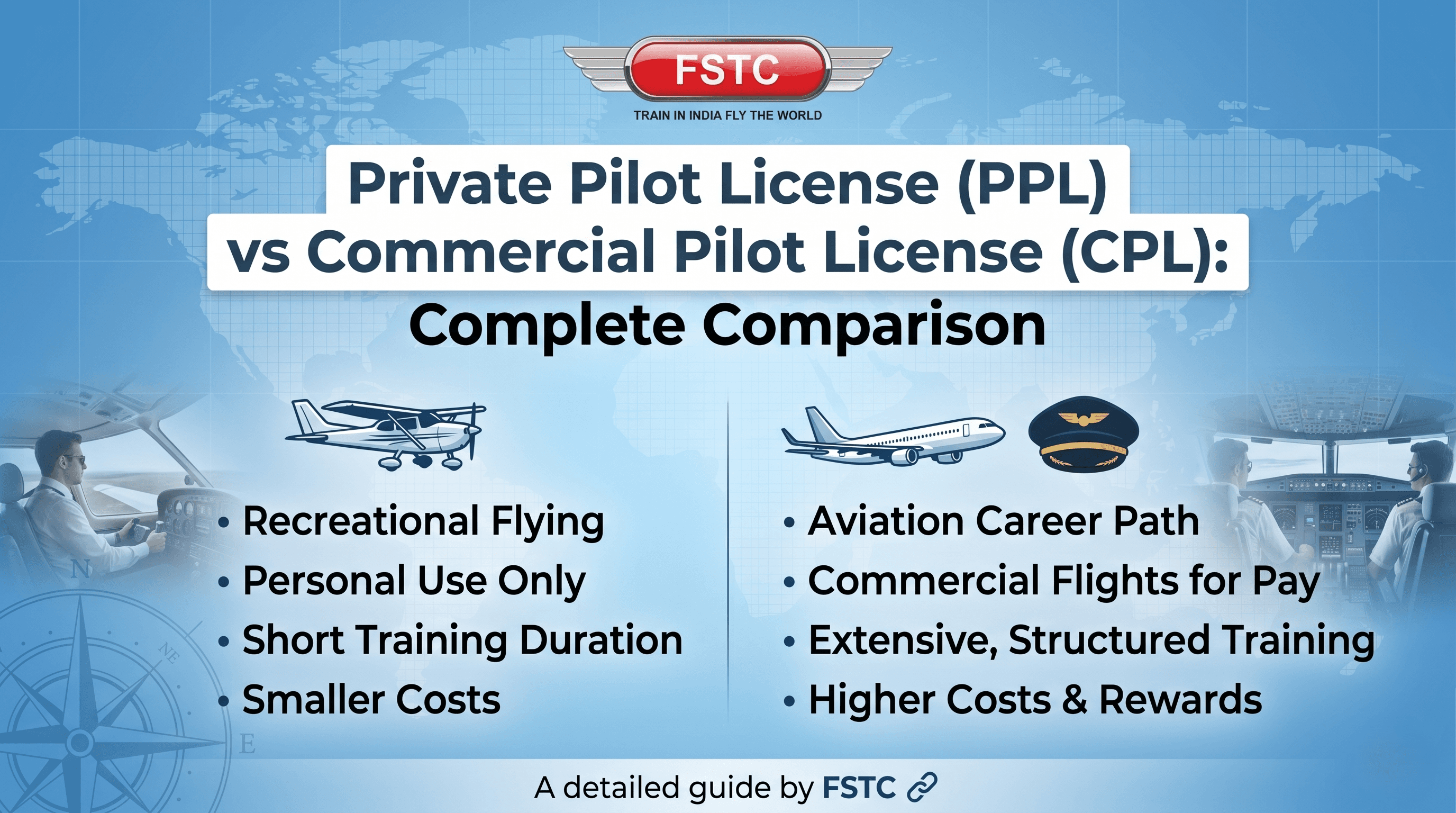
The most fundamental difference between a Private Pilot License and a Commercial Pilot License lies in their purpose — a PPL is meant for personal and recreational flying, while a CPL qualifies you to fly professionally and get paid for it.
In terms of eligibility, the PPL has a slightly lower minimum age requirement of 17 years compared to 18 years for the CPL. The flight hour requirements also differ significantly: the DGCA mandates a minimum of 40 hours for a PPL, whereas a CPL demands 200 total hours in the air.
Medical standards are stricter on the commercial side as well. PPL aspirants need to clear a Class 2 Medical, while CPL candidates must meet the higher bar of a Class 1 Medical. Similarly, the theory workload is heavier for the CPL — 7 DGCA subjects versus 5 for the PPL.
Cost and time commitment are perhaps the most defining practical differences. A PPL in India typically costs somewhere between ₹8 and ₹15 lakhs and can be completed in 6 to 12 months. A CPL, on the other hand, runs anywhere from ₹35 to ₹60 lakhs and takes 18 to 36 months to finish.
Private Pilot License in India: Regulatory Framework
All pilot licenses in India are issued and controlled by the Directorate General of Civil Aviation (DGCA). To obtain a private pilot license in India, the candidate must fulfil the eligibility criteria as per DGCA, enroll in an approved private pilot aviation academy, clear the theory and practical tests and obtain the relevant medical certificate.
India has a growing list of DGCA approved flying schools that provide structured private pilot training courses. These academies offer simulator training, ground school and actual flight time with certified flight instructors.
PPL Pilot Training: What to Expect
Signing up for PPL pilot training is a well organized and exciting journey. This is what you are normally trained on:
- Ground School: Training in aviation theory including Air Navigation, Meteorology, Air Regulations, Technical General and Radio Telephony
- Simulator Training: Develops instrument and emergency handling skills in a safe environment
- Dual Flight Training: Training with a Certified Flight Instructor to Learn Take-offs, Landings and Maneuvers
- Solo Flight Hours: Once your instructor gives you the green light, solo flights help build your confidence and command
- DGCA Written Examinations: All the 5 theory papers must be cleared before the skill test
- Flight Test (Skill Test): Final evaluation by a DGCA authorized examiner
You get your PPL on successful completion of the private pilot training course – valid for life (subject to medical validity and currency requirements).
Should You Start with PPL Before CPL?
Absolutely yes — and here's why. Almost every aspiring commercial pilot begins with PPL as it builds the foundational skills and confidence required before advancing to CPL level training. The PPL phase helps you understand aircraft behavior, navigation, and decision-making at a manageable pace.
Additionally, the flight hours logged during your PPL training count toward the 200-hour requirement for the CPL, making it a smart and structured investment in your aviation journey.
Choosing the Right Private Pilot Aviation Academy
The quality of your training is greatly influenced by the flying school you choose. Here are some key factors to consider when choosing a private pilot aviation academy:
- DGCA Approval: Make sure that the academy is DGCA approved and follows the prescribed syllabus
- Modern, Well-Maintained Fleet: Good condition aircraft for safer, more effective training
- Instructor Quality: Experienced flight instructors with certifications make a huge difference
- Pass Rate: Check the academy’s DGCA exam and skill test pass record
- Infrastructure: Good simulators, classrooms and weather monitoring systems
- Placement Support: Airline tie-ups and placement assistance for CPL aspirants
Conclusion
Whether your dream is a weekend sky adventure or a career in the cockpit, the Private Pilot License (PPL) and the Commercial Pilot License (CPL) are life-changing milestones on your aviation journey. The PPL gives you the opportunity to fly for your own pleasure, while the CPL gives you a career in aviation.
If you’re just starting your journey, the best first step is to take a quality private pilot training course at a reputable private pilot aviation academy. Your PPL is the stepping stone to your CPL and further if you wish to fly professionally.
Start your journey today — the sky is not the limit, it is just the beginning.
Frequently Asked Questions (FAQs)
Q1. What is the main difference between PPL and CPL?
The PPL (Private Pilot License) allows you to fly aircraft for personal and recreational use without compensation. With a CPL (Commercial Pilot License) you are legally permitted to fly for hire and reward and it is essential for a professional aviation career such as airline, charter or cargo flying.
Q2. How many hours of flying are required to get a private pilot license (PPL) in India?
DGCA rules say one needs to have a minimum of 40 flight hours to get a private pilot license in India. Includes dual instruction time and solo flight time. Many students complete the required hours within 6 to 12 months depending on weather and frequency of training.
Q3. What is the cost of PPL pilot training in India?
The average cost of PPL pilot training in India is between ₹8 Lakhs to ₹15 Lakhs, depending upon the flying school, location, type of aircraft and duration of the training. Best is to compare DGCA approved private pilot aviation academies before deciding.
Q4. Can I fly commercially after getting a PPL?
No. A private pilot license (PPL) does not permit you to fly for hire or for commercial purposes. To fly commercially with airlines or charter companies, you have to complete full CPL training and get a Commercial Pilot License (CPL) issued by DGCA.
Q5. Is PPL necessary before enrolling in a CPL training program?
While it is possible to start integrated CPL programs without a standalone PPL, it is most often recommended that aspiring pilots and aviation academies complete a private pilot training course first. The PPL phase develops the basis of vital flying skills and builds confidence and the hours flown count towards the total 200 hours needed for the CPL so it is both economical and practical.