
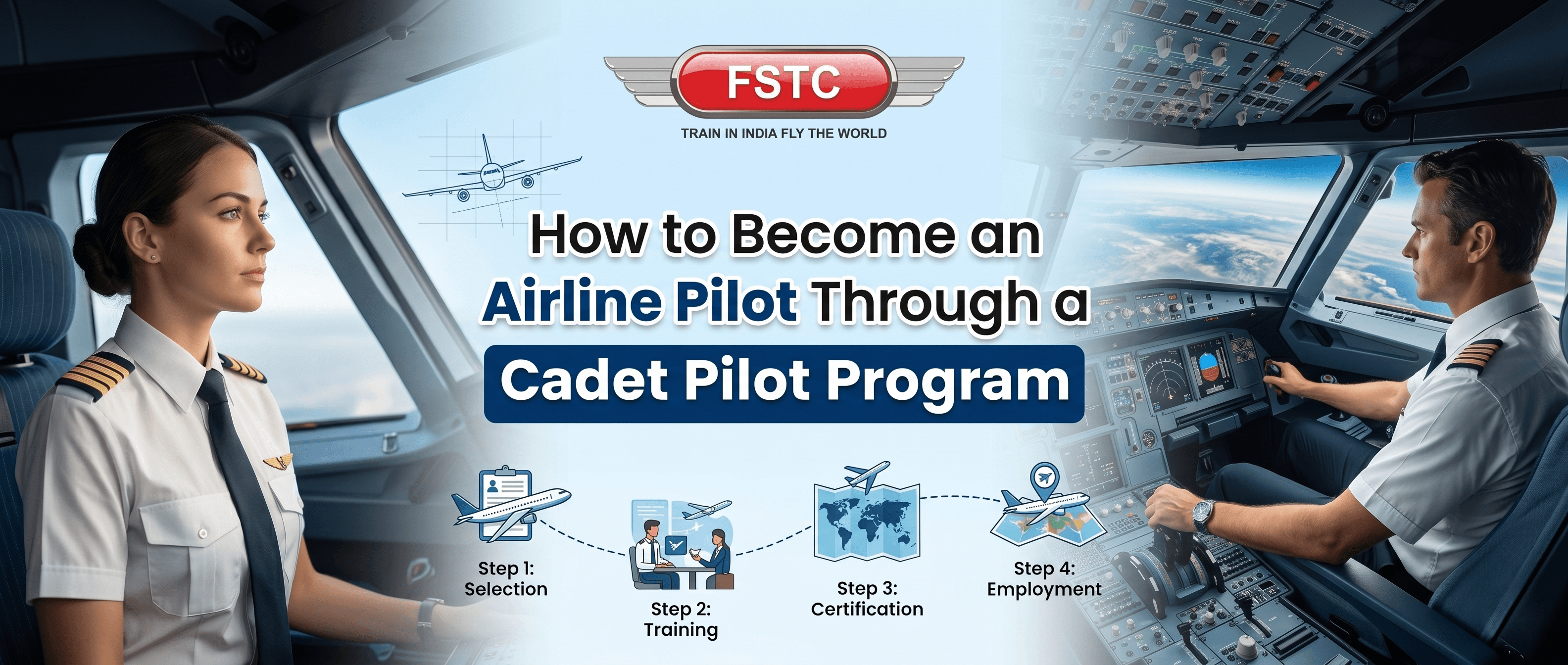
Ever wanted to fly commercial airlines, soaring above the clouds? Today the fastest and most organized path to the cockpit is a cadet pilot program. If you’re a recent school graduate or an aspiring young professional who’s interested in changing careers, then a career as an airline cadet pilot provides a clear and straightforward path to earning your wings and getting a job with a major airline.
In this blog, we take you through all that you need to know about cadet pilot programs in India, how they work, what to expect, and how to choose the best cadet pilot program for your aspirations.
What Is a Cadet Pilot Program?
A cadet pilot programme is an integrated training programme that is designed to take students with no previous flying experience and train them to become fully licensed commercial pilots. These programmes are offered by airlines, aviation academies and flight schools in association with regulatory bodies like Directorate General of Civil Aviation (DGCA) in India.
Unlike self-funded flying training, aviation cadet pilot programs offer a structured curriculum, mentorship, simulator sessions, and, very often, a direct job placement with an airline partner after successful completion. This is one of the most efficient ways to start an aviation career.
Why Choose a Cadet Pilot Program in India?
India is one of the fastest growing aviation markets in the world. Airlines are expanding their fleets and opening new domestic and international routes, and the need for qualified pilots has never been greater. Here’s why an India cadet pilot program makes a lot of sense:
- Increasing demand for trained commercial pilots in Indian airlines.
- Structured training reduces the time taken to achieve a Commercial Pilot Licence (CPL).
- Graduates from many programs are directly placed with airlines.
- Internationally recognised qualifications with access to DGCA approved training.
- More cost effective than self-funded overseas flying training.
Structure of a Commercial Pilot Cadet Program
Commercial pilot cadet programs typically last between 18 and 36 months, depending on the institution and the type of license being pursued. Here's a general overview of what the training journey looks like:
Phase 1: Theory School
Cadets receive intensive theoretical training in subjects such as air navigation, meteorology, aviation regulations, aircraft technical knowledge and flight planning. You must do well in the ground school before you can get into actual flight training.
Phase 2: Basic Flight Training
Students log the required flight time in single-engine and multi-engine aircraft. This stage covers training in solo flights, cross-country, instrument flying, and emergency procedures. The DGCA requires a minimum of 200 flying hours to be eligible for a CPL.
Phase 3: Advanced simulator training
Advanced cadet pilot classes include time in full-motion flight simulators where cadets learn to fly types of commercial aircraft, deal with complex emergency scenarios, and hone crew resource management (CRM) skills. This is the transition from basic flying to airline operations.
Phase 4: Type ratings and Placement in an Airline
Once they have received their CPL and Instrument Rating (IR) cadets are type rated on certain commercial aircraft such as the Boeing 737 or Airbus A320. The top graduates from the best cadet pilot programs are then immediately placed with airline partners as First Officers.
Eligibility Requirements for an Aviation Cadet Pilot Program
The requirements vary from institution to institution, but most aviation cadet pilot programs in India require:
- The age should be between 17 to 28 years at the time of application.
- 10+2 (Class XII) with Physics and Maths from a recognized board.
- Minimum 50% aggregate marks in Physics and Mathematics.
- Class 1 Medical Certificate from DGCA approved medical examiner.
- Spoken and written English proficiency.
- Clean background check and no criminal record.
How to Choose the Best Cadet Pilot Program
There are several options in India, and selecting the best cadet pilot program requires careful consideration. The main things to consider are:
- DGCA Approval & Accreditation: Ensure that the program and flight school are duly approved by the DGCA. Your licence will not be recognized by Indian airlines without proper accreditation.
- Airlines Partnerships: Airlines like IndiGo, Air India or SpiceJet often back schemes which provide direct placement pipelines, cutting down the time spent on job hunting after graduation, significantly.
- Fleet and Simulator Quality: A modern training aircraft and a Level D full motion simulator equals a quality institution. Good equipment makes for better pilots.
- Instructor Experience: Experienced airline captains and former military instructors teach cadet pilot classes, providing invaluable real-world insight beyond textbooks.
- Placement Record: Request data on graduation rates and first-officer placement A good program will tell you about their track record up front.
- Cost & Financing Options: Training to become a commercial pilot is a huge investment, often costing anywhere between INR 40 to 80 lakhs or more. Find out if the institution provides education loans, scholarships or has tie-ups with banks.
Career Outlook After Completing a Cadet Pilot Program
Graduates from an approved airline cadet pilot program should anticipate joining an airline as a First Officer, typically within six to twelve months after finishing their type rating. With experience your career path goes to Senior First Officer , Captain and finally Senior Captain . In India, the First Officer salary could be anywhere between 1.5 to 3 lakhs per month . Captains earn a lot more , depending on the type of aircraft and the airline .
India’s aviation industry will need thousands of new pilots in the next decade, making it one of the most future-proof career options out there today.
Conclusion
The most direct, structured and career-oriented route to becoming a commercial airline pilot is via a cadet pilot program. From the ground school in the classroom, to the advanced simulator sessions, and airline placement, these programs are designed to produce competent pilots ready for the job.” If you are serious about an aviation career, the time to start researching cadet pilot programs in India is today. Compare your options carefully and take that first step towards the cockpit.
Frequently Asked Questions (FAQs)
Q1. What is the duration of a cadet pilot program in India?
Most cadet pilot programmes in India take 18 to 36 months to complete, depending on the institution, pace of training and weather conditions affecting flying hours. This includes ground school, basic flying, instrument rating, multi-engine rating and type rating on a commercial aircraft.
Q2. How much does a commercial pilot cadet program cost in India?
The costs for a commercial pilot cadet program in India typically ranges from INR 40 lakhs to INR 80 lakhs or more, depending on the academy, the aircraft fleet and if the type rating is included. Many institutions have tie-ups with banks and financial institutions for education loans to make training more accessible.
Q3. Do I need prior flying experience to join an aviation cadet pilot program?
Must you be a pilot to sign up for an aviation cadet pilot program? No, generally you are not. These programs are designed for students with no flying experience. The only requirements are the necessary educational qualifications, a Class 1 Medical Certificate and love of all things aviation.
Q4. Are cadet pilot classes conducted online or in person?
Most cadet pilot classes have to be in-person because they involve real flight training and simulator sessions, which can’t be done online. That said, some ground school modules, theory lectures and study materials may be available through online platforms. Always check with the institution for the format before applying.
Q5. What is the difference between a cadet pilot program and self-funded flying training?
A cadet pilot program is a holistic, end-to-end track that includes training, mentorship and often airline placement in a job. However, self-funded flying training means students must manage each stage of their training independently, source their own aircraft hours and find job placement on their own. “Cadet programs are more structured, faster, and there is a much greater possibility of immediate airline employment after graduation.